By Ainur Rohmah
JAKARTA, Indonesia
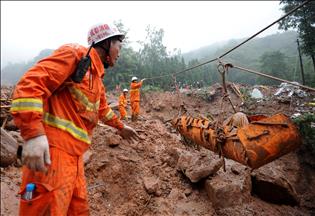
Heavy rainfall hampered efforts Wednesday to recover the bodies of 54 people on board a plane that crashed in the mountains of Indonesia’s eastern Papua, according to officials.
Brigadier General Arthur Tampi, chief of the national police’s Medical and Health Center, told Anadolu Agency that search and rescue teams had earlier planned to evacuate the bodies by helicopter but the downpour made the plan impossible.
"For now, the evacuation is expected to happen by road and it will be up to Oksibil Airport this afternoon," he said.
Tampi added, however, that a Disaster Victim Identification team expected to start the process of identifying the victims Thursday as they had already collected data from 51 from the 54 victims’ relative, including details of antemortem characteristics and DNA samples from family members.
Officials confirmed Tuesday that there had been no survivors from the Trigana Air Service flight that crashed Sunday around 7 miles from an airport in Oksibil -- a remote settlement near the border with Papua New Guinea.
The aircraft had also been carrying around Rp 6.5 billion ($470,000) to be distributed to the poor in the region.
Ground rescuers have been traipsing through thick vegetation in the Bintang Mountains Regency to reach the spot, which is at an altitude of around 2,529 meters (8,300 feet).
The National Transportation Safety Committee has assigned four investigators to look into the cause of the crash.
The committee’s chief, Tatang Kurniadi, told Anadolu Agency that the short-haul ATR 42-300 airliner had been airworthy.
"This aircraft type is suitable to be used in Papua with a short runway," he insisted, saying the government had been employing them to improve transportation to Papua.
"This type of aircraft is no problem. It [the crash] is likely because of another cause," he said.
Referring to the plane’s black box that is currently being kept by the National Search and Rescue Agency, Kurniadi said he suspected the recorders had been functioning after the crash as search teams had been unable to detect its signal.
"But it could be that the black box was ejected, so no signal was detected," he added.
The committee has so far been unwilling to speculate on the cause of the accident.
Meanwhile, the director of operations at air navigation management company Airnav Indonesia has also said that the plane was in airworthy condition, but expressed his confusion on why the pilot had lowered the plane’s altitude to below that of the mountain, which rises to a height of 13,000 feet.
Wisnu Darjono told Tempo.co, "that is still a mystery, why the pilot lowered the plane to an altitude of 8,800 feet, or about 2,700 meters".
While reports have cited officials and locals as referring stormy conditions at the time of the crash, Darjono said the weather had been sunny when the flight lost contact, with visibility as far as five kilometers.
The Trigana Air Service, which had started operations by perform specific activities such as forest mapping, currently provides freight services as well as passenger flights to 24 destinations in Indonesia.
Indonesian aviation -- both civilian and military -- has suffered a number of blows to its record. It has resulted in the European Union -- which had barred flights by Indonesian airlines between 2007 and 2009 -- reissuing the ban last June.
In late June, an air force plane crashed in a residential area of North Sumatra province’s capital, killing more than 140 people who were aboard the flight and on the ground.
On Dec. 28, a flight of AirAsia’s Indonesia subsidiary crashed in the Java Sea with 162 people on board.