By Michael Vurens van Es
KATHMANDU, Nepal
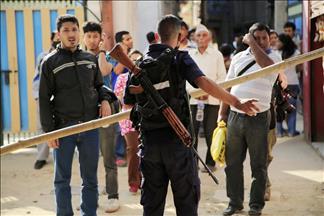
Nepal was accused of descending into a police state by the Asian Human Rights Commission on Wednesday but Nepal-based activists have questioned whether the situation has significantly deteriorated recently.
The statement from the Asian Human Rights Commission, a Hong Kong-based organization, said there was increased police violence under the current government coalition formed by the Nepali Congress party and Communist Party of Nepal (Unified Marxist Leninist).
The statement said Nepali “police have become more visibly allied to the elite and the politicians” since November 2013 elections and criticized the government for failing to order an inquiry into the beating of villagers in Dho, a remote mountain community, in June 2014 which resulted in two deaths.
It goes on to say that this year “witnessed increasing police brutality and extrajudicial killings in the Terai region,” and directly criticizes the action taken against Superintendent of Police and Head of Kathmandu Police Ramesh Kharel after he openly alleged the hand of political corruption in the promotion of officers.
While acknowledging the seriousness of recent examples of police high-handedness, Subodh Pyakurel, chairperson of Nepal-based human rights watchdog Informal Sector Service Center, provided a note of caution: “I don't think that the number of cases of police brutality has increased in comparison to previous years. The expected correction and improvement has not been achieved. A few cases cannot establish the general trend.”
At the same time as dismissing the “sensational” and partisan nature of the Asian Human Rights Commission statement, he further said: “The long outstanding demand for the establishment of an independent, credible and effective police commission has not materialized. In the name of the constitution-making process the state has been closing its eyes on police reform.”
The politicization of Supreme Court appointments is likewise criticized in the document. In July, six judges with blemished records were appointed to the apex court after being recommended by the Judicial Council in a process that has been accused of succumbing to political affiliations, cash incentives, and nepotism.
“There is a general perception that the Court has been politicized as a result of these appointments," said Mandira Sharma, a senior legal advocate and head of anti-impunity NGO Advocacy Forum. "There has been clear evidence of strong political affiliations being the primary reasons for the choices made.”
These appointments may affect the country’s post-conflict reconciliation process and the permissibility of amnesty for those who committed grievous rights violations during the country’s decade-long civil war.
In January, the Supreme Court ruled against the use of amnesty, though this was contradicted by the Truth and Reconciliation Commission Act promulgated in May which leaves open the possibility of amnesty. An appeal made by 234 conflict victims at the apex court is yet to be heard.
According to Sharma, “The case will be a real test as to the extent to which the Supreme Court has been compromised.”
At an event organized by the National Human Rights Commission on Wednesday, Prime Minister Sushil Koirala acknowledged the importance of ensuring the new constitution adequately safeguards the human rights of Nepal’s citizens. Koirala was, however, silent on issues related to the country’s post-conflict truth and reconciliation process.
On Sunday, five former Maoist cadres responsible for the 2004 murder of journalist Dekendra Thapa were successfully prosecuted and sentenced at Dailekh’s District Court for their role in the crime. Four more accused remain on the run. Investigations into the case had earlier been called off by Attorney General Mukti Pradhan in 2012, during the term of Maoist Prime Minister Baburam Bhattarai.
www.aa.com.tr/en