CAIRO
Human Rights Watch (HRW) on Tuesday accused Egyptian security forces of "systematic" killing of 1,150 demonstrators, including at least 817 during the dispersal of the Rabaa al-Adawiya sit-in alone, suggesting the killings probably amount to crimes against humanity.
"In Rabaa Square, Egyptian security forces carried out one of the world's largest killings of demonstrators in a single day in recent history," HRW Executive Director Kenneth Roth said in a new report based on a year-long investigation.
"This wasn't merely a case of excessive force or poor training," he added.
"It was a violent crackdown planned at the highest levels of the Egyptian government," insisted Kenneth Roth.
"Many of the same officials are still in power in Egypt, and have a lot to answer for," he said.
The New York-based rights group said that security forces, who were following a plan that envisioned several thousand deaths, killed a minimum of 817 and more likely at least 1000 Rabaa demonstrators.
The 195-page report, entitled "All According to Plan: The Rabaa Massacre and Mass Killings of Protesters in Egypt," documents how police and army personnel opened fire on crowds of protesters opposed to the military's July 3 ouster of Mohamed Morsi, Egypt's first elected civilian president, during six demonstrations between July 5 and August 17, 2013.
It confirmed that some protesters had used firearms during a few instances, insisting that this does not "justify the grossly disproportionate and premeditated lethal attacks on overwhelmingly peaceful protesters."
HRW asserted in its report that Egyptian authorities had failed to hold even a single low-level policeman or army officer accountable for any of the violence – let alone the officials responsible for ordering them – and continued to brutally suppress dissent.
"In light of the continued impunity, an international investigation and prosecutions of those implicated are needed," the watchdog said.
"States should further suspend military and law enforcement aid to Egypt until it adopts measures to end its serious rights violations," it added.
Live from the inferno
In order to write its report, HRW said it had interviewed more than 200 witnesses, including protesters, doctors, local residents and independent journalists, had visited each of the protest sites during or immediately after the attacks, and had reviewed physical evidence, hours of video footage and relevant statements by public officials.
"They immediately fired teargas and live ammunition. It was so intense; I can't even describe it," one protester, a businessman interviewed by HRW, was quoted as saying.
"It was raining bullets," he added. "I smelled the gas and immediately saw people being hit and falling down around me. I have no idea how many people were hit. We didn't hear any warnings, nothing. It was like hell."
HRW said it had written to relevant Egyptian government ministries in an effort to hear their account of events, but had received no response.
Its report includes a detailed examination of the planning and execution of the protest dispersal at Rabaa al-Adawiya Square, where from July 3 to August 14 tens of thousands of largely peaceful Morsi supporters – including women and children – had held an open-ended sit-in to demand Morsi's reinstatement.
The rights group said it had used satellite imagery from one night of the sit-in – August 2 – estimating that some 85,000 demonstrators had been assembled in the square.
"On August 14, security forces attacked the Rabaa protest encampment from each of its main entrances, using armed personnel carriers, bulldozers, ground troops and snipers," it asserts in the report.
"Security forces gave little to no effective warning and opened fire into large crowds, leaving no safe exit for nearly 12 hours," it added.
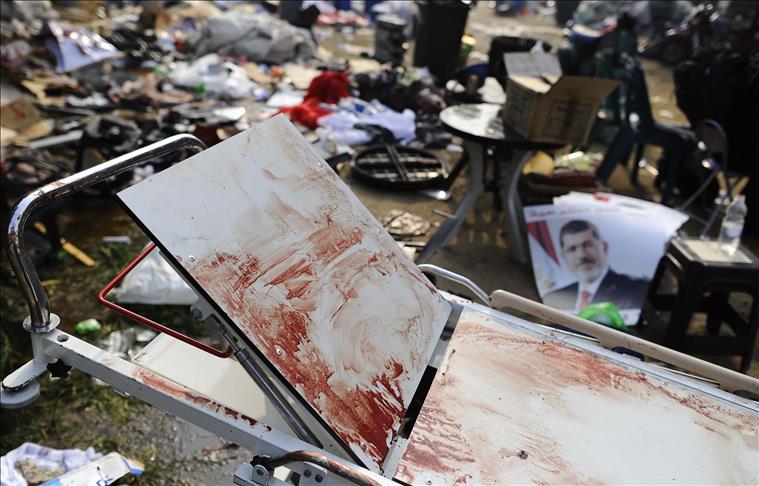
It said security forces had fired on makeshift medical facilities and deployed snipers to target whoever sought to enter or exit a field hospital. It went on to note that, towards the end of the day, the sit-in's central stage, field hospital and mosque had been set ablaze – probably by security forces.
The organization said it had documented 817 people slain during the Rabaa dispersal alone.
It added that – given strong evidence of additional deaths compiled by Rabaa survivors and activists, other bodies taken directly to hospitals and morgues lacking accurate records or known identities, and individuals who remained missing until today – it was likely that more than 1000 were killed in Rabaa Square.
Defense
Egyptian government officials claimed that the use of force by security personnel had come in response to violence by protesters, including gunfire.
HRW, for its part, says it found that – in addition to hundreds of protesters who threw rocks and Molotov cocktails at police once the assault began – demonstrators had fired at police in at least a few instances.
It quoted officials at Egypt's state-run Forensic Medical Authority as saying that eight police officers had been killed during the Rabaa dispersal.
It also quoted Interior Minister Mohamed Ibrahim as saying, after clearing the sit-in on August 14, that his forces had found 15 guns in the square.
"If accurate, this figure indicates that few protesters were armed and further corroborates the extensive evidence we compiled that police gunned down hundreds of unarmed protesters," HRW stressed.
It added that Egyptian officials had attempted to justify the move by claiming that the sit-in had disrupted the lives of local residents and had provided a forum for "incitement and terrorism" in which demonstrators had detained and abused political opponents.
"However, the killing of 817 or more protesters was clearly disproportionate to any threat to local residents, security personnel, or anyone else," the watchdog said.
It said the government had a legitimate security interest in securing the site of the sit-in, but that it had failed to carry out the dispersal in such a way as to minimize casualties.
"Lethal force should be used only when strictly unavoidable to protect an imminent threat to life – a standard that was far from met in this case," HRW said.
According to Roth, evidence showing how security forces opened fire on crowds of protesters from the first minutes of the dispersal operation belied claims that the government sought to minimize casualties.
"The brutal way security forces dispersed this demonstration resulted in a shocking death toll that anyone could have foreseen, and, indeed, the government had anticipated," he added.
He said the government's ongoing efforts to "crush dissent," "sweep its abuses under the rug" and "rewrite" history could not erase what happened in Rabaa last year.
"Given Egypt's resounding failure to investigate these crimes, the time has come for the international community to step in," Roth added.
His organization says it has identified more than a dozen of the most senior leaders in the Egyptian chain of command who should be investigated for their roles in the killings.
These leaders include Interior Minister Ibrahim; then-defense minister and current president, Abdel-Fattah al-Sisi; and Egyptian Special Forces head and commander of the Rabaa dispersal operation, Medhat Menshawy.
"Where there is evidence of responsibility, these individuals should be held individually accountable for the planning and execution [of the operation] or failing to prevent the anticipated widespread and systematic killings of demonstrators," HRW stated.
"The United Nations Human Rights Council should establish an international commission of inquiry to investigate the mass killings of demonstrators [by Egyptian security forces] since June 30, 2013," it added.
It went on to declare that criminal charges should also be brought against anyone implicated in these acts, especially in courts that apply the principle of universal jurisdiction.
"The legacy of the Rabaa massacre continues to cast a dark shadow over Egypt," Roth was quoted by the report as saying.
He added: "Egypt will not move forward until it comes to terms with this bloody stain on its history."
englishnews@aa.com.tr
news_share_descriptionsubscription_contact

contact_the_ombudsman
is_there_an_error_in_this_story