By Fatih Erel
GENEVA
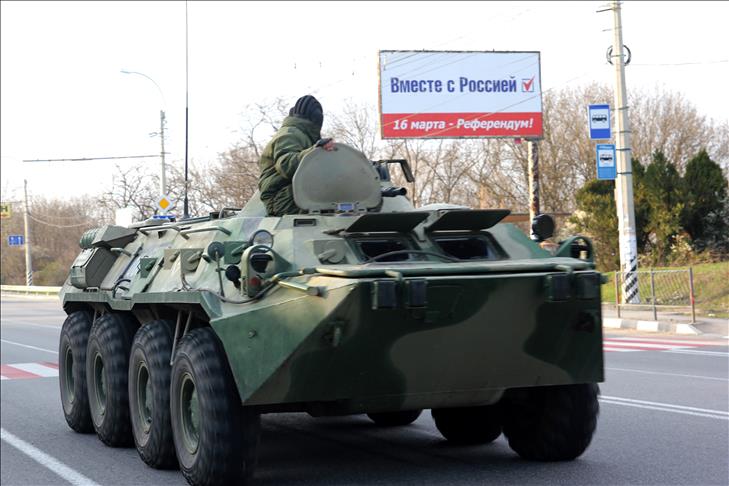
Russia and China are among the nations that are sharply increasing their military spending while contributions to global humanitarian aid decrease.
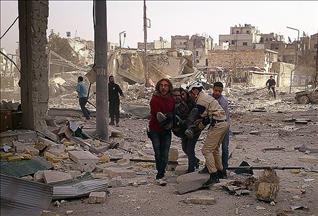
The possibility of rising U.S. and Russia-China tension, the Ukraine and Syrian crisis, the conflict in Africa particularly in the Central African Republic and South Sudan, the ongoing instability in the Middle East, the conflict between South-North Korea, all can speed up the armament race in the near future while global humanitarian aid slows down.
While the UN in 2013 and 2014 asked for almost $13bn to fund its humanitarian operations for a one year period, global military spending totaled $1.75 trillion in 2013 - 130 times higher than the planned humanitarian aid in 2013 and 2014.
The UN appeal for humanitarian aid for this year, which will be used for 52 million people in 17 countries, was the highest ever but not even close to the global military spending.
While global military spending in 2014 is in uptrend, the development on global humanitarian aid is totally different. The international humanitarian response fell by 8 percent from $19.4 billion in 2011 to $17.9 billion in 2012.
Even though western countries, including the U.K. and the U.S., reduced defense budgets, China, Russia and Saudi Arabia increased arms spending last year, but the overall world military expenditure in 2013 fell by 1.9 percent to $1.75 trillion.
The military spending by the U.S. has slightly decreased to $640 billion in 2013. But the U.S. still tops the list on global military spending.
Humanitarian assistance provided by U.S. in 2012 was $3,805 billion. However, the U.S.' nuclear weapon spending according to 2011 data was $61.3 billion with 7,700 nuclear warheads - a quantity that could massacre over 2 billion people.
China, Russia and Saudi Arabia sharply increased their spending between 2012 and 2013. China invested 7.4 percent more in its military, bringing its total budget to $188 billion.
China's defense budget increased 12 percent this year and the total spending for 2014 is due to be $132 billion. China's defense budget is expected to increase from $119.80 billion to $238.20 billion between 2011 and 2015.
Japan has recently announced its new national security strategy and said that it intends to increase military spending over the next five years.
Russian defense spending rose by 4.8 percent to $88 billion, devoting a larger share of their GDP on military than the U.S. for first time since 2003, which is a big sign that Russia is getting ready for some expected tough days in the near future.
With the ongoing instability in the Middle East, Saudi Arabia's military spending has risen from seventh place to fourth in the world. In 2013, the country's military expenditure totaled $67 billion - an increase of 14 percent from the previous year.
China contributed only $27 million worth of humanitarian aid after a large decrease when compared to its $60 million in 2012. This places the country in 28th place among the list of countries which contributed to global humanitarian aid. Russia also contributed only $50 million and was placed in 23rd place in 2012.
Turkey, with the largest increase in 2012 in global humanitarian aid, increased from $775 million to $1 billion, and the largest decrease was by the U.S. with $483 million to $3,805 billion.
- Armament in Africa
While Africa struggles with starvation, poverty and drought, African countries still choose to invest in weapons. African countries spend more money than they receive with their expenditure on importing weapons from developed countries while the developed countries contribute humanitarian aid to African countries. However, weapon exports from developed countries outweigh aid contributions to Africa. Even, military spending in Africa increased by more than 8 percent in 2013, reaching an estimated $44.9bn.
- U.N. fails to maintain peace
The reason of the creation of the U.N. was to maintain peace and security. But the organization has failed many times in doing so after its establishment in 1945.
The six countries who are the exporters of major weapons in 2009–2013 was Germany with the five U.N.'s permanent Security Council member - U.S., Russia, China France and U.K.
During these last five years, the U.S. delivered weapons to at least 90 recipient countries. Russia delivered weapons to 52 states and China supplied major arms to 35 states while the U.N. has been trying to help only 17 countries.
- The future developments in near future to shape military spending
The possibility of rising U.S. and Russia-China tension, the Syrian crisis, the ongoing expansion of existing settlements by Israel, Palestine's efforts to protect the rest of its land to acquire full recognition as a state, the future of Egypt after the coup, conflicts in Africa especially in Central African Republic and South Sudan, the ongoing instability in the Middle East, the conflict between South-North Korea, all contribute to shape and direct the arms race and humanitarian aid efforts.
englishnews@aa.com.tr