Şeyma Erkul Dayanç
05 May 2026•Update: 05 May 2026
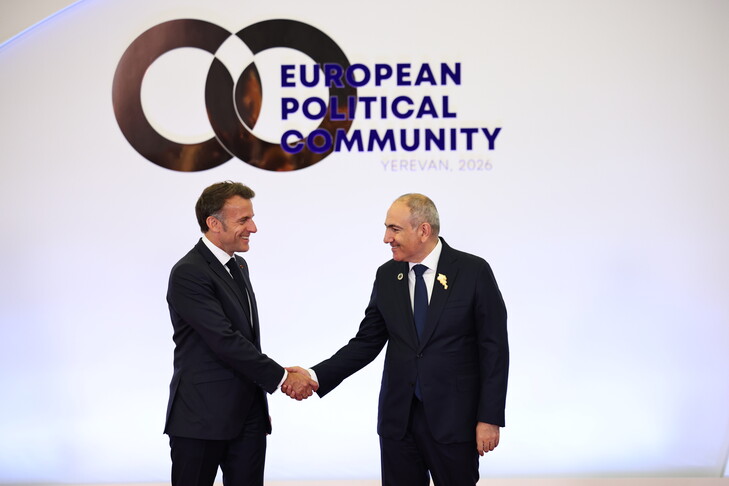
French President Emmanuel Macron said Tuesday that the South Caucasus should not become a “space of rival external powers,” and should instead serve as a “crossroads” linking Europe, Central Asia, and the Middle East.
“The South Caucasus is not destined to be a field of empires competing over it as a trophy,” Macron said at the Yerevan Dialogue.
“I know that for a long time, many believed Armenia’s destiny could only lie under the so-called protective wing of Russia. But the 2020 war showed that this protection was not as reliable as many thought,” Macron said, adding that the South Caucasus had long been seen as a region shaped by external powers.
Macron said Armenia had made “a courageous and necessary choice” by advancing peace initiatives and pursuing normalization with Azerbaijan, adding that the process had helped stabilize the country’s political and economic trajectory.
He called for the reopening of all regional borders, including those between Armenia, Azerbaijan, and Türkiye, saying that “borders must open, all borders, and they must open fully.”
“This is what will unlock full economic opportunity and allow for routes of peace rather than imperial conflicts in the South Caucasus,” he said.
Macron also said the region’s transformation was supported by international financial actors, including the IMF and the French Development Agency, which he said is backing regional projects worth nearly €4 billion (nearly $4.3 billion).
Macron said the region should evolve into a connectivity hub linking Europe, Central Asia, and the Middle East, adding that reliance on outside protection had proven unstable.
He also referred to shifting geopolitical realities in the region, saying that the 2020 war had exposed the limits of long-standing security assumptions and the risks of over-reliance on external guarantees.
Macron argued that Europe’s own historical experience of conflict and institutional rebuilding had led to a model based on sovereignty, rule of law, and cooperation between states, which he said now serves as a reference for regional stability.
He also noted that a broader transition was underway toward a more rules-based international order, arguing that lasting peace could only be achieved through international law and cooperation rather than power politics.
The Yerevan Dialogue, held on Tuesday and Wednesday, brings together policymakers, experts, and stakeholders in the immediate aftermath of the European Political Community summit to discuss regional and global challenges.