Egypt's prime minister-designate Hazem Al-Beblawi told the Anadolu Agency that the new government lineup will be announced in 72 hours.
"We will examine all the nominations put forward by the political powers, including the National Salvation Front (NSF), the Salafist Nour Party and Tamarod (Rebellion) Movement to choose the most qualified," he told the AA over the phone.
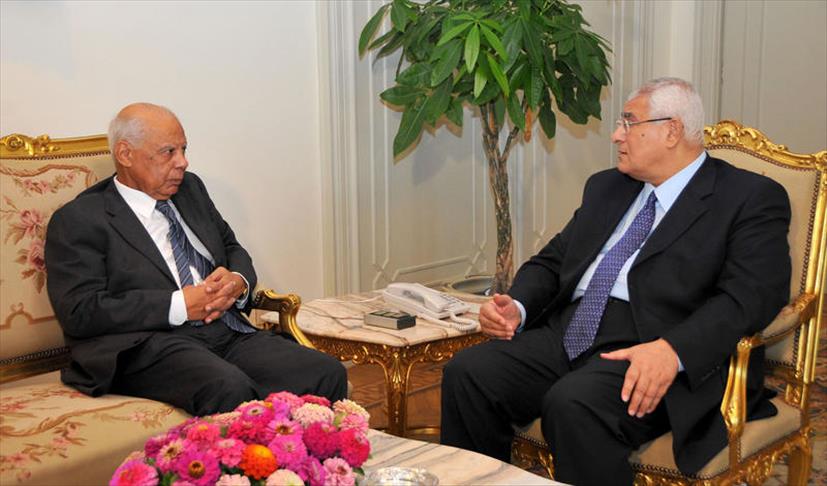
Al-Beblawi, a veteran economist with close ties to the oil-rich Gulf countries, was appointed by interim president Adly Mansour earlier today to form the new government.
He said his government might include members of the Muslim Brotherhood, which has been leading protests to reinstate deposed President Mohammad Morsi.
"We may see ministers from the Muslim Brotherhood in the new government," he said in statements to the website of Tamarod, which spearheaded the campaign to oust Morsi.
Al-Beblawi pledged to work to achieve "the goals of the Egyptian revolution and cruise Egypt to a new era of security and stability."
Born in 1937, Al-Beblawi obtained his law degree from Cairo University in 1957, a diploma in political economy a year later and then a diploma in general law in 1959.
He got a diploma in economics from France’s University of Grenoble in 1961 and a PhD in economic sciences from Paris University three years later.
Al-Beblawi worked as an advisor to the Kuwaiti finance minister and head of the economic research unit between 1976 and 1980.
He has served as an advisor for the Abu Dhabi-based Arab Monetary Fund since 2001.
Al-Beblawi served as undersecretary-general at the UN and executive director at the UN Economic and Social Commission for Western Asia (ESCWA) between 1995 and 2000.
He was appointed on July 16, 2011 deputy prime minister and finance minister in the government of Essam Sharaf during the army-administrated transition period that followed the ouster of Hosni Mubarak.
Al-Beblawi resigned his post in on July 16 protest at the killing of several Copts in clashes with army troops outside the state television building.
The resignation was not accepted and he remained in office until December 2011.
He taught economy-related courses at several universities including the Sorbonne, the University of California, the American University of Cairo, Ein Shams University and Cairo University.
Al-Beblawi authored a number of publications on banking, finance, international trade and development including "The Arab Gulf economy in a turbulent age".