BANNU, Pakistan
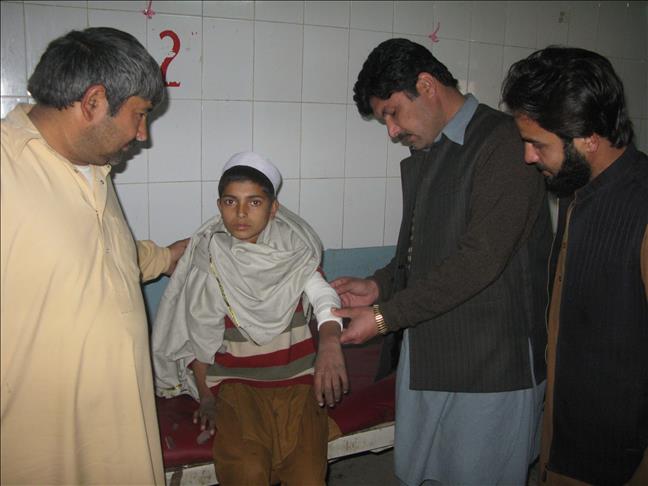
In a hospital in northwestern Pakistan, up to six children suffering from diarrhea, gastro and dehydration share beds. Scores of others sit next to or in the laps of their mothers, in scorching weather that has reached heights of 45 degrees Celsius. In the courtyard, drips hanging from tree branches inject a couple of children with glucose.
Bannu's Women and Children's hospital is overflowing, creaking under the pressure of the masses who have been displaced by the Pakistan army's onslaught of neighbouring North Waziristan. Since June 15, more then 300 militants have been killed in an army operation aimed at wiping out the Pakistani Taliban's mother organization, Tehrik-e-Taliban Pakistan. As with previous operations in the region, it has caused wholesale displacement.
The 130-bed hospital is currently catering to more than 800 patients -- all women and children -- being treated for various heat-related conditions caused by trudging the burning roads, for 16 to 24 hours, from different parts of North Waziristan.
Other hospitals in adjacent Lakki Marmat, Kohat, Karak and Peshawar, the capital of the northwestern Khyber Pakhtunkhawa province, are bearing a share of the burden, without exception.
In the suburbs of Bannu sits the only shelter camp set up by the government to host the almost 500,000 displaced from North Waziristan. Various parts of the camp lack properly functioning electricity and makeshift tents essentially become furnaces in the heat.
“Conditions are completely pathetic here,” says Hussein Khan, a resident of North Waziristan's Mir Ali town, who moved to the Bannu shelter camp with his family last week. "There is no electricity in many parts of the camp, no potable water and no other basic facility. We are lying here like orphans.”
The conditions have meant that most who have left North Waziristan have settled with relatives or in rented houses in nearby districts. The camp is only hosting a fraction of the internally displaced. Many avoid it because of adherence to the strict Pardah (veil) code. Tents are erected close to each other, while women have to walk more than a mile to use the washroom, something unacceptable to many.
“We would rather prefer to die instead of exposing our women there,” says Ghulam Mustafa Dawar, from North Waziristan administrative headquarters Miramshah, who has rented a two-room house in Bannu.
There is no real system for the distribution of rations among the affected families. Hundreds of frustrated of refugees clashed with police in Bannu on Tuesday, after failing to receive any share of the rations distributed by the administration. Though the army, government agencies, and Islamic charities have taken steps to relieve the woes of displaced persons, it has not been enough to meet the demands of the crisis. The government has announced 7000 Pakistani rupees (US$70) for each displaced family as compensation, enough to pay only one month's rent in Bannu.
“The government is doing nothing for us,” an emotional Mustafa Dawar says, with sweat rolling down his bearded face. “They will understand our problems only when their sisters and daughters will have to face these conditions.”
Ghulam Rasool Dawar, a Peshawar-based journalist, who hails from North Waziristan, agrees. His sister-in-law had delivered a baby only a day prior to leaving North Waziristan and is now struggling for her life in a Peshawar hospital, after the 16 hour walk to Bannu. Rasool Dawar’s nine-year old nephew was hit by a car while crossing the road, to get a water bottle from an army distribution camp in Bannu, and is in a coma in the same Peshawar hospital.
“I used all my contacts to peacefully bring my family from North Waziristan to Peshawar but to no avail,” Rasool Dawar says.
“We are collecting charity, not to help the IDPs (internally displaced persons) but to buy a land for graveyard,” he says. “That is the ultimate destination of IDPs from North Waziristan in given circumstances.”
www.aa.com.tr/en