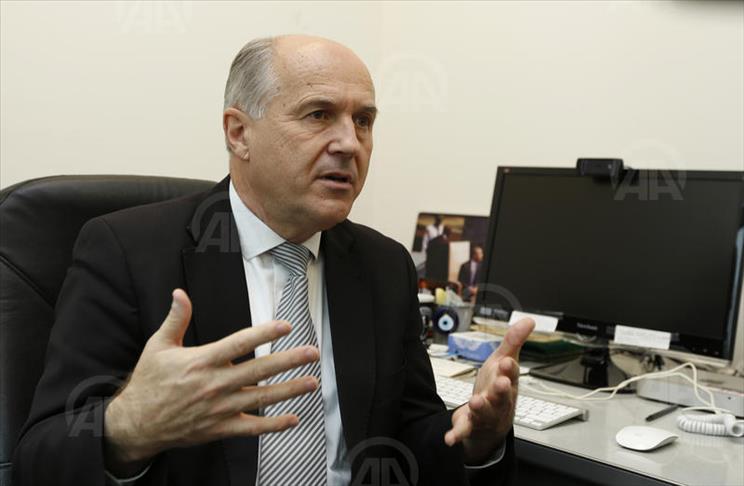
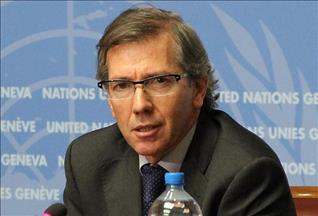
In a special interview to Anadolu Agency just hours after he delivered his latest report to the UN Security Council, Inzko responded to a question whether he can use the "Bonn powers", which grants the High Representative the power to remove public officials from office if they violate legal commitments.
"Bonn powers can be applied only if there remains no other choices", said Inzko, emphasizing that "The real holders of 'Bonn powers' are the Bosnian people".
"I think the best possibility is when people will have in their hands the ‘Bonn powers’ during the elections 11 months later".
Inzko also sent a message to the politicians that there are still chances to make up for the lost time, which, Inzko said, put Bosnia and Herzegovina to the last place in the region.
"The region is moving as you know. Croatia has now become an EU member state. Serbia will soon be a candidate state. Montenegro has already closed three chapters negotiations with EU – only Bosnia is lagging behind. Actually – the recipe [for success] is simple: do just the same what Montenegro is doing. Do what Serbia is doing."
Inzko compared the internal problems of Bosnia and Herzegovina to the problems encountered by Kosovo and Serbia, stating that solving Bosnia's problems are even easier.
The High Representative touched on the "Sejdić and Finci v. Bosnia and Herzegovina" case, the judicial verdict of which found BiH violated Article 14 of ECHR for not allowing Dervo Sejdić and Jakob Finci, who are Roma and Jewish respectively, to stand for election to the House of Peoples.
“If you compare the huge problem which is the 600 years old regarding Serbia and Kosovo – if you compare this huge problem -- ‘Sejdić-Finci’ is much smaller. So if they could solve this huge historic issue in such a short time why can not the Bosnian politicians solve also ‘Sejdić-Finci’”
On Tuesday, High Representative Valentin Inzko had addressed the UN Security Council, expressing his conviction that “Bosnia and Herzegovina, its leaders, and its peoples still have every chance to work together, to succeed, and to prosper.”
In his speech, Inzko sent a message to the Bosnian politicians that there is still time for the ruling parties in Bosnia and Herzegovina to turn things around before the October 2014 elections, but the “time is running out”.
During his presentation he called for the UN Security Council to explore options on getting the country on the EU road. He said that would help to ensure that the gains made after the war in terms of stability, rebuilding the country and reconciling its peoples, are preserved and advanced.
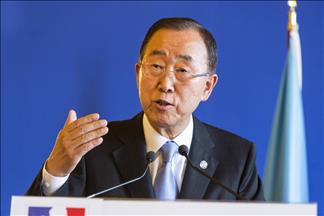
Inzko, had met UN Secretary General Ban Ki Moon and stated “Unfortunately, since my last address to the Security Council in May, and with less than a year left until the next general elections, the situation in the country has not changed: The country’s political leadership has still not shown a firm commitment to carrying out the basic political and economic reforms needed to move the country forward. Nor have they made a serious effort towards progress on Euro-Atlantic integration.”