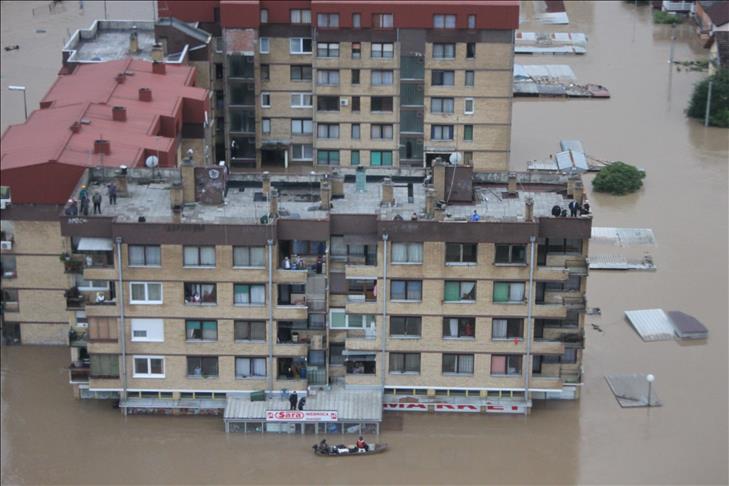
The death toll reported by Anadolu Agency teams at the scene has risen to 35, while engulfing waters have prompted the evacuation of tens of thousands in Bosnia-Herzegovina and Serbia.
In addition, the floods have forced Bosnia to deal with its own landmines, a legacy of the 1992-95 Bosnian war which killed about 100,000 people.
“A vast number of landslides have worsened the situation[…], and there are reports that landmines buried during the conflict, and not yet removed, are in some instances being shifted with the landslides adding danger for people living in the areas as well as for rescuers,” the Red Cross said in a statement on Sunday.
More than 500,000 people of Bosnia-Herzegovina’s population of almost four million live in areas littered with mines left over from the 1992-95 Bosnian war and face the risk of being blown up on a daily basis.
About 220,000 mines are still lying beneath the ground across the country, according to the country’s de-mining center.
Infrastructure failures
The waters began to recede only after hundreds of cities and villages had already been submerged and landslides had laid waste to entire towns, wreaking havoc on both Bosnia and Serbia’s infrastructure.
An estimated 300,000 people in Serbia and an additional 50,000 in Bosnia are without access to electricity or drinking water, as some are living in unsafe and unsanitary conditions.
As rescue coordinators appeal for food, water and essential needs to help those affected, humanitarian support has streamed from across the world.
Turkey’s Cooperation and Coordination Agency continued delivering cans of tinned food, flour, oil, boots and hygiene supplies to devastated areas on Sunday, as requested by PM Recep Tayyip Erdogan, said Dr. Zulkuf Oruc, the agency’s coordinator for the Sarajevo region.
Turkey has also sent aid to several cities where shortages of medical supplies were particularly acute, which triggered fears of epidemics.
Turkish Foreign Minister Ahmet Davutoglu, in a phone conversation with Chairman of the Bosnian Presidential Council Bakir Izetbegovic, promised additional aid.
The floods across Bosnia-Herzegovina and Serbia are believed to be the heaviest in the region in a century. Officials expect the death toll to rise.
So far, 19 lives have been claimed in Bosnia, 15 in Serbia and one in Croatia.
Many homes, farmland, workplaces and vehicles have been submerged in scenes photographed and filmed by AA, and a bridge collapsed after the Tinya river burst from its banks near the northeastern Bosnian city of Brcko.
englishnews@aa.com.tr