By Max Constant
BANGKOK
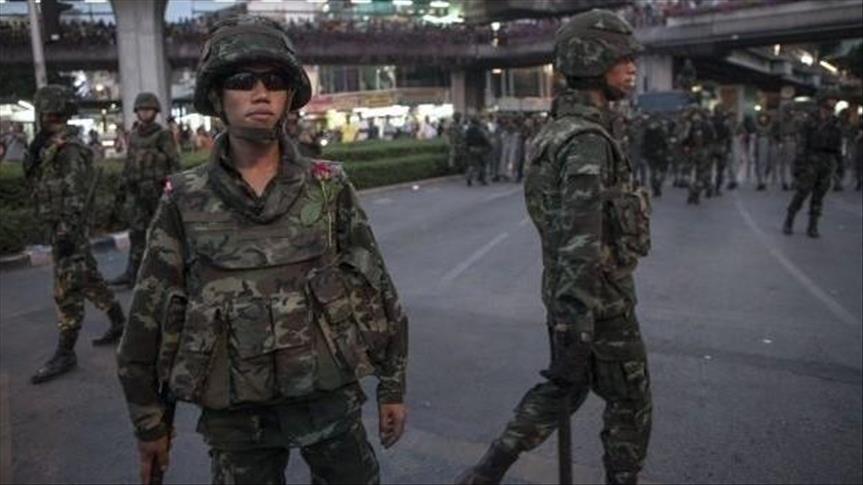
At least 11 people – mostly soldiers – have been injured in a series of shootings and bombings in Thailand’s Muslim majority south, in what authorities describe as a show of force marking the founding anniversary of one of the region’s main insurgent groups.
Data obtained by Anadolu Agency Monday from the southern bureau of Thailand’s main domestic security agency showed that 15 violent incidents occurred Sunday across Narathiwat and Yala, provinces in the far south near the Malaysian border.
Another explosion took place Monday in Narathiwat, according to the chief of the Tak Bai district police station.
“On Monday morning, a remote-controlled bomb exploded when a group of eight soldiers, on their way to protect teachers travelling to their school, was passing by,” Police Colonel Jiradet Pornsawang told Anadolu Agency.
"Two were wounded,” he said.
The Internal Security Operational Command’s southern bureau considered the violent campaign to be linked to the March 13 anniversary of the founding of the National Revolutionary Front (BRN) 56 years ago.
The incident resulting in the most injuries occurred when a group of people fired military-grade automatic weapons at a military patrol in the province’s Cho-Arong district Sunday, leaving 7 soldiers wounded.
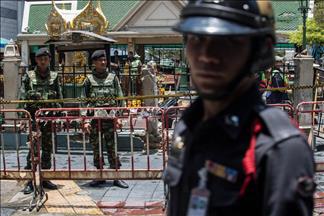
Junta leader-cum-Prime Minster Prayuth Chan-ocha responded to the attacks by ordering Monday that security be tightened around attack-prone areas in the region, including crowded places and bus stops.
The Bangkok Post quoted government spokesperson Maj. Gen. Sansern Kaewkamnerd as saying that Chan-ocha ordered that the crackdown on all such illegal activities be effective within six months.
Kaewkamnerd underlined that development and investment in the far south had been hindered by the unrest.
"If the southerners want to see improvements, they should unite to prevent people with ill intentions towards Buddhists and Muslims by putting pressure on them,” he said. “Those villains should be given no space to stand in society."
The attacks shook the conflict-ridden region as Thai authorities are about to release a report on the results of negotiations between the military government and an umbrella organization of insurgent groups.
The leader of the military government’s negotiating team announced last week that the report would be published in both Thai and English, with as many copies as possible distributed “as the team’s accomplishments have not yet been publicized widely”.
“While all sides claim they are acting on behalf of the people, we would like to tell them that the people don’t want to see violence, but peace,” General Aksara Kerdpol said.
“We reject any form of violence. It is now, during the period of building mutual trust, that there should be no violent incidents in order to achieve that goal,” he had stressed.
Negotiations between an umbrella group representing various insurgent factions – including some from the BRN – and the military government – which seized power in a May 2014 coup – have been ongoing since 2015, with Malaysia acting as a facilitator.
Last year, Mara Patani set out three pre-conditions for formal peace talks with the junta.
First, the organization demanded that the southern issue be made a priority on the government national agenda through a parliamentary vote.
Secondly, it asked the government to recognize Mara Patani as "a legitimate organization" and thirdly that Mara Patani representatives be given immunity and safe passage throughout the south.
Last month, Gen. Nakrob Boonbuathong, a representative of the Internal Security Operational Command, said that Chan-ocha had approved the first request, but not the two others.
In a strongly-worded editorial published Sunday, Thai newspaper The Nation dismissed the negotiations as “a flop”.
“Every time the military government pushed that line about peace and the peace initiative being on the right track, the insurgents responded with more violence on the ground,” said the daily.
“The spike in violence these past weeks are reminders that peace won’t come easily in the deep south,” it added. “If the junta won’t think in terms of deliverables – give and take and making meaningful concessions – the only thing that Aksara Kerdpol and his negotiating team can do is sit back, cross their fingers and hope for a better tomorrow.”
Despite a decrease in the number of violent incidents in 2015 compared to previous years, bombings and shootings continue to destabilize the three provinces of Yala, Pattani and Narathiwat – as well as four districts of the Songkla province to the north – where around 6,500 people have been killed and over 11,000 injured since 2004.
The southern insurgency is rooted in a century-old ethno-cultural conflict between Malay Muslims living in the southern region and the Thai central state where Buddhism is considered the de-facto national religion.
Armed insurgent groups were formed in the 1960s after the then-military dictatorship tried to interfere in Islamic schools, but the insurgency faded in the 1990s.
In 2004, a rejuvenated armed movement – composed of numerous local cells of fighters loosely grouped around an organization called the National Revolutionary Front or BRN – emerged.
The confrontation is one of the deadliest low-intensity conflicts on the planet.