YALA, Thailand
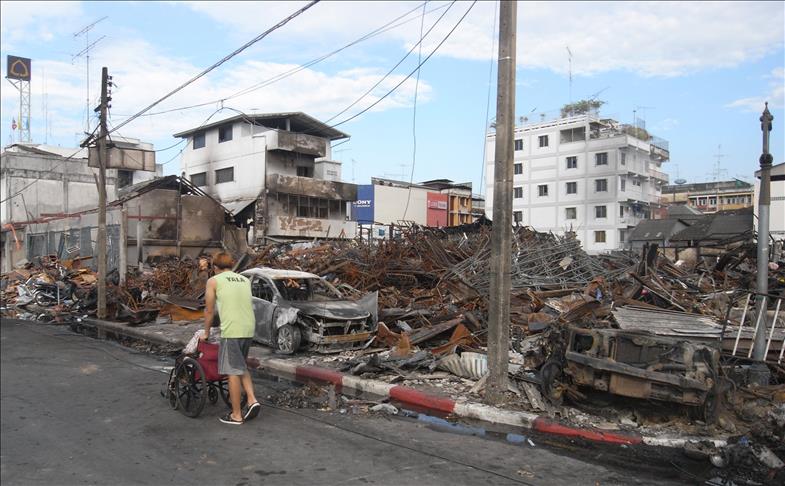
Violence continued Monday in Thailand's Muslim south with suspected separatist insurgents bombing two 7-Eleven convenience stores, a government-run education center, and burning down a warehouse in the southernmost province of Yala.
Ten hours after the attacks, an Anadolu Agency reporter watched fire trucks still desperately trying to extinguish blazes at the scene.
The Monday attacks followed four simultaneous bomb blasts Sunday that hit the heart of Yala's commercial district. One car bomb almost took out an entire city block, leaving one person dead, four seriously wounded and at least 10 admitted to hospital for treatment.
“We have strong reason to believe that these attacks were the work of the separatist militants, but we (local authorities) are not ruling out other motivations that may or may not be related to the ongoing insurgency," Lt. General Charin Amornkaew, director of the Centre for the Enforcement of Human Rights Law and Forensic Science, told the Anadolu Agency on Monday.
“We are using forensic evidence to establish the identity of the people or cell behind this wave of violence,” he said.
Amornkaew added that even though Muslim insurgent groups are suspected to be behind the attacks, their reason is all but clear with criminality often confused with insurgency.
In February 2011, a massive fire caused by a car bomb again almost destroyed an entire block of shop houses, just one block away from the Sunday attack. Sources in the Barisan Revolusi Nasional (BRN), a long-standing separatist group that emerged in the mid-1960s, confirmed to AA on Monday that both attacks were carried out by separatist militants belonging to its network.
The BRN source - who did not wish to be named for matters of personal security - revealed his frustration to AA that some combatants had been moonlighting for criminals.
The motivation behind the February incident was not ideological, he said, but criminal - militants paid by crime syndicates to avenge Thai authorities' efforts to crack down on their smuggling businesses.
He declined to elaborate as to what measures, if any, the organization would take to control such behavior.
Thailand's three Muslim-dominated southern provinces of Yala, Pattani and Narathiwat have been troubled by a Muslim insurgency since Siam (the name of Thailand pre-1939) took control of what was then a Malay Sultanate following an Anglo-Siamese treaty in 1907.
The insurgency became a full-blown civil war in the 1960s when the Bangkok government tried to control education in the region's Islamic schools.
In January 2004, a rejuvenated insurgency movement launched a series of attacks that shook up the Thai State. Since then bomb attacks, drive-by shootings and ambushes have happened on an almost daily basis.
The insurgency took a turn for the worse in February this year when insurgents retaliated against the shooting deaths of three young boys by two men from the Army’s Paramilitary Rangers with a series of attacks against soft targets
Over the next two weeks, a monk and three Buddhist women were killed, their bodies doused with gasoline and set on fire.
Sunai Phasuk of New York-based Human Rights Watch (HRW) told AA that the Thai government's unwillingness to prosecute the security officials behind extra judicial killings has set off a vicious cycle of retaliation with insurgents responding to any such killings with attacks on such soft targets.
In a recent statement, HRW said: “Southern insurgents are killing Buddhist women and spreading terror by beheading and burning their bodies. Claims by separatist groups that they are retaliating against government abuses are no justification for attacks on civilians.”
Since the conflict restarted in 2004, around 6,000 people – Buddhists and Muslims, military, teachers, civil servants and civilians – have been killed and around 10,700 others wounded.
englishnews@aa.com.tr