HONG KONG
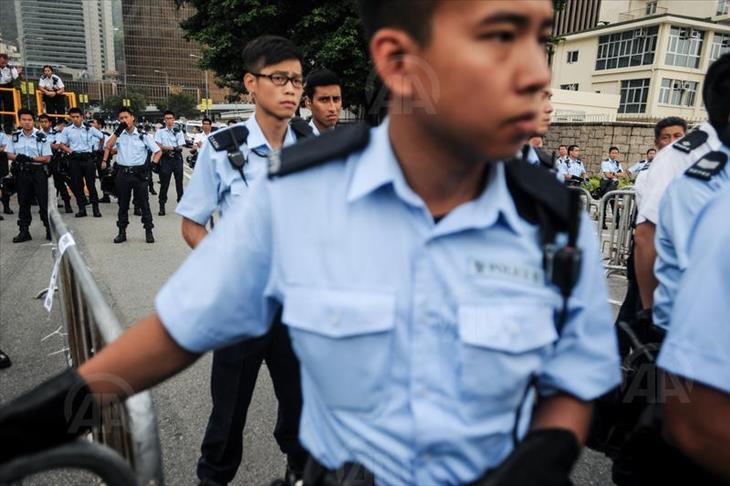
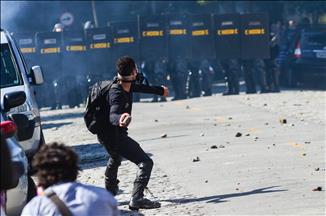
Hong Kong police arrested 37 people in a second night of clashes as hundreds of pro-democracy protesters took to the streets for a second night during the Christmas holiday period after demonstrators' road blockades across the city were removed.
The government said in a statement Friday police had arrested 26 men and 11 women, aged from 13 to 76 years, in the Mong Kok district on suspicion of offences including "criminal damage" and "disorderly conduct in a public place."
Tensions rose at around 09.00 p.m. (01.00 p.m. GMT) Thursday as hundreds of protesters, many holding yellow umbrellas, headed toward Mong Kok police station, an Anadolu Agency correspondent at the scene reported. A call spread online had urged demonstrators to gather outside the building at 9.30 p.m. to show support for a protester held there following his arrest the previous evening.
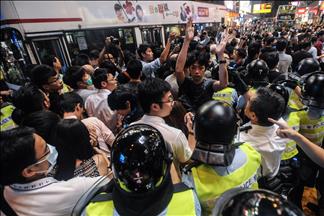
About one kilometer from the station, police surrounded a main group of around 200 protesters on Tung Choi Street, demanding they show identification before they could leave.
Outraged by the police blockade, they shouted "We demand an explanation for police obstructing the road!" and "We want real universal suffrage!" The standoff lasted about five hours.
Some protesters showed their IDs and left, but many refused. Eventually police canceled their cordon and the remaining protesters left.
Hundreds of other protesters went directly to the police station, without joining the march.
In a show of force, some 300 gathered outside the station as about 50 officers stood guard at its main entrance. At around 02.00 a.m., some 100 protesters walked a short distance away before rushing onto a main road and briefly occupying it.
They also threw a rubbish bin and garbage on to the road, obstructing traffic. Police rushed to the scene, arresting one person.
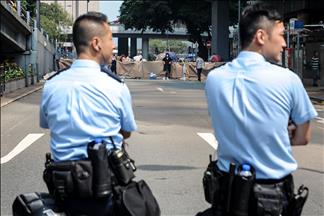
Around 1,000 police were deployed to handle the protesters overnight, and yellow warning flags were raised several times, urging protesters to disperse.
Of the 37 arrested, 30 were suspected of criminal damage after residents on a private apartment block complained they had illegally entered the property. They had entered the property in an apparent attempt to escape the police's kettling of protesters.
Tensions escalated markedly when police surrounded the protesters in Tung Choi Street, a tactic that has drawn criticism from Independent Police Complaints Commission member Eric Cheung Tat-Ming, according to the pro-Beijing South China Morning Post.
"Although there were no complaints about physical contact, some said they were unsatisfied with how police had cordoned off the crowd," the newspaper quoted Cheung as saying.
Melody Chan, a 21-year-old student, told the Anadolu Agency she was walking home after meeting friends when she was caught up in the police operation.
"This is wrong. Why can the police take away my freedom to walk the streets like this? I am not a protester. I am a passerby," she said. She later lined up to show her ID to police before exiting the cordon.
Several other protesters told AA that police had treated them roughly or spoken to them in a rude, aggressive manner.
Chinese Premier Li Keqiang praised Hong Kong's chief executive, CY Leung, "in the face of difficulties" -- a possible reference to the recent pro-democracy demonstrations, public broadcaster RTHK reported.
Li told Leung, who is paying a visit to Beijing, that he and his team had maintained Hong Kong's stability, the report added.
Police had arrested 12 people the day before for assaulting and obstructing police, disorderly conduct, criminal damage and failing to produce proof of identity.
Around 500 to 1,000 demonstrators gathered in Mong Kok on Christmas Eve, roaming around and chanting slogans such as "I want real universal suffrage!" Some carried yellow accessories, including the umbrellas that have become the protests’ symbols.
They called on the city’s top political official, chief executive CY Leung, to step down as he pays a visit to Beijing.
In the shopping district of Causeway Bay, protesters raised yellow umbrellas, singing Christmas carols and yelling: "I want real universal suffrage for Christmas!"
The protests – which involved more than 100,000 people at their peak – ended after two and a half months, with the clearance of the final and smallest site in Causeway Bay.
More than 955 people were taken into custody since the beginning of the protests in September.
Demonstrators had been calling for a fully democratic election with open nominations for the territory's next chief executive in 2017. At the end of August, the Chinese government said it will allow "one man, one vote" suffrage but that candidates will have to be approved by a body loyal to Beijing.
Hong Kong, a former British colony, returned to Chinese rule in 1997 under the “one country, two systems” formula, which promised a high degree of autonomy from Beijing, including universal suffrage.
www.aa.com.tr/en