ISTANBUL
Turkish Premier Recep Tayyip Erdogan on Tuesday said that Turkey has no intention to interfere in the internal matters of Syria.
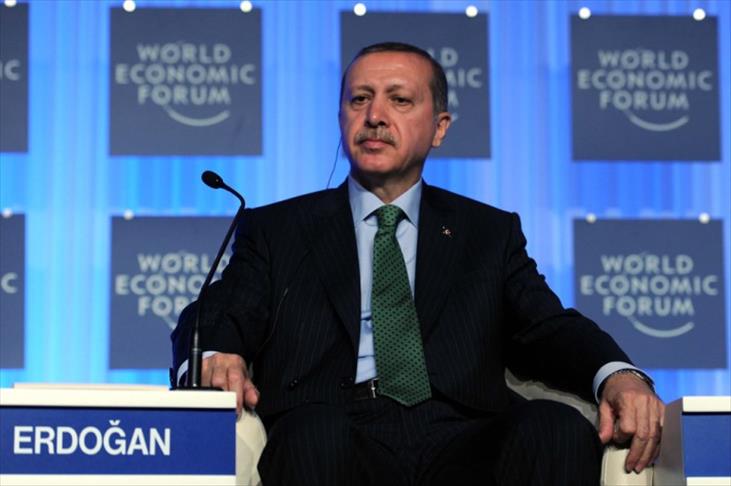
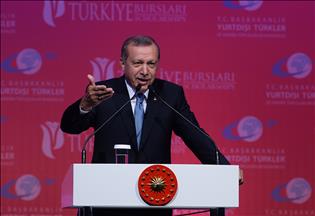
We are trying to make the necessary warnings as we believe that a fire in Syria would affect the whole region, Erdogan stressed as he addressed the participants of the World Economic Forum (WEF) on Europe, the Middle East, North Africa and Central Asia taking place under the title "Uniting Regions in Transformation".
Thousands of people had to migrate from Syria to Lebanon, Turkey and Jordan due to the clashes in Syria. Around 24,000 Syrians now live in Turkey. The Syrian issue is now beyond the borders of Syria, Erdogan stated.
On Turkey's approach to Arab countries, Erdogan said that Turkey always reminded its interlocutors that a transition had to be made to democratic structures from autocratic structures.
-Global crisis need global measures-
If all the incidents taking place are not sufficient, the latest global economic crisis must force the global community to look at the reasons of the global crisis and take global measures, I find the Istanbul meeting crucial from the perspective of finding global measures, Erdogan noted.
During our government in the past decade, Turkey has stayed away from all steps that may negatively affect stability and confidence. We have stayed away from populism in all elections and never made concessions from fiscal discipline and monetary policies. Turkey's experiences could be a model to all countries badly affected by the global crisis, Erdogan stated.
Turkey's achievements in the past decade are a result of reforms at home and an active, multi-dimensional and constructive foreign policy, Erdogan said.
The stability, prosperity, peace and tranquility of any country in this region depend on the prosperity, stability, peace and tranquility of the region, Erdogan indicated.
Common points in this wide geography are more than differences. As such, a problem of a country is a matter of concern to another country in the region. War, clashes, migration and terror in a country are matters of concern to a country nearby. Our initiatives on regional issues and raising voice in reaction to regional issues are not interference in the internal matters of countries. We only try to attract attention to the sensitivities (in the region), Erdogan underlined.
Turkey to pay off IMF debts by next year
Turkish Premier Recep Tayyip Erdogan on Tuesday said that Turkey's debt to the International Monetary Fund (IMF) was 23.5 billion USD in 2002 due to stand-by agreements and that this debt went down to 1.7 billion USD in 2012.
Turkey's debt to the IMF will be paid completely by April 2013, Erdogan stressed as he addressed the participants of the World Economic Forum (WEF) on Europe, the Middle East, North Africa and Central Asia taking place under the title "Uniting Regions in Transformation".
I am pleased to see the WEF meeting taking place in Istanbul. I am thankful to all those who made the forum possible in Istanbul, Erdogan noted.
I find the forum in Istanbul, with the heading "Uniting Regions in Transformation", highly well-timed and meaningful, Erdogan stated.
Despite all difficulties and problems in a tough geography, Turkey continues to develop with stability and democracy and protects its identity of being a secure island, Erdogan underlined.
It is clear that any country which runs away from regional cooperation in the Caucasus, Middle East, North Africa and Balkans will be deprived of not only prosperity but tranquility, stability and security as well, Erdogan stressed.
Our government's active and peace focused foreign policy in the past decade in addition to reforms made for democratization are highly meaningful to show how a country can advance, Erdogan said.
-Economic figures-
In the past 10 years, the Turkish economy grew around 5.3 percent annually, Erdogan noted.
When you consider the global financial crisis in the past decade, an annual growth of 5.3 percent is an important achievement, Erdogan said.
In 2011, Turkey was the second country in the world after China with its growth figure of 8.5 percent. While Turkey's national income was 230 billion USD in 2002, this figure jumped to 772 billion USD in 2011. Income per capita in Turkey went up to 10,444 USD in 2011. By the end of 2011, Turkey's foreign trade volume went up to 376 billion USD from 88 billion USD in 2002. Turkey's tourism income was recorded as 23.5 billion USD in 2011. Direct international investments in Turkey in 2011 were worth 16 billion USD, Erdogan indicated.
While Turkey's economic figures may have been negatively affected in 2009 due to the serious global financial crisis, economic figures in Turkey today are better than they were prior to the crisis, Erdogan also said.