ANKARA
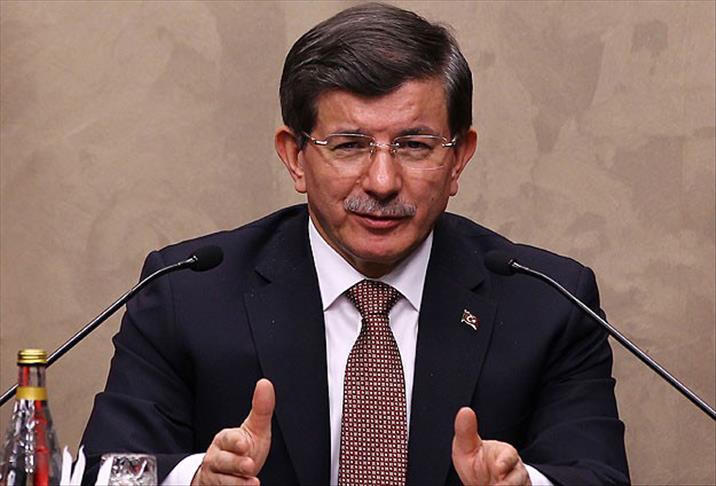
A new constitution will be among the top 10 priorities of the Justice and Development (AK) Party government if it is re-elected in the upcoming June 7 general election, Turkish Prime Minister Ahmet Davutoglu has said.
In an interview with private Haberturk TV early Sunday, Davutoglu listed 10 targets in the next term that included a new constitution, solution process, social consensus, structural economic reforms, an increase in employment, meeting the demands of different segments of society, implementation of the law on transparency, judicial reform, restructuring of the "frayed" bureaucracy, and new master plans for the restructuring of all Turkish cities.
"Some of them will be immediately implemented starting from early June 8, while some will be realized within a process," the premier said, adding that the 10 priorities would set the framework of the overall government program in the next term.
New constitution
"Regardless of the election result, I call upon the opposition parties: Turkey can no more stand the September 12 constitution. Let's try to do something that nobody could realize until now: a civilian constitution," he said.
Turkey’s current constitution was written after the Sept. 12, 1980 military coup.
He invited the opposition parties to lay the foundations of a new constitution that would be based on the principles of separation of powers and a sense of liberalism based on human dignity; it would also pave the way for a new presidential system of governance.
President Recep Tayyip Erdogan has also highlighted the importance of a new presidential system in Turkey in his recent speeches.
Solution process
"The solution process will continue on its own course no matter what the election result," Davutoglu said.
The “solution process” refers to the 2013 initiative of the AK Party government that aims to end the decades-old conflict with the Kurdistan Workers’ Party (PKK), which has claimed the lives of more than 40,000 people.
The PKK is listed as a terrorist group by Turkey as well as by the U.S. and the European Union.
The prime minister emphasized that if re-elected the government planned to continue the existing “solution process committee” after the elections.
About social consensus goals, Davutoglu said he envisioned a new era where all parts of the society would freely express their views and "where we can have a warm communication".
"In the new four-year term, we aim to open a new communication channel with all those who have any trouble, so as to encourage participatory democracy," he said, adding that non-governmental organizations would also be included in the process.
The premier added that he himself would steer a new economic management mechanism to monitor the restructuring together with all related institutions on economy.
Early November, Davutoglu had announced a comprehensive plan called the "economic structural transformation" to boost Turkey’s economy through wide-ranging structural reforms in various sectors, including trade, energy and health.
About employment, he said that one of the key concerns for the future was to increase jobs, especially for the youth.
"I'm planning to devise an intermediary model where the government, Ministry of National Education and the private sector will enable a rapid participation of the youth to the labor force through vocational training," he said.
He also said that he wanted to eradicate the problem of subcontracted labor.
Davutoglu also said that the ruling party if re-elected would rapidly put the law on transparency into effect to define the relations between politics and economy.
He also highlighted the need for judicial reforms in order to restore the confidence in the judiciary.
Davutoglu said that the party would also restructure the bureaucracy, even some ministries if need be on the basis of merit especially since "we have witnessed many issues like the parallel structure and the recent fraud in a 2010 nationwide civil service recruitment exam".
About the restructuring of all Turkish cities, he said that master plans would be drafted for cities, especially those with the highest rates of population growth.
"We will prepare a framework so as to pave the way for public works and development efforts that will integrate with the culture, history and identity of the city by controlling the unplanned urbanization and reconstruction," he added.