ANKARA
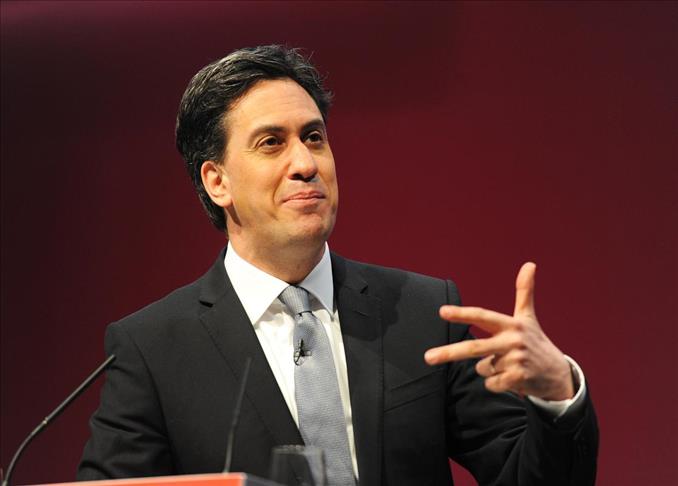
Scottish National Party leader Nicola Sturgeon repeatedly clashed with Labour Party chief Ed Milliband at the election debate on Thursday night.
Sturgeon of the left-wing separatist Scottish National Party offered to form an anti-austerity coalition with the center-left main opposition Labour Party, but Milliband wasn't having any.
“I can help Labour be bolder. We have the chance to kick David Cameron out of Downing Street. Don’t turn your back on it - people will never forgive you,” Sturgeon told a recalcitrant Miliband.
She was bluntly rebuffed. “We have profound differences. That's why I’m not going to have a coalition with the SNP. I’m not going to put at risk the unity of the United Kingdom. It’s a no, I’m afraid,” Miliband said, citing Sturgeon’s refusal to rule out another independence referendum in the next parliament as a key grievance.
“You want to gamble on getting rid of a Tory (Conservative) government. I can guarantee that we get rid of a Tory government if you vote Labour,” he told the audience.
The Scottish nationalist leader then laid down her ultimatum for any future coalition agreement.
“That’s my offer to Ed Miliband. If he’s prepared to be better than the Tories, then I am prepared to work with him to replace the Tories, which I think is what many people want to see. Don’t turn your back on that, Ed, and let David Cameron back into Downing Street.”
Sturgeon had some punch to back up her demand for a coalition.
A poll released earlier this week suggested the real possibility of electoral annihilation for Labour in its Scottish heartland.
The poll gave the SNP a 28-point lead over Labour. Just over half of Scottish voters, 52 percent, said they would vote SNP, with only 24 percent saying they would vote Labour.
The election debate brought together leaders of the five British opposition parties.
The calls for a coalition were echoed by Natalie Bennett of the left-wing environmentalist Green party and Leanne Wood of the left-wing separatist Plaid Cymru, all of whom wanted to forge a progressive alliance among the opposition parties.
But Miliband said he aimed for a Labour-majority government. Milliband has pledged to cut the deficit every year in the next parliament in an attempt to rebrand his party as one of fiscal resonsibility. Milliband issued a call, as he has repeatedly in past days, for a one-to-one debate with Conservative Prime Minister David Cameron.
Nigel Farage of the right-wing anti-EU, anti-immigrant United Kingdom Independence Party, also participated in the debate, and he accused the audience of being biased against him.
Farage found it “just astonishing” that his co-panelists would not admit the detrimental pressure immigration was having on public services and housing.
He claimed the National Health Service was spending too much money treating foreign nationals and that the “vast majority” of Britons would agree that the NHS should not be an “international health service.”
Miliband, whose party founded the NHS in 1948, responded with force. “The problem I’ve got with you Nigel is that you want to exploit people’s fears rather than address them.”
He then read out a statement purportedly made by Farage in the past, where the UKIP leader argued for replacing the NHS, which is free at the point of use, with a private health insurance system.
Furious, Farage responded, “You are lying and lying to millions and millions of people and you keep on doing it. Lying won't win you the election.”
In a truly bizarre reversal of roles, Farage had earlier heckled the audience, accusing them of extraordinary bias “even by the left-wing standards of the BBC.”
Britain’s public broadcaster is often accused of left-wing bias by the hard-right of the country’s political spectrum.
Speaking over audience boos and jeers, moderator and veteran BBC presenter David Dimbleby explained that the audience had been selected by an independent polling company, not the broadcaster, to reflect the political composition of the country.
Conservatives assail 'coalition of chaos'
Conservatives leader William Hague told the BBC News Channel, "What we saw then was that any combination would be a coalition of chaos."
Echoing the views of his party’s former coalition partner, Danny Alexander of the Liberal Democrats said centrist voters would have been “alarmed” by the debate.
"Listening to that rabble tonight, people will be very worried about the future of their country," he said, arguing that a “responsible, strong and balanced” coalition would need his party to anchor it in the center ground.
Conservatives and Liberals have governed in a coalition since 2010.
The U.K. general election will take place on 7 May, 2015.