By Karim El-Bar
ANKARA
The Conservative Party, Britain’s center-right governing party, unveiled its election manifesto Tuesday, pledging to extend the right-to-buy scheme for housing association tenants.
The party also announced plans to offer parents 30 hours per week of free childcare and legislation to ensure the minimum wage is not subject to income tax.
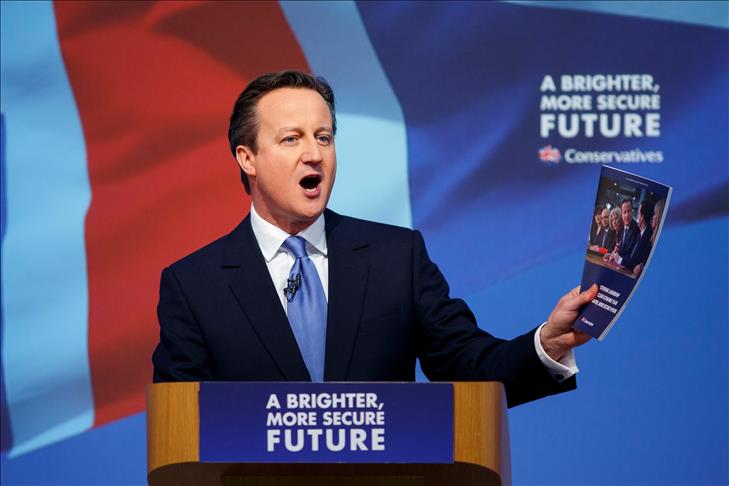
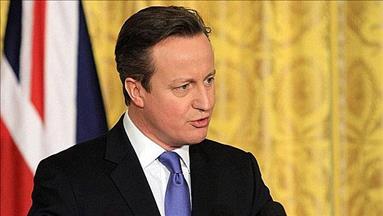
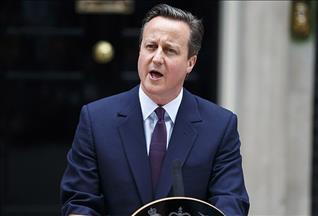
Speaking in Swindon, Conservative leader David Cameron said, "We are the party of working people, offering you security at every stage of your life."
"My message to Britain is this: we have come this far together. Let’s not waste the past five years. Now is not a time to put it all at risk, but to build on the progress we have made," he said.
In what has been thus far been derided as a dull and lifeless campaign, the Conservatives hope their policies will energize their base and the electorate.
In a speech replete with high flying rhetoric, Cameron described Britain as a "small island with a massive impact, the bright light in the North Sea that's exceeded expectations decade after decade, century after century. And we are on the brink of being that country once again."
"I didn't come into politics to be some sort of high-powered accountant and balance the books. I desperately want this to be a country where children can make the most of their God-given talents whatever their background," Cameron said, stressing that his next term would be about "turning the good news in our economy into a good life for you and your family."
Right-to-buy scheme
In a clear echo of Margaret Thatcher’s attempt to sway working class voters to their party in the 1980s, the core pledge of the 2015 Conservative manifesto is to extend the right-to-buy scheme to allow more tenants in England to buy their council homes at a discounted rate.
There are currently 2.5 million housing association homes, 1.3 million of which have tenants who have lived in their home for three years or more and would qualify for the Conservatives' pledge to buy their property at a discounted rate.
Housing associations are private, not-for-profit bodies that provide low-cost housing.
The discount will be 35 percent for a house where the tenant has been living for three years, with an extra 1 percent discount for every extra year the tenant has rented. With regards to apartments, the discount will be worth 50 percent after three years and rise by 2 percent each year afterwards.
Discounts on buying housing association property will be capped at £77,000 in England and £103,700 in London.
Councils would be forced to sell 15,000 of their most expensive homes as soon as they become vacant.
The Conservatives estimate this would raise a handsome £4.5 billion a year, totaling to £18 billion over the course of a parliamentary term of five years.
This money would be used to build a new, more affordable house for every one sold.
"That is 1.3 million extra families, a whole generation given the security of a home of their own," Cameron said. "The dream of a home-owning democracy is alive, and we will help you fulfill it."
Tax-free childcare and minimum wage
Cameron announced that the current 15 hours of universal free childcare for three and four-year-olds would be doubled to 30 hours, saving parents £5,000.
He also announced that his party will increase the income tax allowance to £12,500 by 2020.
He then pledged to go "one step further" by legislating that, as the minimum wage increases, the income tax allowance will increase as well, meaning no one working 30 hours on the minimum wage will pay income tax.
"It means we can proudly say this is the party of working people. Not just the party of low income tax, but us, the party of no income tax!" he declared.
David Maddox, political journalist for The Scotsman newspaper, tweeted, "Tories (Conservatives) to legislate that nobody on minimum wage pays income tax. Big rabbit to pull out of hat outflanks Labour and Lib Dems."
Other manifesto pledges included: increasing the inheritance tax threshold on family homes to £1 million by 2017, lifting the cap on university places, a rail fare freeze until 2020, an extra £8 billion per year investment for the NHS (National Health Service) by 2020, an EU referendum by 2017 and plans to build 200,000 starter homes.
Reaction: 'short-term political con'
Political reactions focused on the right-to-buy scheme and were mostly negative.
Emma Reynolds, shadow housing minister for the center-left main opposition Labour Party, fired the first shot.
"Having exhausted the magic money tree, the Tories now want people to believe that they can magic up billions of pounds a year from selling off a few council homes. Last year that raised just over £100m, while this policy costs £4.5bn a year. Under David Cameron, homeownership is at its lowest point for three decades -- there are over 200,000 fewer homeowners since 2010," she said.
Miliband focused on the Conservatives’ attempt at rebranding, saying, “The reality about the Conservatives is that they are the party not of working people, from first to last and always, they are the party of the richest in our society."
The centrist Liberal Democrat Party, the Conservatives’ junior coalition partner from 2010 to 2015, was scathing.
"This proposal will lead to longer waiting lists for homes and fewer social houses. It does nothing to tackle the country’s affordable housing needs and will only benefit the lucky few," Liberal Democrat election spokesman Brian Paddick said.
Danny Alexander, the Liberal Democrat chief secretary to the Treasury, told the BBC news channel: "This Tory manifesto is a short-term political con, not a long-term economic plan -- it keeps their massive cuts secret and their promises unfunded… The Conservatives are now embarking on an unfunded spending spree that would make even Gordon Brown shudder -- which can only be paid for by even more cuts."
Party leader Nick Clegg said the Conservatives lacked originality.
"I think it's a measure of how the Conservatives have run out of new ideas that on the day they publish their manifesto their big idea is a poor cover version or one of Margaret Thatcher's 1980's hits… As the housing industry have said it's not affordable and it's certainly not new," he said.
Ruth Davidson, director of policy for the National Housing Federation, said the policy is “deeply unfair.”
"While extending Right to Buy will see some people being able to buy their own home with help from the taxpayer, these are people already living in good secure homes on some of the country’s cheapest rents," she said.
Campbell Robb, chief executive of housing charity Shelter, also criticized the scheme.
"This would be yet another nail in the coffin for affordable housing. We have already seen an outright failure to replace like for like the homes sold under right to buy, with only one new affordable home built for every five sold," he said. "At a time when more and more people are struggling to find an affordable place to live, the next government’s priority has to be building more affordable homes, not selling off the few we have left."
Concerns were even raised on the right of the political spectrum.
Tim Montgomerie, Conservative activist and columnist for the Times, tweeted, "The right-to-buy policy needs a housebuilding policy alongside it -- otherwise it repeats the errors of the 1980s."
The U.K. general election will take place on May 7, 2015.