Kasım İleri, Esra Kaymak
12 December 2015•Update: 15 December 2015
WASHINGTON
The head of Britain’s defense vowed Friday to employ more aerial capabilities in the fight against Daesh, but ruled out deploying ground troops.
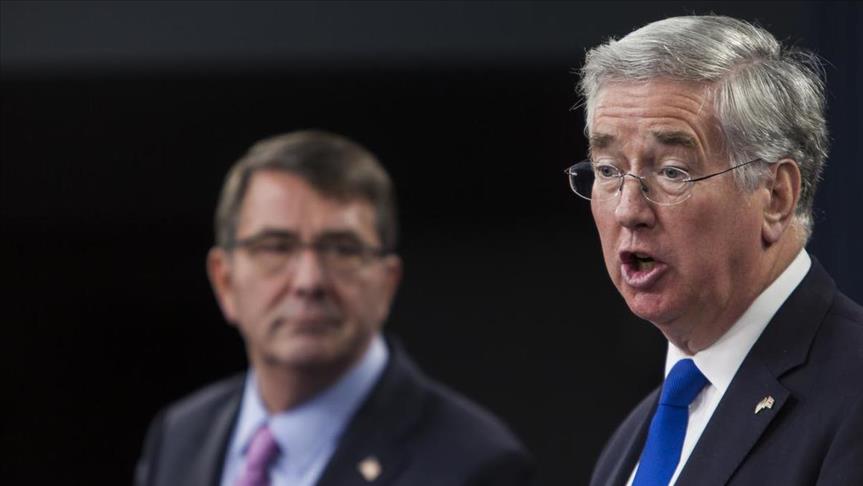
“We're not proposing to send combat troops back into Iraq or into Syria,” Michael Fallon said during a joint press conference with U.S. Defense Secretary Ash Carter at the Pentagon.
“Prime Minister Haider Abadi made it very clear to me when I was last in Baghdad that they do not want to see British troops on the ground there. And with great respect, they don't want to see American troops there,” he added.
Last week the British Parliament voted to authorize the its military to conduct airstrikes on Daesh targets in Syria.
The UK was already playing "the second biggest part against these terrorists in Iraq”, according to Fallon, by providing 60 percent of the anti-Daesh coalition's reconnaissance sorties and up to one third of the airstrikes.
“The vote last week means that we can now treat this as one theater and use our expertise against ISIS-Daesh in its heartland,” he said. “We have brought more planes to the region and we have more than doubled the number of missions that we fly by day and by night.”
He also warned that Daesh may carry out plots against the U.S. and the UK, noting that the coalition should not allow the idea of plots to hold it back from stepping up the fight against the militant group.
He said the UK has doubled its airstrikes on Daesh since last week when it targeted oil infrastructures controlled by the militant group, adding that the number of airstrikes will increase.
Carter told reporters that President Barack Obama will on Monday visit the Pentagon to discuss enhancing the fight against Daesh and measures to counter the group’s plots on American soils.
“He'll hear not only from us here in the Defense Department, his senior commanders in the field, about the military dimensions of the campaign to defeat ISIL, but also this is a National Security Council meeting,” Carter added.
He also pointed out that the U.S.’s focus will to defeat Daesh as the “parent tumor of Syria and Iraq” but he said the militant group will be pursued across the region and North Africa, especially Libya.
UK working to avoid Russia in Syria, says defense chief
The U.K. is working to avoid any miscalculations in Syria as Russian aircraft has failed to respond to air communications, Britain’s defense chief said Friday.
“We have been pressing for avoiding any miscalculation or accident,” said Michael Fallon. “Because these aircraft have not been responding to communications from the air traffic control or indeed from signals from the planes that we set up too.”
He said the U.K. has seen “a number of incursions into the British flight information region over recent months” and that the issue has come up during a discussion in Moscow on Thursday.
British aircraft in Syria acts in accord with an agreement between the U.S. and Russia that seeks to avoid accidents between aircraft operating in Syria, he added.
In September, Russia began air operations in Syria in support of Syrian President Bashar al-Assad.
The Kremlin claims the strikes are aimed at supporting the government against Daesh but NATO believes Russia is targeting groups opposed to Assad - which include those backed by a U.S.-led coalition.
Shortly after Russia began operations, the U.S. and Russia signed a Memorandum of Understanding to deconflict air activities above Syrian airspace.
Fallon said recent deadly attacks by Daesh pushed the U.K. to join the fight against the militants in Syria but that local ground forces were needed to destroy the group in Syria and Iraq -- not foreign forces.
"This will have to be done by homegrown forces, perhaps with the support of other regional pleas as well," he said.
"What is clear is that these forces can't be Western forces," he added.