BERLIN
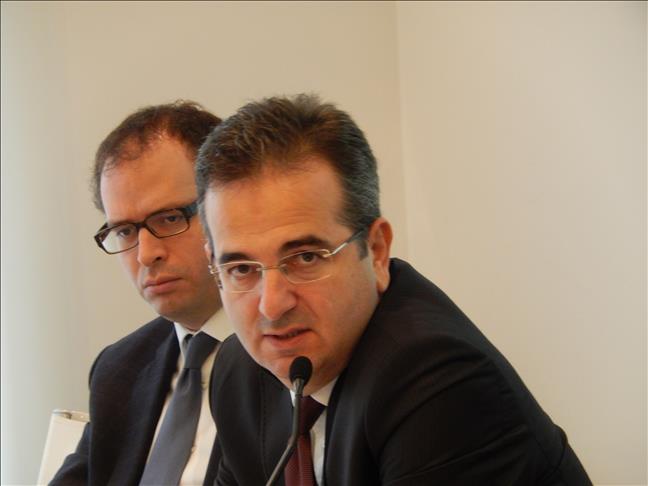
Turkey’s exclusion from the European Defense Agency is undermining closer cooperation between Turkish and European defense companies, Sedat Guldogan, deputy undersecretary of the country's Ministry of National Defense Industries said Wednesday.
“Turkey’s defense expenditures make up almost 10 percent of Europe's total defense expenditures, but cooperation between Turkish and European defense companies is way behind,” Guldogan said at a panel discussion at the 13th Berlin Security Conference, also known as the Congress on European Security and Defense.
Turkey's defense industry achieved high growth rates in recent years, with more than $5 billion in 2013, including $1.5 billion in exports.
Exports to the U.S. reached $680 million in 2013 and $336 million to EU member countries.
“European defense industry companies have not been successful in the Turkish defense market in the last 10 years," Guldogan said. "There are no major programs apart from conventional business.”
Guldogan also said that Turkey’s inclusion in the planning work and programs of the European Defense Agency would create opportunities both for European and Turkish defense companies.
Integration with Europe, priority for Turkey
Muharrem Dortkasli, president and CEO of Turkish Aerospace Industries, said Turkish defense companies see significant benefits in closer cooperation with their European partners.
“Integration with Europe is a priority for Turkey that we have been following for the last 60 years,” Dortkasli said at a panel discussion at the Berlin Security Conference. "The main policy has not changed. Governments and industries need to work together to increase the current level of partnership.”
Turkey’s cooperation with the European Defense Agency, the main body supporting cooperative defense projects and programs of the EU member states was blocked by the Greek Cypriot Administration in 2005.
Turkey started membership negotiations with the EU in 2005, but it disputes EU member Greek Cypriot Administration's claim to represent the whole island. Ankara officially recognizes the Turkish Republic of Northern Cyprus as the only legitimate government.
The island of Cyprus has remained divided into Greek and Turkish zones since 1974 when a Greek Cypriot coup was followed by Turkey’s peace mission to aid Turkish Cypriots in the north.
Germany seeks cooperation
Dirk Grabowski, division head at the German Federal Ministry for Economic Affairs and Energy, said development of Turkey's defense and security industry has been impressive.
"Turkey is an important market, one of the biggest markets worldwide and it is a market with an enormous growth potential," Grabowski said, adding that the German firms look forward to cooperating with their Turkish counterparts.
Peter Scaruppe, Director of Acquisition at the NATO Communications and Information Agency, said the alliance's recent program will present new opportunities for cooperation between the firms.
"Turkey is a key NATO ally and its defense industry is very capable," Scaruppe said. "NATO's two initiatives, Industry-Cyber Partnership and Small Medium Enterprises will help stimulate industrial cooperation Turkish defense and security industry can benefit greatly from the enhanced cooperation across the alliance."
Turkish army managing over 600 modernization projects
The Turkish Armed Forces are managing more than 600 modernization projects to address the challenges of the world’s new security environment, Lt. General Alpaslan Erdogan, chief of Plans and Policy Division of the Turkish General Staff, announced Wednesday.
"The Turkish Armed Forces are determined to improve their shortfalls and conduct effective defense planning that would ensure continuous transformation in order to adapt to the new security environment,” Lt. General Erdogan said at the c Berlin Security Conference.

He underlined that in addition to the modernization projects, recent military procurements and projects will help the Turkish Armed Forces to fill its capability gaps and to utilize its existing capabilities effectively.
These projects include ballistic missile defense, strategic airlift, intelligence, surveillance and reconnaissance.
Lt. General Erdogan criticized several NATO allies for drastically cutting military spending in recent years and for failing to see the need for improving military capabilities to address new challenges.
“Latest developments have proven that it was not a prudent approach of the new allies and some others to make drastic reductions in their defense expenditure,” Erdogan said.
He noted that developments in Ukraine, Syria and Iraq have shown the changed characteristics of the recent conflicts and the new nature of the security environment.
“The main elements of the new security environment can be expressed as change, uncertainty and complexity. Emerging risks and threats have the potential to affect global and regional peace and security in the long term,” the Lt. general said.
He underlined that Turkey has been among the countries that are mainly affected by the new security environment.
“It is easy to understand the need for a strong armed forces in this critical region where Turkey is located,” he said.
Turkey was the partner country of the two-day Berlin Security Conference, which ended Wednesday night.
The conference, one of the most prominent forums on European security and defense, brought together around 1,000 participants from more than 50 countries.

contact_the_ombudsman
is_there_an_error_in_this_story