By Jim Pollard
BANGKOK
The Thai government on Tuesday lifted a two-month old state of emergency imposed in Bangkok and surrounding provinces at its weekly Cabinet meeting.
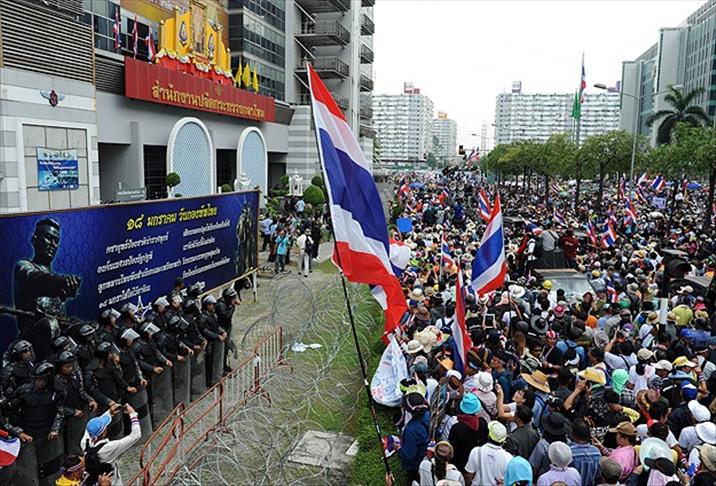
Prime Minister Yingluck Shinawatra's caretaker administration has been under pressure to lift the emergency law since anti-government protesters abandoned a blockade of key intersections in the capital – known as the "Bangkok Shutdown" – two weeks ago.
The decree was imposed January 22 to help contain protests in the lead-up to a snap election called February 2, which was marred by protests – mainly in Bangkok and the south – that have prevented a new government from being formed.
The emergency law will be replaced by an imposition of the Internal Security Act, as anti-government protesters are still massed at Lumpini Park in the city center.
Deputy Prime Minister Surapong Tovichakchaikul, who has also overseen the Centre for Maintaining Peace and Order, foreshadowed the move on Monday, saying he would ask the Army to remove bunkers it has set up on roads in the Thai capital.
Outgoing National Security Council chief Paradorn Pattanabut said prior to the meeting that the Internal Security Act would be imposed from tomorrow till April 30.
At least 20 people have been killed and over 700 injured since the end of November in clashes between anti-government groups, police and supporters of the prime minister.
Minor incidents of violence have continued to occur in recent weeks, although these have mainly been “symbolic” grenade attacks at courts and independent agencies – seen as opponents of the Shinawatra administration – and the firing of grenades at the 5,000 or so anti-government People’s Democratic Reform Committee protesters that continue to gather in Lumpini Park.
Business and tourism industry chiefs, many of whom opposed the emergency decree, were expected to welcome the news, given it should boost the tourists' confidence in the country.
Thai courts are expected to play a key role in ending the country’s long-running political divide. The Constitutional Court has been asked by several groups to annul the February 2 election, which failed to achieve a quorum – 95 percent of MPs from 500 constituencies – to form a new Parliament.
Further pressure on the government comes from the National Anti-Corruption Commission (NACC) who informed the premier in January that it is considering charging her with negligence over her failure to stop huge losses by a controversial rice price-pledging scheme, which was allegedly riddled with graft and marred by “fake” government-to-government sales.
The PM’s lawyers were last week given an additional 15 days to respond to the NACC accusations.
However, even if Shinawatra is indicted by the anti-graft body and has to step down, senior party ministers have indicated they will step up to take her place.
Deputy PM Surapong said Tuesday morning that he and other top ministers were ready to take over if Shinawatra was forced to step aside.
The latest public survey, announced by Dusit Poll on Saturday, has suggested that most Thais – 54 per cent of about 1,500 people questioned last week – now feel the prime minister should quit and take responsibility for the crisis that has brought the country to an unprecedented impasse.
Shinawatra is facing a wave of opposition protests after her government pushed through an amnesty that would have lifted a conviction against her brother, Thaksin – a deeply divisive figure in Thai politics - whose Thai Rak Thai (Thai love Thai) party led the country from 2001 to 2006 until he was overthrown in a coup and then found guilty of abuse of power.
Confronted by massive protests, the government withdrew the bill, but the opposition has alleged massive corruption by the government and Shinawatra family.
Yingluck dissolved parliament December 9 and called February 2 elections, which were disrupted by protesters who want an unelected “people’s council” to run Thailand until the political system is reformed in a way which would limit the influence of elected governments and increase the power of independent agencies appointed by magistrates.
englishnews@aa.com.tr