LAGOS
Christian politicians and community activists in Lagos, Nigeria's commercial capital, are demanding that the governorship of the rich city state go to a Christian candidate in 2015 elections – a demand received with caution by the state's powerbrokers.
"We are not asking for anything impossible," Apostle Alexander Bamgbola, spokesman for the Pentecostal Fellowship of Nigeria (PFN), an amalgam of Pentecostal churches nationwide, told Anadolu Agency.
"All we ask for is fair play and justice. Let one of us be governor too," he added.
Lagos, Nigeria's non-oil-producing – but richest – city, has been under the opposition All Progressives Congress (APC), formerly the Action Congress of Nigeria, since the country returned to democracy in 1999.
Since then, it has had only Muslim governors, although cabinet members are often carefully drawn from across the country's ethno-religious mosaic.
No authoritative data exists about the state's Muslim-Christian population sizes, owing largely to the fact that Nigeria did not include religion and ethnicity as criteria in previous population censuses.
However, history, culture and traditional title holdings suggest that Muslims were the earliest settlers and aristocrats who formed the core of the traditional ruling elite.
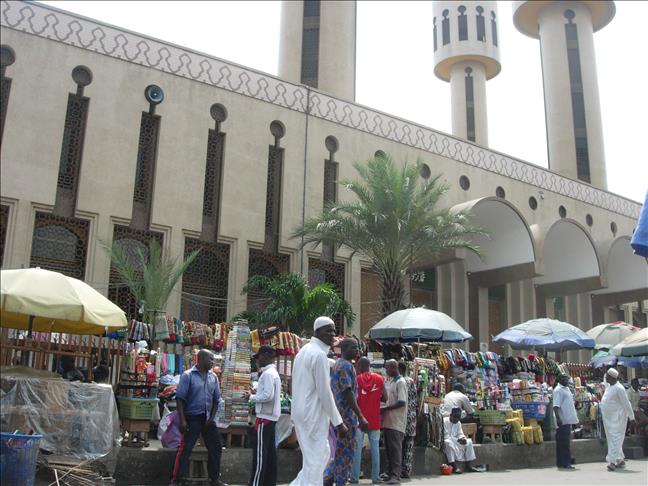
Lagos' redesigned central mosque is a short distance from the palace of the Lagos monarch, a longstanding symbol of the inseparability of the state and Islam.
More than two-thirds of the city's traditional chiefs and top politicians are Muslims.
But Christians, who also constitute a large percentage of the populous state, believe that justice dictates that the governorship be conceded to them.
"It is only fair and just that, in line with God's will, we all come together as stakeholders to elect a bona fide Christian of integrity who will take over the mantle of ruler-ship from Babatunde Raji Fashola in 2015," said Bamgbola.
In 2007, Fashola, a Muslim, succeeded Bola Tinubu, another Muslim governor who had served two four-year terms in office.
Celebrate diversity
Rev. Sam Ogedengbe, a senior aide to the state governor on Christian affairs, hopes political parties will field a Christian candidate in the 2015 electoral race.
He believes it is only fair to allow a member of the Christian faith to govern the state.
"While we are not in any way promoting politics of mediocrity, it would not be out of place if the political parties field a Christian candidate," Ogedengbe told AA.
"That would be a way of respecting the diversity of our community," he added.
Ogedengbe is the national president of the All Christian Leaders/Ministers Forum, one of the lobby groups pushing for a Christian governor of Lagos in 2015.
PFN spokesman Bamgbola threatened a protest vote against the ruling APC if it refused to field a Christian as its candidate for the governorship.
"If the ruling party in the state decides to field a Muslim candidate, there are other parties that will field Christians," he said.
"What we are saying is that we are going to vote for a Christian. Let it be known," he added. "The church will vote for a Christian in the next election."
Merit-based
The ruling APC, meanwhile, has been keeping quiet on the Christian governor campaign.
However, officials who spoke to AA on condition of anonymity since the party has opted not to make any official comment on the issue said the request was genuine "only if weighed against the complexities of our society."
"The Christian Association of Nigeria has written to the party leadership to make this demand before and our position is that religion does not influence our choice of candidate," insisted an APC chieftain who asked not to be named.
"If we truly had a religious agenda, you wouldn't see Muslims condemning the government for banning the hijab [Muslim headscarf for women] in public schools," he added.
Cardinal James Odumbaku, APC deputy chairman in the state, urged people not to base their choice of leaders on religion, because such sentiments could lead to further polarization.
"The choice of our candidate is determined by competence and ability to mobilize the people for development. Nothing more," he told AA, stressing that his comments only represented his personal view.
"But there is nothing bad about any group of people expressing their desire. This is a democracy where everyone is allowed a say," he added.
Civil rights activist Joe Okei-Odumakin, for her part, warns that basing the choice of leader on religion could be disastrous.
"One major crisis we have as a people is this appeal to primordial sentiment," she told AA. "I don't care who governs any state. What I care about is the quality of governance."
Okei-Odumakin added: "Poverty and death from curable diseases do not discriminate between Christian and Muslim – so why should I bother myself about it?"
By Rafiu Ajakaye – Anadolu Agency
englishnews@aa.com.tr