NEW DELHI
Defying sweltering heat, millions of voters came out to vote in the third phase of India’s national election on Thursday, with 91 seats being contested after two earlier phases in the country’s northeast.
“This election, I have voted for change,” Nazia Erum, a Delhi-based media consultant told The Anadolu Agency.
“I want clean and educated politics”, Erum said.
Erum, young mother of a two-month-old daughter, took the baby along in the scorching heat of Delhi.
“Nothing should stop one from voting,” she said adding that one of her cousins cancelled a beach holiday to remain in the capital and vote.
More than 5 million of a total of 10 million voters thronged to polling booths in Delhi where there is a contest between popular anti-corruption party Aam Aadmi Party (AAP), Hindu nationalist Bharatiya Janata Party (BJP) and the ruling Congress party for the seven parliamentary seats.
Young and enthusiastic voters flooded social media websites like Facebook and Twitter flaunting their inked fingers – the indelible ink mark that shows one has voted. Political analysts term this trend an empowerment of India’s vibrant democracy.
Prominent early voters in India’s national capital include Congress party Chief Sonia Gandhi, Vice-President Hamid Ansari, Arvind Kejriwal of AAP and Congress Vice-President Rahul Gandhi.
The voting began at 7 a.m. and was scheduled to continue till 6 p.m. The one-hour extension was initiated by India’s Election Commission to encourage voters.
Ajay Maken, senior Congress party leader and one of the contestants in Delhi, told reporters after voting that he would retain his seat and his party would regain the Delhi’s lost vote which went to AAP in the assembly election of December 2013.
In Western state of Maharashtra, the average voter turnout was 40% in 10 constituencies while Bihar and Uttar Pradesh in North India recorded sluggish voter turnout as of 3 pm.
The complete picture of voting percentage would emerge later after election commission releases the voting data.
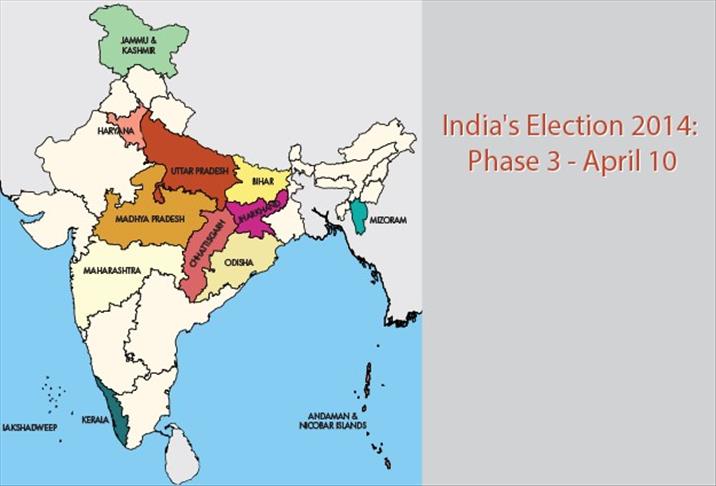
The third phase involves the length and breadth of India – from the Indian-held Jammu & Kashmir state in the north to Kerala in the south.
Key states include Uttar Pradesh – the state which elects the most lawmakers – and Bihar in north India and Maharashtra in the west.
The other five states include Chhattisgarh and Madhya Pradesh in central India, Haryana and Jharkhand in the north and Odisha in the south.
Out of the total 543 seats, 104 constituencies have gone to polls till Thursday.
In the third phase of the parliamentary election, one constituency of Indian-held Jammu & Kashmir, six constituencies of Bihar, one constituency of Chhattisgarh, ten constituencies of Haryana, four constituencies of Jharkhand, twenty constituencies of Kerala, nine constituencies of Madhya Pradesh, ten constituencies of Maharashtra, ten constituencies of Odisha and ten constituencies of Uttar Pradesh went to polls Thursday.
Four federal territories, which collectively elect 10 lawmakers, also went to polls Thursday.
The opposition Bharatiya Janata Party (BJP) is trying its best to wrest control of the federal government, riding on the “popularity wave” of its Hindu icon Narendra Modi, the controversial politician and three-time chief minister of the western state of Gujarat.
The ruling Congress party-led coalition, the United Progressive Alliance – which has ruled India since 2004 – has come in for sharp criticism and public scrutiny for a series of corruption scandals, policy paralysis and the dwindling economy.
Apart from the two principal parties, a number of state-based regional parties are in the fray for Lok Sabha or House of People, the lower house of the Indian parliament.
This is the first national election in which India’s voters have the right to reject candidates by pressing a NOTA -- None of the Above -- button, a reform being initiated as a result of a Supreme Court ruling last year.
The hotly contested election is being fought in nine phases from April 7 to May 12 around the key issues of corruption, inflation, unemployment, anti-incumbency and secularism.
The results will be announced on May 16.
About 815 million registered voters are expected to cast their ballots, an increase of 100 million new voters compared with the 2009 election.
According to opinion polls, the BJP, which has been in opposition for the past two terms, is expected to form the next federal government after defeating Congress, which has been in power since 2004.
englishnews@aa.com.tr