04 December 2015•Update: 07 December 2015
BERLIN
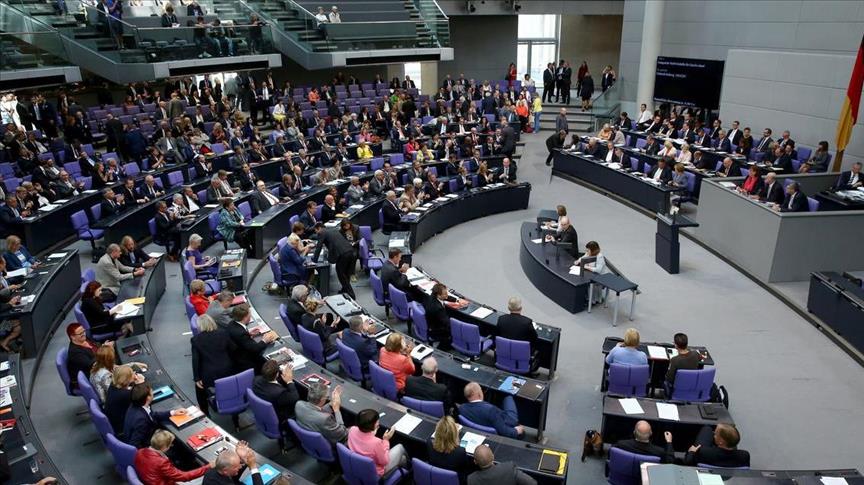
Germany’s parliament has approved the deployment of surveillance jets, a tanker aircraft and a warship to the Middle East, to support the international coalition against Daesh.
The vote cleared the way for more active support for the anti-Daesh coalition, but the mission does not envisage a combat role for German troops.
Friday’s vote comes a day after the U.K. parliament voted to back British air strikes against Daesh targets in Syria.
Some 445 German lawmakers, mostly from Chancellor Angela Merkel’s Christian Democratic bloc (CDU/CSU), and its coalition partner Social Democrats (SPD), voted in favor of the mission.
One-hundred-and-forty-five German lawmakers voted against, seven lawmakers abstained.
Norbert Rottgen, a senior lawmaker from the CDU/CSU group, defended the government’s move, arguing that the Nov. 13 Paris attacks showed that European countries should assume more responsibility for security and addressing international conflicts.
“For decades, we Europeans have left the Middle East region to the U.S. For years we have left these regions alone,” Rottgen said, criticizing a purported lack of European engagement towards the region.
“The terror of ISIL [Daesh], [President] Assad’s bombing of his own people by barrel bombs, Russia’s military intervention and the death of hundreds of thousands of people have been the consequences,” Rottgen said.
The socialist Left Party, which has 64 MPs, opposed the motion arguing that the German government was dragging the country into a dangerous war with incalculable conclusions.
“It’s a lie that this deployment will weaken ISIL,” Sahra Wagenknecht, The Left’s parliamentary group leader said before the vote.
“War makes things much worse. You cannot fight ISIL like that; you will only make it stronger,” she claimed.
The Left called for stronger measures to cut financial and logistic support for Daesh.
Most of the opposition Green Party also voted against the motion.
Germany is to deploy up to six Tornado surveillance jets, a tanker aircraft and a warship in the region.
The warship will provide protection for the French aircraft carrier Charles de Gaulle in the Mediterranean, which France uses in airstrikes against Daesh targets in Syria and Iraq.
The motion allows the German government to deploy up to 1,200 soldiers as part of the mission.
This mandate ends on Dec. 31, 2016, with the possibility of further extension.
The mission is expected to cost around €134 million ($142 million).
So far, Germany has refrained from an active military role in airstrikes against Daesh but focused on equipping and training Kurdish peshmerga forces in northern Iraq, which have recently cleared several areas of Daesh in Iraq, including the town of Sinjar near Mosul.
Germany’s more active military role against Daesh also follows a more active foreign policy advocated by Merkel’s coalition government, stressing Germany's responsibility for international peace and stability.
The German army, or Bundeswehr, currently has around 3,000 soldiers stationed abroad, for international peace and stability operations.
Around 850 German soldiers are currently taking part in the NATO-led Resolute Support mission in Afghanistan, and around 110 German soldiers are supporting the UN Interim Force in Lebanon, or UNIFIL, in Lebanon.