Anadolu Ajansı © 2026


By Karim El-Bar
ANKARA
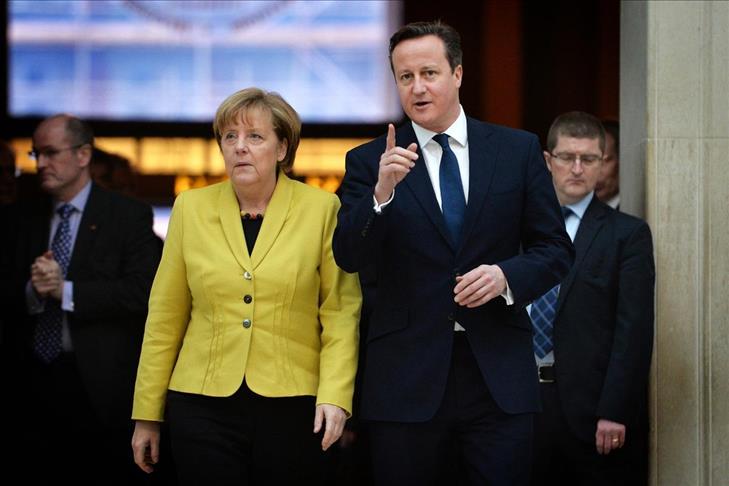
British Prime Minister David Cameron visited German Chancellor Angela Merkel Friday to end his two-day tour of European leaders to renegotiate the terms of the U.K.’s membership in the EU.
Merkel said the U.K. should clearly stay in the EU and would work constructively with Britain as it renegotiates the terms of its membership.
She said that while there was common ground in many areas, there were principles such as the free movement of people which were “red lines” for other European countries.
"Where there is a will, there is a way," Merkel told the press after meeting with Cameron, indicating that she wanted to accommodate the U.K.'s demands as far as possible.
"Europe has proved this," she said. "Everyone knows how hard it can be to change a treaty."
Cameron met with Dutch premier Mark Rutte and French President Francois Hollande on Thursday before visiting Polish premier Ewa Kopacz Friday morning.
Rutte backed plans to devolve power to national parliaments, saying: “European where necessary; national where possible.”
Cameron’s reforms were less warmly received by France and Poland.
“I find this process quite dangerous,” French Foreign Minister Laurent Fabius told a French radio station before Cameron’s visit to Paris on Thursday. “One can’t join a football club and decide in the middle of the match we are now going to play rugby.”
Speaking to the BBC on Friday, Polish Minister for European Affairs Rafal Trzaskowski said: "If every country comes with a shopping list to change European Union policies, that will be the end of the European construction, it will simply implode."
- German business ‘astonished’ at Britain's EU referendum
Cameron’s center-right Conservative Party has pledged to hold an in-out EU referendum by 2017, giving the British premier time to renegotiate the terms of the U.K.’s membership in the 28-nation bloc.
The vote will be the first referendum on Britain’s membership in the EU since 1975, with the yes option being to stay inside the EU.
“If we are not able to deliver on those big areas of concern that the British people have, we will not win the referendum,” British Foreign Secretary Phillip Hammond told BBC Radio 4 on Thursday. “We expect our European Union partners to engage with us in delivering a package that will enable the British people to decide that they think Britain's future is best delivered inside the European Union.”
While Cameron has urged his fellow European leaders to be “flexible and imaginative,” one of Germany’s most senior businessmen said Europe should refuse to negotiate with him.
Volker Treier, deputy chief executive of Germany’s chamber of commerce and industry, told the BBC that the German business world was “astonished” the U.K. was holding a referendum.
"Our recommendation is not to deal (with Britain) under such circumstances,” he said.
Treier’s strong words will be unwelcome in Downing Street, as Cameron is likely to need the support of Europe’s largest economy to push his reforms through.
Merkel is a staunch supporter of the free movement of people principle, but has also said she wants the U.K. to stay in a “strong and successful Europe.”
- "Red line" for Poland
Cameron’s core aim is to force EU migrants working in the U.K. to wait four years before claiming social benefits and banning unemployed EU migrants from claiming benefits outright.
These reforms will face fierce opposition from newly elected Polish president Andrzej Duda, who hails from the nationalist Law and Justice Party, which describes itself as Poland's patriotic party.
Britain currently hosts 800,000 Polish migrants and with Polish parliamentary elections coming up this year, compromise will be hard to come by in the eastern European state.
“I do understand that British society would want to counter some of the benefit abusers,” George Byczynski of the British Poles Initiative told BBC Radio 4 on Friday. “But with regards to people who want to work, want to provide for their families, I think that it is important to make them feel welcome and equal.”
Polish Minister for European Affairs Rafal Trzaskowski told the BBC: "As far as treaty changes are concerned or the introduction of discriminatory measures, that would be a red line for Poland."
A No 10 spokesman, commenting on Cameron’s meeting with his Polish counterpart, said, "On immigration and welfare, Prime Minister Kopacz welcomed the prime minister's commitment to respect the principle of free movement."
"They agreed that there were issues concerning the interaction between free movement and national welfare systems that should be discussed further," the spokesman said.
- French FM: "The answer is no"
Cameron is also pushing for an opt-out from the “ever closer union” commitment.
France and Germany, the two most influential EU powers, however, agreed to an integration pact Tuesday, according to French daily, Le Monde.
The newspaper said the proposal “shows that French and German leaders do not have much in common with David Cameron.”
The deal calls for closer political integration among Eurozone member states within the current treaty framework.
It comes as a blow to Cameron as many British Eurosceptics have cast doubt as to whether fundamental reform can be achieved without treaty change.
France and Germany will put their proposal to an EU summit on June 25, where it is expected to pass and, in turn, shut the door on reforming the Lisbon treaty, the basis of the EU’s constitutional order.
This poses difficulties for restrictions on EU migrants claiming benefits, for example, which would require treaty change according to “the best legal advice that we are receiving,” Hammond said.
Cameron may push for a legally binding protocol instead, according to the liberal-left Guardian newspaper. This protocol could be attached to a future revision of the Lisbon treaty.
The British premier is also seeking greater powers for national parliaments to block legislative proposals and prevent Eurozone members from forcing changes to the single market on non-Eurozone EU members such as the U.K.
While Hollande said “France wants Great Britain to stay in the European Union” after his meeting with Cameron, his foreign minister was more forthright.
“If it is about giving a special status to Britain that gives it advantages for nothing, then the answer is no,” Fabius said.
news_share_descriptionsubscription_contact

contact_the_ombudsman
is_there_an_error_in_this_story