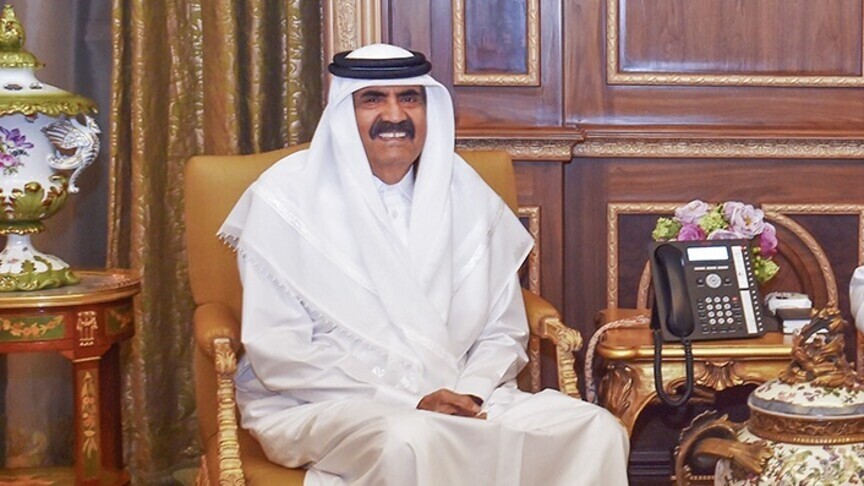
Former Qatari Emir Sheikh Hamad bin Khalifa Al Thani died on Sunday at the age of 74, leaving behind an 18-year reign that, according to official accounts, marked the beginning of Qatar's modern transformation.
"With hearts that believe in God's will and decree, the Amiri Diwan mourns the passing of the nation's esteemed leader, His Highness the Father Amir Sheikh Hamad bin Khalifa Al Thani, who passed away this morning," the Qatari Amiri Diwan said in a statement.
According to the diwan, Sheikh Hamad led through a period laying the foundations of modern Qatar, overseeing sweeping economic, social and cultural reforms that raised the country's profile on the regional and global stage.
During his rule, Qatar's GDP grew more than 24-fold, while GDP per capita increased nearly sixfold.
The value added by Qatar's hydrocarbon sector increased from about $3 billion to over $110 billion, according to official figures.
His tenure also saw the adoption of Qatar's permanent constitution and the launch of the Qatar National Vision 2030, a long-term strategy aimed at transforming the country into a knowledge-based economy and achieving sustainable development.
Early life, military career
Sheikh Hamad was born in Doha in January 1952. After completing his education in Qatar, he attended the Royal Military Academy Sandhurst in the UK, graduating in 1971.
Upon returning home, he joined the armed forces, rising through the ranks to become a lieutenant general.
According to the officials, he played a key role in modernizing Qatar's military.
On May 31, 1977, he was appointed crown prince and defense minister.
In May 1989, he became chairman of the Supreme Planning Council, responsible for shaping the country's economic and social policies.
Accession to power
Sheikh Hamad assumed power on June 27, 1995, launching a broad program of political, economic and social reforms that transformed multiple sectors, according to the Amiri Diwan.
His rule saw major advances in education, healthcare, sports, culture, media and infrastructure, alongside rapid growth in the economy and energy sector.
Following the start of liquefied natural gas exports from the North Field in 1996, state revenues increased sharply.
By 2006, Qatar had become the world's largest exporter of liquefied natural gas, with annual production capacity reaching 77 million tonnes by 2010.
In October 2001, he established the Supreme Council for Economic Affairs and Investment, which he chaired, overseeing economic, energy and investment policies aimed at diversifying domestic and international investments and expanding the country's sources of income.
One of his first major initiatives after taking office was the establishment of the Qatar Foundation for Education, Science and Community Development in August 1995 to promote scientific and cultural advancement.
His government lifted press censorship in October 1995 and abolished the Ministry of Information in 1998, measures it said expanded freedom of expression and encouraged media development, the diwan said.
Al Jazeera was also launched in 1996 during his rule.
Political, international milestones
In 1996, Qatar began introducing democratic reforms under Sheikh Hamad's leadership, holding its first Chamber of Commerce elections that year, followed by the country's first municipal elections in 1999, in which women were allowed to vote and stand for office for the first time.
Qatar's first permanent constitution came into force on June 8, 2004, following a national referendum in April 2003. According to official accounts, it established the people as the source of state authority, strengthened the separation of powers and guaranteed fundamental rights and freedoms.
During his reign, Qatar also expanded its economic, cultural and diplomatic presence, becoming a host for major international political, economic, cultural and scientific conferences.
The country's diplomacy played an active role in mediating regional and international conflicts.
The Amiri Diwan said Sheikh Hamad's investment strategy helped Qatar become the first Arab and Muslim country to win the right to host the FIFA World Cup, awarded in December 2010 for the 2022 tournament.
The late emir received numerous honors from Arab and foreign countries in recognition of his efforts to strengthen bilateral relations and international cooperation.
On June 25, 2013, Sheikh Hamad bin Khalifa Al Thani announced the transfer of power to his Crown Prince, Emir Sheikh Tamim bin Hamad Al Thani, the country's current emir.