Mohammad Sio
05 August 2026•Update: 05 August 2026
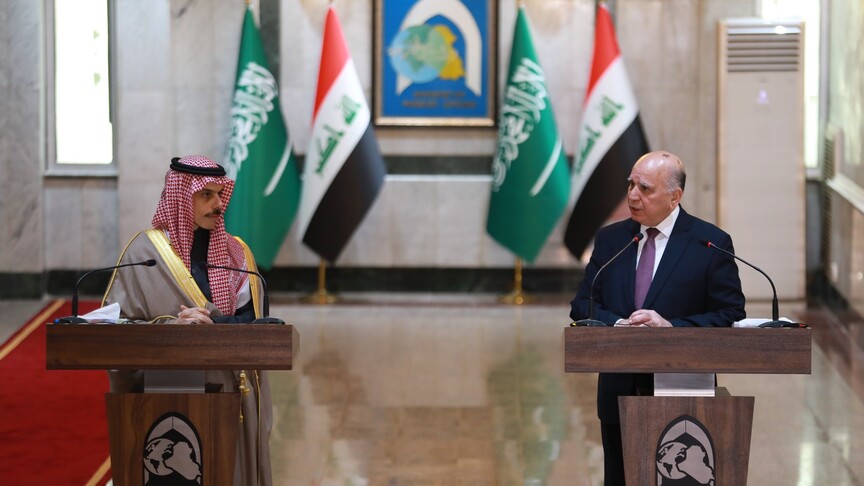
Iraqi Foreign Minister Fuad Hussein and his Saudi counterpart Prince Faisal bin Farhan discussed preparations Wednesday for upcoming visits by an Iraqi security delegation and Prime Minister Ali Al-Zaidi's visit to the kingdom, one week after joint US-Saudi airstrikes targeted Iranian-aligned groups in Iraq.
The talks took place on the sidelines of a ministerial meeting on Jerusalem in the Jordanian capital Amman, according to a statement from Iraq's Foreign Ministry carried by the Iraqi News Agency (INA).
The two foreign ministers reviewed arrangements for the security delegation's visit and discussed reciprocal visits at various levels aimed at strengthening bilateral cooperation and coordination.
Hussein later posted details of the meeting on the US social media company X, saying the discussions also covered preparations for Al-Zaidi's planned visit to Saudi Arabia, without specifying a date.
The trip would be Zaidi's first visit to the kingdom since taking office as Iraq's premier in May.
Last week, Iraqi media reported that Zaidi had been expected to visit Saudi Arabia but that the trip was delayed amid tensions following attacks that Riyadh said had originated from Iraqi territory. Neither Baghdad nor Riyadh officially commented on those reports.
The meeting between Hussein and Prince Faisal came a week after US and Saudi forces carried out overnight precision strikes on targets linked to Iranian-aligned groups in Iraq. US Central Command said the operation targeted sites connected to attacks on US forces and Saudi energy infrastructure.
Saudi Arabia said it would take further military action if Iranian-backed groups launch additional attacks.
Regional security developments
The Popular Mobilization Forces (PMF), a predominantly Iranian-backed coalition of Shiite armed groups, said the strikes hit several of its headquarters, killing at least 20 members, wounding 32 others, and causing extensive damage.
On Saturday, Iraqi Prime Minister and Armed Forces Commander-in-Chief Ali al-Zaidi stressed the need to prevent “any violation or threat” originating from Iraqi territory against neighboring countries, directing authorities to establish deterrent measures to prevent similar incidents from recurring.
Hussein also outlined the Iraqi government's policy aimed at placing all weapons under state control, while Prince Faisal reiterated Saudi support for Iraq's new government and its efforts to enhance the country's security and preserve regional stability.
The Iraqi government has sought to consolidate all weapons under state control and strengthen the authority of the country's security institutions as part of broader efforts to reinforce internal stability and shield Iraq from the repercussions of regional tensions.
The two foreign ministers also discussed regional security developments and their impact on oil export routes and energy supplies, as well as regional efforts aimed at reopening the Strait of Hormuz to maritime traffic.
On June 18, Washington and Tehran signed a framework agreement and launched negotiations toward a final deal before the talks stalled over disagreements on guarantees for security and freedom of navigation through the Strait of Hormuz.
Last month, tensions escalated again as the US carried out strikes inside Iran, while Tehran responded by targeting what it described as US military facilities and equipment in several Arab countries, particularly Jordan, Bahrain, and Kuwait.