- 'Oil built the Gulf. Desalinated water keeps it alive,' says Shafiqul Islam, director of the Water Diplomacy Program at Tufts University
- Strike on desalination or power systems could halt daily life within hours ANKARA
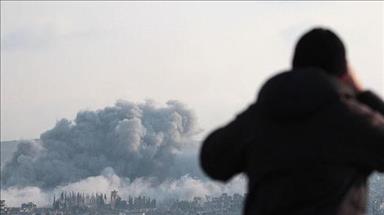
As the US-Israel war on Iran escalates, the region’s dependence on desalination is emerging as a critical vulnerability, with a strike on a major plant capable of halting daily life within hours.
Across the Gulf, entire cities rely on desalination to supply drinking water, with some countries sourcing up to 90% of their potable water from these systems in one of the world’s most water-scarce regions.
The risk is growing.
On March 23, Iran’s semi-official Fars News Agency circulated images of 11 key energy and desalination facilities across Gulf countries and Jordan, signaling they could be potential targets if the conflict escalates.
On Monday, US President Donald Trump warned that US strikes could extend to critical infrastructure.
“If for any reason a deal is not shortly reached … we will conclude our lovely ‘stay’ in Iran by blowing up and completely obliterating all of their Electric Generating Plants, Oil Wells and Kharg Island (and possibly all desalination plants!),” he posted on Truth Social.
“Oil built the Gulf. Desalinated water keeps it alive,” Shafiqul Islam, director of the Water Diplomacy Program at Tufts University in the US, told Anadolu.
Islam added that these desalination plants also depend on power stations, high-voltage grids and coastal intakes that are all vulnerable to attack or cyber operations.
“In the Gulf, you can essentially cut the water by cutting the power,” he said.
Examples from Iraq, Syria and Gaza have shown that the collapse of a country’s water infrastructure can quickly become a serious security threat, directly leading to deaths and the spread of infectious diseases.
“That is why escalating US and Israeli strikes on Iran, and Iran’s retaliatory options, pose serious risks not only to energy markets but also to the basic water supplies of millions of people in the Middle East,” he added.
Gulf countries heavily reliant on desalination
There are more than 400 desalination plants along the Gulf coast, supplying drinking water, agriculture and industry.
Gulf countries produced around 7.2 billion cubic meters of freshwater through desalination in 2023, according to the GCC Statistical Center. Saudi Arabia was the top producer, followed by the UAE, Kuwait, Qatar, Oman and Bahrain.
Islam said the region has extremely limited natural water resources, with per capita annual water availability at around 100 cubic meters, well below the UN threshold for “absolute water scarcity.”
To close this gap, Gulf states have built systems heavily dependent on desalination, with these plants accounting for roughly 40% of global desalinated water production.
“Desalination has solved the water problem in peacetime; but it has created a new vulnerability in wartime,” Islam said.
In many Gulf countries, desalination accounts for more than half of total water use and around 90% of drinking water, making daily life highly dependent on these coastal facilities.
“You can live without oil. You cannot live without water for more than a few days. Oil can be substituted but water can’t be substituted. This is no longer just an energy story. It is now a water security story,” he stressed.
‘Effects of an attack felt within hours’
Islam warned that the consequences of an attack would be immediate.
“In the Gulf, a successful strike on major desalination plants would be felt within hours, not weeks,” he said. “Many systems only store one to two days of treated water.”
Within the first 24 to 72 hours, water pressure would drop and panic buying of bottled water would likely begin, he said.
Hospitals would impose emergency water restrictions, affecting surgeries, dialysis and infection control.
Islam warned that such disruptions could quickly escalate into a public health crisis.
“Experience from Gaza and Syria shows that when water and sanitation systems collapse, infectious diseases surge,” he said. “Gaza recorded around 700,000 cases of infectious
diseases in shelters by January 2024, largely driven by unsafe water and overcrowding.”
“In a highly urbanized, desalination-dependent Gulf city, the combination of heat, density and limited alternatives could make such a scenario even more explosive,” he added.
‘Targeting desalination plants is a war crime’
Islam stressed that international humanitarian law is clear: drinking water infrastructure is indispensable for civilian survival and must not be targeted.
He said deliberately or disproportionately striking such facilities could constitute a war crime, but warned that enforcement remains weak.
The problem, he said, “is not the absence of rules, but the gap between law and practice.”
“Instead of only bombing military units, belligerents go after power grids, water plants, hospitals and digital networks that keep cities functioning,” he added.
He noted that water infrastructure in Syria, Gaza and Yemen has repeatedly been damaged despite legal protections and is increasingly at risk in the current conflict.
Recent incidents underscore those concerns.
On March 7, Iran accused the US of striking a desalination plant on Qeshm Island, disrupting water supplies to 30 villages, a claim denied by both Washington and Israel.
The following day, Iran said it carried out a retaliatory strike that caused damage to a desalination facility in Bahrain.
On March 30, Kuwait said an Iranian drone attack on a power and desalination plant killed one worker and damaged infrastructure. Iran claimed Israel was responsible.
*Writing by Asiye Latife Yilmaz