By Deepak Adhikari
KATHMANDU, Nepal
When Birendra Karki, 40, a vegetable vendor who plied his trade near the temples of Kathmandu's Durbar Square, returned to Nepal's capital after spending a week at his home in the eastern hills, he hoped to restart life after last month's devastating earthquake.
His mud and stone home in the village of Majhuwa in Sindhuli district had withstood the April 25 earthquake, but his two sons and two daughters were keen to go back to school, which was scheduled to reopen this week.
Also at stake was his livelihood: He earned 30,000 Nepali rupees ($300) a month selling vegetables near the centuries-old temples, some of which were reduced to rubble.
Nepal's rural hamlets, whose able-bodied men have already left to work in the Gulf and Southeast Asia, were not the place to earn a living.
The landlord of his two-room apartment near the square was insisting that he pay the rent.
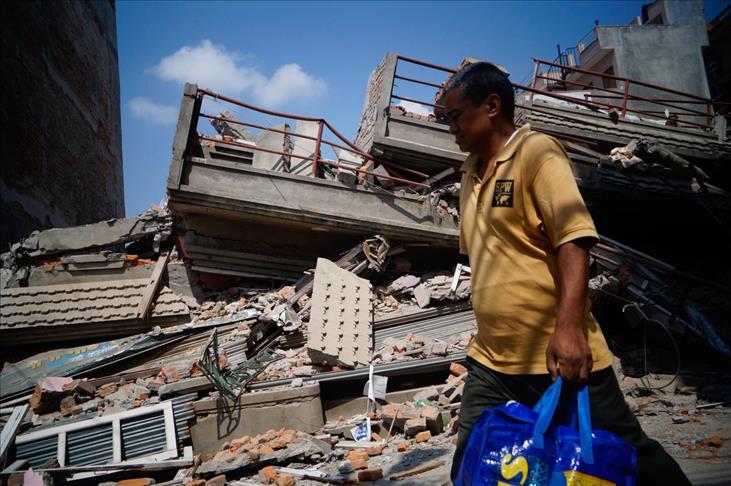
But another powerful earthquake Tuesday shattered Karki's hope of picking up the pieces of his life from the wreckage of Kathmandu.
Over the last fortnight, tens of thousands of residents of Kathmandu had begun to dust themselves off from the disaster and start life anew. They inspected their broken buildings and after an assurance from engineers, most chose to stay inside their home.
But Tuesday’s quake dealt them yet another blow, making them more vulnerable, their life precarious.
In a cruel twist, their hopes and plans mirror the fragile buildings that they have now abandoned in search of a safe corner.
On Tuesday morning, the dwindling number of tents in the army parade ground in downtown Kathmandu saw a steady increase as hundreds returned to the open field.
By Wednesday morning, many were thankful that it did not rain overnight, but they had to bat away mosquitoes and wrap themselves with tattered blankets as they spent yet another night gripped by fear of aftershocks.
Hundreds of displaced were not even that fortunate. They slept under an overcast sky.
To drive through Kathmandu on Wednesday morning was surreal.
A person shuffling through the city would be greeted with the sight of people holding blankets, sleeping on shop fronts under tarpaulins and children and elderly huddling around a single flimsy plastic hut.
Raj Kumar Kafle, an officer of the Nepal Police, said the army parade ground was now home to 1,800 people.
On Tuesday midnight, the security forces hastily brought 33 tents to accommodate the growing tide of people scampering for safety after the quake.
"Each tent can house up to 20 people. We have provided free water and food to the displaced," Kafle said, pointing to rows of blue tents; gifts from the Chinese government.
The police officer, it turned out, was himself a victim of the latest quake: his mud and stone home in the small town of Manthali in Ramechhap district was toppled by Tuesday’s quake and he was arranging for a few sacks of rice to be sent to his distraught parents.
"I can’t travel home because I am deployed here. In this hour of crisis, I need to look after my fellows here in Kathmandu," Kafle said, echoing the voice of thousands of security personnel who have dedicated themselves to rescue and relief efforts.
As they found themselves being roiled by Tuesday’s powerful quake, residents of Kathmandu have been forced to brace for nature’s annual fury: the monsoon.
While the pre-monsoon rains have already began in Kathmandu, the season that runs June through September, wreaks havoc, triggering landslides in the hills and floods in the plains.
Karki, the vegetable vendor, was working hard to give a modicum of protection to his makeshift home building it with an assortment of discarded materials: a traffic sign and bamboo poles.
Standing nearby as their children -- oblivious to the tragedy -- played around her, Karki’s wife Bachchu Karki, 37, blamed fate for the misfortune visited upon her and her family after the disaster.
"I feel like crying. I don’t see any hope. Had we been killed by the earthquake, we would have been spared of this suffering," she told Anadolu Agency.
"But even the Mother Nature is playing game with us. It’s better to die than to live like this,” she said.
Still, a look around the green field offered a vision, almost peaceful, of family life.
Lying on a mattress was a burly man in his thirties. His toddler engaged in an attempt to fish the wallet from his jeans as the man’s wife caressed him.