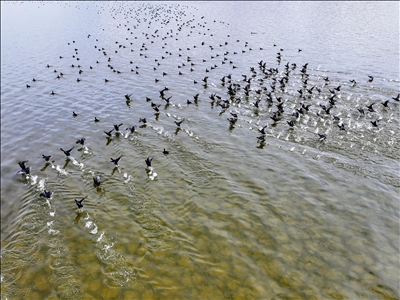
Reviving lake in central Türkiye sees birds return amid drying wetlands


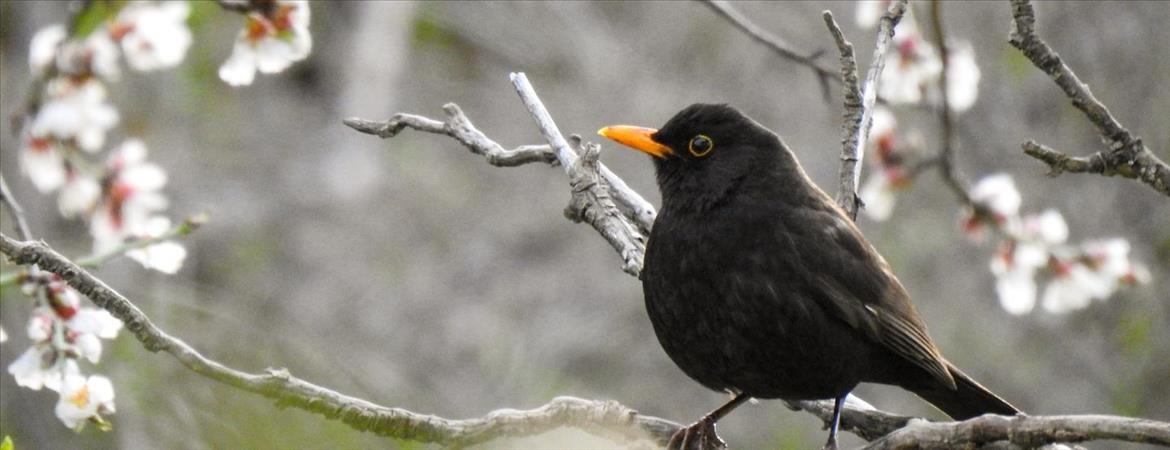
Rana Hijawi is a 27-year-old middle school teacher living in the West Bank region of Palestine under Israeli occupation. Hijawi, a biology graduate from Birzeit University, has been documenting wildlife in Palestine since 2016.
Hijawi told Anadolu about the origins of her work and the challenges she has faced. She explained that she began her nature observations by documenting plants native to Palestine, both in her university garden and at home.
Mentioning seeing the Palestine sunbird in the early days of her observations, “It was so beautiful with iridescent feathers. When I looked it up, I learned that the Palestine sunbird was declared our national bird in 2015. I was surprised I did not know that. This bird symbolizes the resilience of Palestinians in my opinion. I am very grateful that more people are learning more about it and that now it has become a symbol to advocate for what is currently happening in Palestine. A beautiful bird that carries powerful message — that we exist,” said Hijawi.
Hijawi noted that during her field trips in the region, she also encountered the Syrian woodpecker, Eurasian Jay, white-spectacled bulbul, and many other native bird species. She shares these observations with her students whenever possible.
“I don’t have the freedom of movement to see all the species that I would love to see in real life”
Hijawi explained that due to the situation in the region, she cannot move freely across the country and therefore most of her observations take place in Ramallah:
“Palestine is rich in biodiversity thanks to its geographic location and diverse topography. However, unfortunately, I don’t have the freedom of movement to see all the species I would love to see in real life. It is hard for a person that lacks the ability to travel in their own country to explore other forms of wildlife. On the other hand, I have always loved birding in the city, even more than the wilderness sometimes. Because somehow the birds are used to us, they bring life to the city,” she said.
Hijawi mentioned that she occasionally encountered rare bird species as well, such as the common linnet and the masked shrike. She noted that Palestine’s location along major bird migration routes makes it a crucial observation point:
“As for migration, Palestine being a crossroad between three continents, many bird species pass by and reside in Palestine during summer or winter time. In my neighborhood, I have encountered the European Robin in winter and the woodchat shrike in summer. I have also seen the white storks in an area near Nablus,” she said.
She also highlighted how Israel’s illegal practices further endanger already fragile ecosystems, pointing out that the Israeli settlements are among the main factors contributing to these negative effects:
“Wildlife in the West Bank has been threatened way before the war, when the illegal separation wall was built separating the West Bank, land was fragmented and many plants and animals lost their habitat, and got separated. The new settlements are being built on regions which were homes to many native living things. The waste water produced by settlements is also released into Palestinian land causing more damage to underground water and native life,” she said.
Due to permit issues, she suspended her fieldwork
Hijawi had to suspend her work two years ago due to permit issues, as local security forces considered her wildlife photography a potential security risk. Emphasizing that she was only trying to observe birds, Hijawi explained that traveling to other parts of Palestine would likely expose her to further challenges. Therefore, she had decided to keep Palestine’s wildlife alive through her own drawings:
“I try to combine my passion for observation with art by describing the wildlife in Palestine through drawings. I designed calendars, postcards, coloring pages, and a memory game for children, all inspired by our native birds. I presented these products under the name ‘Abu Zraiq’, which means “Eurasian Jay”, a bird that is so clever and dear to my heart,” she said.
“I am sure all the birders out there can relate to the joy of recognizing a bird from its sound, finding a new species, or simply observing the beauty of a bird in flight. One thing no one can relate to unless they have been to the West Bank is the restriction of movement, and the constant worry for safety. I will always see birds as a symbol for freedom when land itself is constantly being taken away and destroyed, yet the sky still prevails with birds giving us hope for a new horizon,” she added.