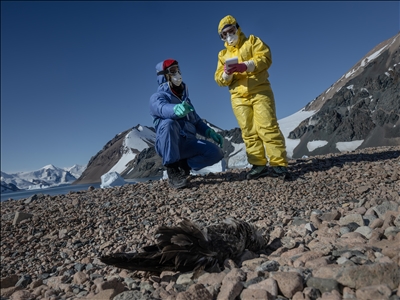
Bird flu threat forces Australia to pull researchers from sub-Antarctic island


First proposed in the 1970s by biology professor Arthur W. Galston during the Vietnam War, the concept gained prominence in protests against the U.S. military’s use of herbicides and Agent Orange to destroy vegetation and crops in the country.
Since then, many civil society organizations and legal experts have supported the criminalization of ecocide in international law.
After Galston, the term reappeared in 1972 in a speech by Swedish Prime Minister Olof Palme at the United Nations (UN) Conference on the Human Environment. Referring to the ongoing war in Vietnam as an act of ecocide, Palme said: “The immense destruction brought about by indiscriminate bombing, by large-scale use of bulldozers and herbicide is an outrage sometimes described as ecocide, which requires urgent international attention.”
Legal status
Ecocide is recognized only under the Rome Statute, the founding treaty of the International Criminal Court, where it is classified as a “war crime.” The statute defines as a crime any intentional attack carried out during war or armed conflict that causes widespread, long-term and severe damage to the natural environment.
According to the “Ecocide Law” Project supported by the University of London and the University of California, 10 countries currently recognize ecocide as a crime.
These countries are listed as follows according to the year they recognized ecocide as a crime:
Vietnam (1990), Russia (1996), Kazakhstan (1997), Kyrgyzstan (1997), Tajikistan (1998), Georgia (1999), Belarus (1999), Ukraine (2001), Moldova (2002) and Armenia (2003).
In addition to the list, in 2021, France recognized ecocide as a crime, as well as Belgium in 2024.