Reviving lake in central Türkiye sees birds return amid drying wetlands


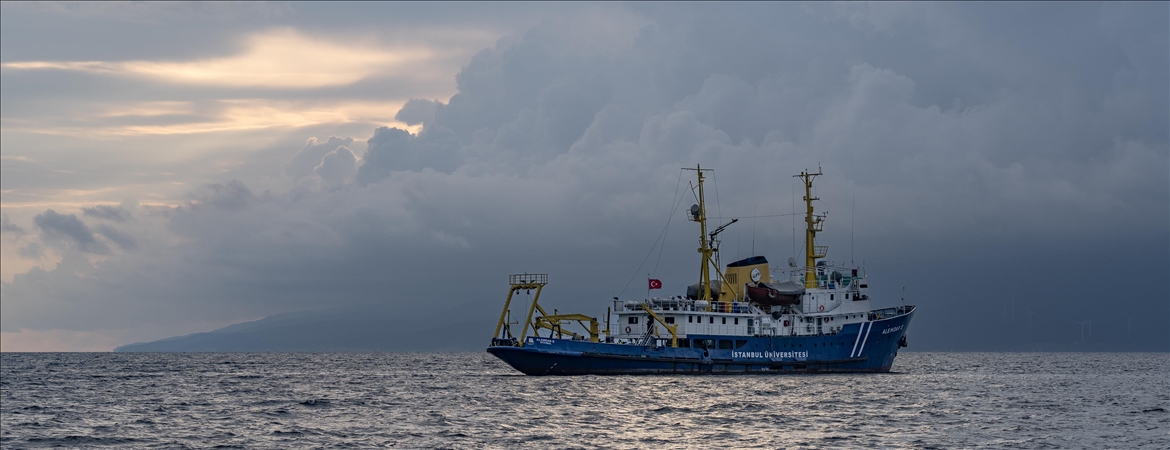
Behind Türkiye’s marine research efforts stands an experienced team working aboard the scientific research vessel. Some crew members are fulfilling childhood dreams, others have turned their passion for the sea into a profession, supporting every step taken to protect marine environments.
The crew ensures the accurate collection of essential data for the researchers’ studies, ranging from water samples to oceanographic measurements. Their years of experience contribute to continuous monitoring of changes in the seas.
Murat Inan, the captain of R/V ALEMDAR II, and chief officer (second captain) Yasin Denizman have been at the center of scientific studies conducted for Türkiye's seas for years.
The captain, 53-year-old Inan, has been working at the institute for 25 years. He began on the R/V ARAR in his early years at the institute, and has been serving on R/V ALEMDAR II for the past 15 years.
Second captain Denizman (43) has also served on both vessels. He first joined R/V ARAR in 2005 as a deckhand, later becoming second captain of R/V ALEMDAR II after years of effort, hard work and dedication.
“Having a role in this work makes me happy”
Inan told Anadolu he began his maritime career on commercial vessels in 1996 and joined the institute’s research vessel R/V ARAR as second captain in 2000, becoming captain after the previous master retired in 2012.
Highlighting the differences between commercial and research vessels, he said, “On commercial ships we took major precautions to prevent accidents when we approached the shore within half a mile. On a research vessel, we sometimes approach within one or two meters deep from our draft (the distance between the bottom of the ship and the water level) to collect samples. This made us more professional and experienced, and it removed the fear barrier of my own profession, operating near the shore.”
He also stressed the presence of women in scientific teams: “When I started, women had no role in this profession. On the research vessel, I saw women among the scientific team endure the difficult conditions we considered challenging, without complaint.”
Noting that missions last from a week to a month, Inan said the greatest challenge of being at sea is being away from family. “Working here in such a place and having a role in something important for everyone makes me happy,” he added.
Inan emphasized he was on duty during the Golden Horn cleanup efforts: “The measurements and ecosystem studies conducted in the Golden Horn are very important to us. We collect water samples, measure water quality and report pollution levels. These studies contribute directly to the protection of the Golden Horn.”
He stressed that the vessel plays an important role in environmental events such as the mucilage outbreaks: “I went to the Gulf of Izmit, and encountered a huge mucilage outbreak, it felt like we were inside a tub of yogurt. Thanks to the reports of our researchers and academics, this disaster was averted with the efforts of the state. Now everyone knows what to do in similar situations.”
“Being part of this work is something to be proud of”
Denizman stated that he comes from a seven-generation seafaring family.
“I was born and raised in Beykoz, where we grew up on boats. Our childhood was spent at the sea. When your family consists of seafarers, the sea inevitably draws you in after a while. Before our R/V ALEMDAR II vessel, there was the ARAR vessel affiliated with our university. My uncle Tayfun Denizman was its captain. Thanks to him, I started working on the ship as a deckhand,” he said.
Denizman said that before he started working, he used to visit his uncle on the ship, and at that time, he was even afraid to go inside, but he was eager to do so, and his uncle was very influential in this regard.
He stressed that his father served as a chief engineer on various vessels, and his brother also works as chief engineer on Istanbul University’s other research vessel, R/V Yunus-S.
“Initially, the passion for the sea draws you to this profession. Later you understand the purpose of the vessel and its impact. We have an emotional bond with R/V ALEMDAR II; it’s like our child. Our scientists study fish populations, measure and weigh them. They conduct measurements where rivers meet the sea. Before learning these things, you might think a river flowing into the sea is ‘wasted.’ But now we know how important it is for fish, nature and the marine environment. There are still things we don't know, things we haven't learned yet, and things we are just starting to learn,” he added.
He said passion and love is essential for maritime work and that when a profession is pursued with love, everything becomes better.
Contributing to science makes him proud: “We take water measurements on this vessel. Someone unaware might say it’s ‘just taking water samples,’ but I remember from my childhood when the Golden Horn was unbearable due to the smell. Thanks to these measurements and scientific studies, it has been saved. Being part of this work is something to be proud of.”
Noting that his 9-year-old son already shows interest in the sea, he added: “He is very curious about the sea and says ‘take me to the vessel’ every week. In our family, there is a transfer of knowledge from father to son about the sea. I have been in this profession for 20 years and served on nearly all of our university’s vessels. May Allah bless us all.”
“Without them we cannot do our work, and without us they cannot do theirs”
Prof. Dr. Cem Gazioglu, Director of the Istanbul University Institute of Marine Sciences and Management, said the vessel’s crew are the unseen heroes of the institute’s work.
He stressed that the crew performs a job that requires great professionalism and dedication: “They possess knowledge and experience passed down through generations. I would argue that most of our Istanbul University seafarers have more experience than academics working in this field,” he said.
Dr. Guzin Gul said crew members are as experienced as scientists: “They help us immensely with sample collection and storage. They ensure our safety in harsh weather conditions.”
Research Assistant Dr. Ilayda Destan Ozturk emphasized the importance of ensuring that samples taken from the sea do not mix into each other: “Without the support of the crew, this work would not be possible. Voyages are long, and we spend the whole day together. This work is a completely collaborative process.”