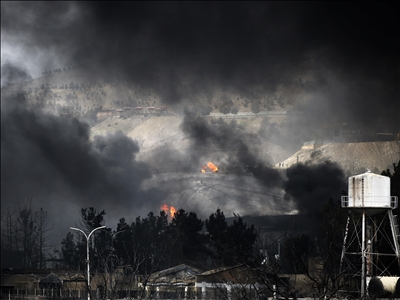
Toxic fires sparked by Israeli strikes on Iranian oil depots raged for days, endangering public health



Speaking to Anadolu, Levent Kurnaz, director of Bogazici University’s Center for Climate Change and Policy Research, evaluated last year’s climate conditions and outlined expectations for 2026.
Kurnaz said it is difficult to make reliable forecasts beyond a few weeks in climate terms, adding that the world continues to warm. As a result, temperatures starting from this winter through the coming spring, summer, autumn and winter are expected to be higher than the 1960–1990 average.
He noted that El Niño and La Niña are among the factors that can be projected to some extent in the short term.
“Models project that a weak La Niña will persist until the end of winter, roughly through March, followed by a neutral phase, and that a weak El Niño will begin toward the end of summer. These projections are not set in stone, but our general expectation is that temperatures will not rise excessively through the end of summer, but could be slightly above normal by late summer,” he said.
Kurnaz said climate change should be considered in two contexts: overall warming and the disproportionate warming of polar regions. He noted that warming causes plants to flower earlier than usual, making them vulnerable to subsequent cold spells that can cause damage.
“The likelihood of agricultural frost is high”
Referring to frost events experienced in February and April last year, Kurnaz said these were linked to warming in the polar regions.
“As the polar regions warm excessively, cold polar air can spill southward. This is something that can be predicted a few weeks in advance, but it is far too early now to say that we will experience frost in April. Right now, we can only talk about mid to late January. Since the most dangerous period for frost is March–April, it would be wrong to make any specific forecasts now regarding those issues in our country. However, does warming continue? Yes, it does. Will there be flowering? Yes. Did the pole get warmer? Yes. Therefore, the probability of agricultural frost is high; but when, how, or whether it will happen cannot be stated at this point.”
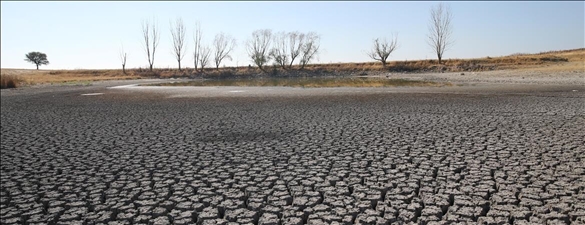
Kurnaz noted that different signals can emerge across Türkiye, with above-average precipitation in the northeast and below-average in the southwest, adding that it is too early to determine which regions may face drought.
He also said rising temperatures increase evaporation, which in turn raises overall water demand, particularly in agriculture.
Stressing that El Niño conditions in the second half of the year could push global average temperatures to be the second-highest levels on record, Kurnaz said:
“It could easily rank second. There is also a chance it could be first, but we will monitor this day by day and month by month. It certainly will not be fourth or fifth, it will be in the top three. Whether it is first, second or third, time will tell, but 2026 will probably be somewhere between first and second place.”
Kurnaz underlined that La Niña generally causes global temperatures to remain below average, but added that temperatures are expected to increase due to climate change. He said 2026 is expected to resemble 2024 in terms of temperatures, with La Niña influencing roughly half the year and El Niño the other half.
He also noted that Türkiye, being geographically distant from the core El Niño–La Niña regions, may experience warming slightly above normal and expected levels.