Polish foreign minister says Iran war could mark end of post-Cold War order
The US-Israeli strikes on Iran may go down in history as a turning point, Polish top diplomat says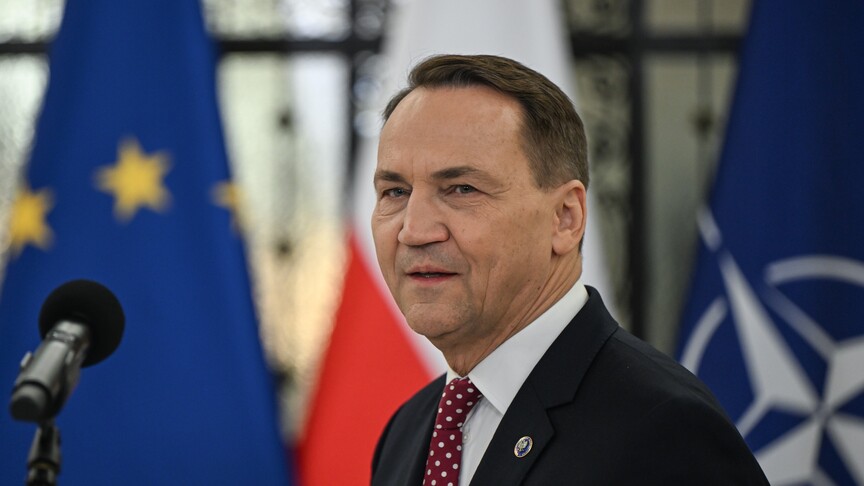
- He rejects calls for Poland to act alone, likening it to 'jumping from an aircraft carrier into a storm'
Polish Foreign Minister Radoslaw Sikorski said that the joint US-Israeli strikes on Iran may come to be seen as the moment the post-Cold War international order began to break down.
Speaking at the East x West Forum conference in the Polish city of Wroclaw on Thursday, Sikorski said future historians might look back on Feb. 28, 2026 — the start of the American-Israeli air campaign against Iran — as a decisive turning point in world affairs.
He argued that the war in the Middle East is not itself the source of global instability, but rather a symptom of a deeper crisis in the international system.
“This is the most serious change in the world order since the collapse of the Soviet Union,” Sikorski said, warning that it remained impossible to know how long the confrontation would last or whether it would spread beyond the region.
According to Sikorski, the conflict has revealed a growing crisis of confidence between the US and its allies, as well as the limited ability of even the world’s strongest military powers to control events.
He said the war had also exposed the vulnerability of modern economies, which remain heavily dependent on secure supplies of energy and critical raw materials.
Forces driving global instability
Sikorski identified three forces driving the wider crisis. The first, he said, was geopolitical. The balance of power that underpinned the post-Cold War system no longer reflects reality, while institutions created after World War II are struggling to adapt.
He questioned whether organizations built in the 1940s could still function effectively in an age of artificial intelligence and humanoid robots.
Many emerging powers, he said, no longer believe the current international order serves their interests, while countries that once dominated it increasingly lack the resources to sustain it.
The second factor he mentioned was technological change. Sikorski said advances in artificial intelligence and computing represented not merely another wave of innovation, but a fundamental shift in the way the world works.
He said new technologies could transform medicine and energy systems, but also risk fueling rivalry over semiconductors, data and energy supplies.
“These are becoming new sources of tension between states,” he said, adding that automation could deepen social inequality and concentrate wealth and knowledge in the hands of a small number of companies and individuals.
The third force behind the current upheaval, according to Sikorski, is growing public frustration.
Using the US as an example, he argued that strong economic indicators do not necessarily translate into a better life for ordinary people.
“Many Americans hear that they live in the richest and most powerful country in the world, but they do not feel it in their everyday lives,” he said.
That disconnect, he argued, is encouraging voters in many countries to reject the foundations of the existing order. He also warned that the use of military force is increasingly seen not as a failure of diplomacy, but as a tool for gaining leverage before negotiations begin.
Poland’s reliance on alliances
Sikorski said these trends were particularly dangerous for countries such as Poland.
Over the last 35 years, he said, Poland had prospered within a rules-based international system, moving from the margins of Europe to become one of the larger members of the European Union.
However, he stressed that Poland remains a medium-sized country that cannot shape the outside world alone.
For that reason, he said, Poland depends on predictability, legal stability and institutions that restrain the actions of more powerful states, especially the EU and NATO.
Rejecting arguments that Poland would be better off acting alone, Sikorski said such thinking was “like jumping from an aircraft carrier into a boat in the middle of a storm.”
During a discussion after the speech, Sikorski was also asked about the foreign policy of US President Donald Trump and the possibility that Washington could eventually leave NATO.
He said Trump should be taken “not literally, but seriously” and admitted he was concerned whenever the US president spoke about NATO allies as “they” rather than “we.”
At the same time, Sikorski argued that Europe should assume most responsibility for conventional defense, while the United States would continue to provide nuclear deterrence and a limited number of strategic capabilities.
He described such an arrangement as “NATO 3.0.”