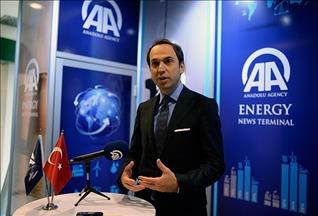
Ebru Sengul Cevrioglu
25 March 2026•Update: 25 March 2026
ANKARA
Türkiye is not experiencing any energy supply problems despite escalating tensions in the Middle East, Türkiye's Energy and Natural Resources Minister said on Wednesday.
In an interview with Anadolu's Editor's Desk in the capital Ankara, Alparslan Bayraktar stated that the joint US-Israeli offensive on Iran has not disrupted the country's energy supply security.
"We are facing a crisis that could have impacts on the global economy," he said, describing the geopolitical tensions as potentially more severe than recent global crises if they persist.
Bayraktar noted that the world has already endured major shocks in recent years, including the COVID-19 pandemic and the Russia-Ukraine war, both of which led to supply chain disruptions, logistical challenges, rising energy and commodity prices, and high inflation.
"However, this crisis could be even more devastating if it continues over the medium to long term," he warned, adding that a prolonged conflict could affect the entire global economy.
He expressed hope that the conflict would be resolved soon to limit its global impact.
Highlighting the central role of energy in the crisis, Bayraktar noted that Türkiye currently remains in a "safe position" regarding energy supply security as a result of its strong energy infrastructure and diversification policies.
Energy security encompasses supply, demand and transmission, Bayraktar explained, adding that the current situation points to a growing supply-side problem globally.
"There is no visible crisis on the demand side yet, but there is a serious supply constraint," he said, citing disruptions in key energy transit routes in the region.
He noted that around 20% of global oil and liquefied natural gas (LNG) flows normally pass through the Strait of Hormuz, adding that current disruptions are creating a significant supply challenge.
Despite this, Bayraktar said Türkiye's exposure to the region remains limited.
"Our dependence on this region is at a low level," he underlined, noting that Saudi Arabia and Iraq account for roughly 15% of Türkiye's oil supply, with overall dependence on the region at around 10%.
He added that Türkiye does not import natural gas from the region and has diversified its LNG suppliers, including recent agreements with the US.