ANKARA
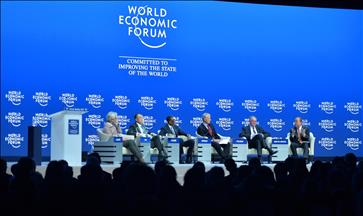
Economic growth and managing risk were the overall themes debated at the World Economic Forum at Davos, eastern Switzerland, on Wednesday.
The conference included more than 2,500 participants from 140 countries, including some of the most important politicians, businesspeople and regulators in the world.
Troubled leadership is one of the clear themes of the crisis, do we need new models for political and economic power? Growth and stability were also much discussed, are new strategies for growth needed in a slow-growth climate? With so much risk and uncertainty, how can leadership achieve credibility and adapt?
“Forms of power, and the nature and quality of power have changed dramatically and this poses new challenges to leadership,” warned former President of the European Commission Jose Manuel Barroso.
“Achieving credibility is the biggest challenge for my country,” said Italian Prime Minister Matteo Renzi.
- Building a case for climate change
Former U.S. vice president Al Gore worked to achieve credibility for action on climate change. Gore said that 2014 was the hottest year on record, and that the higher temperature led to the creation of terrible storms that have struck around the world.
The 10 warmest years since records began in the 19th century have all been since 1997, U.S. data showed.
Gore announced that he is helping to produce a Live Earth music event to demand action on climate change. It will take place on June 18, 2015, across seven continents, including Antarctica, along with pop star Pharrell Williams.
- Building confidence amidst volatility and economic risk
Economist Nouriel Roubini, famous for predicting the onset of the financial crisis of 2008, said that markets were better at managing risks today, and that regulatory measures like quantitative easing were effective. High-impact events are being absorbed by market action, Roubini said.
On the other hand, Anthony Scaramucci, CEO of hedge fund Skybridge Capital, warned that deflation is out of control. “It’s the Darth Vader death threat to our economies,” he insisted.
More moderately, Harvard economist Kenneth Rogoff said that central banks were responding to volatility with some success.
- Restoring confidence in religion
Former British Prime Minister Tony Blair led a forum on the role of religion Wednesday.
Questioned about whether the invasion of Iraq, which Blair supported, had not led to greater religious extremism, Blair said: “You can have a debate on whether it’s the right or wrong decision. But I’d also point out, and I think many people in Iraq would agree, that Saddam Hussain wasn’t exactly a force for stability, peace and prosperity for his country, and was responsible for killing many hundreds of thousands of people.”
Blair then argued that the only way to limit religious extremism is with education. “People must learn about other religions, and so learn to respect them,” Blair said.
Debate was often sharp, particularly as the Russian Deputy Prime Minister Arkady Dvorkovich defended his country’s economic policies against questioning from representatives of neighboring countries.
On Thursday, debates will begin with the fraught question of the effectiveness of monetary stimulus from central banks, on the very day that the European Central Bank is expected to announce such measures.