05 January 2016•Update: 06 January 2016
By Andrew Jay Rosenbaum
ANKARA
The rout on China's stock exchanges may turn into a long-term decline as a series of changes pressure share prices lower, while stocks across the world are likely to suffer as a result, analysts say.
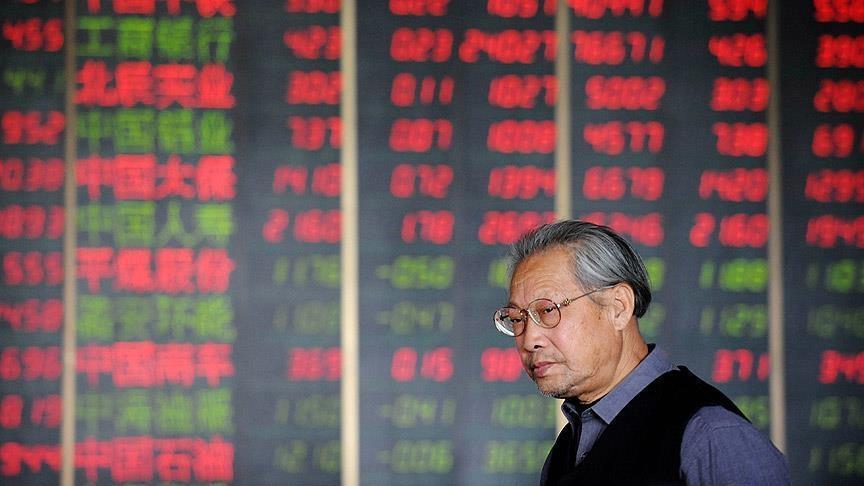
On Monday and Tuesday, shares on Chinese exchanges went into wild swings, as markets reacted to a number of regulatory actions which could keep the pressure on stocks in China, and also hurt global stock trading.
Chinese markets continued to react to regulatory threats on Tuesday, as the Shanghai Composite Index first dropped 3.1 percent, recouped losses around noon to rise 0.7 percent, and then fell back, falling about 2 percent later in the day.
This followed a debacle on Monday: After a plunge of 7 percent, regulators were forced to shut down trading in Shanghai and Hong Kong.
The bear in China spooked investors around the world. In the U.S., The Dow Jones 100 Index closed down 276 points, the S&P 500 index lost 1.5 percent and the Nasdaq dropped 2.1 percent. European stocks fared no better: Germany’s DAX index was down 2.5 percent at the end of the day.
Two regulatory actions in China are behind the bear markets.
First, Chinese regulators have placed so-called “circuit-breakers” on trading: When the Shanghai Composite Index moves more than 5 percent higher or lower, a 30-minute trade suspension will occur if the move occurs before 2.30 p.m. local time [0630GMT]. After that, a 5 percent move will freeze trading until the market closes at 3 p.m. local time [0700GMT].
The circuit breaker went into effect when shares first plunged on Monday, but the reaction was a continued plunge. The challenge is that, once the circuit breaker is put into effect, traders assume the worst and pull their money out of stocks.
On Tuesday, the China Securities Regulatory Commission (CSRC) issued a statement saying that the circuit breaker mechanism would be fine-tuned, so that it did not derail the market as it had on Monday.
The second regulatory action behind the plunge in shares was the upcoming end to the ban in share trading by major shareholders that the CSRC imposed on July 8. Shareholders with more than 5 percent of a company, and company directors, were banned from trading their holdings in the wake of a similar stocks plunge on China’s exchanges at that time.
The ban is supposed to come to an end on Jan. 8, and investors are clearly spooked by the prospect of about $185 billion (CSRC statistics) in stocks hitting the exchanges on that day, with the possibility that major shareholders could take the opportunity to sell off their holdings.
Investors concern about the effect of lifting the ban is justified, Hanfeng Wang, a Beijing-based analyst at China International Capital Corporation, wrote in a note dated Dec. 28.
Wang warned that an extension of the ban was unlikely, although the CSRC said in its statement on Tuesday that it would consider keeping the ban in place for some time.
There is also considerable pressure from major shareholders to regain access to the markets.
But the end of the ban also coincides with a very grim period in China’s recent economic history.
“Real GDP growth is unlikely to accelerate beyond 3-5 percent in 2016. Our estimates suggest that the yuan is around 15 percent overvalued, and we expect the RMB to weaken by 10 percent against the dollar over 12-18 months, more than what most economists are forecasting,” commented Shweta Singh, an economist with Lombard Street Research in London.
In fact, on Monday, when stocks tanked, the plunge was first set off by the release of a weak Purchasing Managers’ Index for the country, with a reading below 50, meaning that manufacturing activity would be poor in the near future.
The challenge is that technical factors on the Chinese exchanges are coinciding with poor economic performance. Those two factors are likely to work together to keep Chinese stocks in the bear mode for a long time, and that could have a serious knock-on effect on global stocks.