By Kyaw Ye Lynn
YANGON, Myanmar
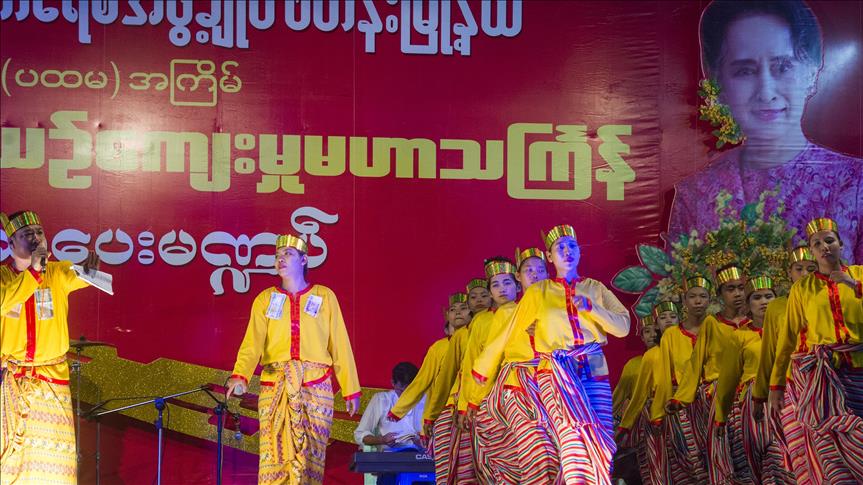
On a traditionally decorated stage in Myanmar's commercial capital, a group of performers is dancing and chanting under the midday sun.
Dozens of people -- mostly in soaking wet cloths -- cheer and sing along, while some sit nibbling on sticky rice and coconut snacks.
“The issues that the parliament debates are so, so funny," chant the performers, as a group of percussionists play the rhythm.
"Those corrupt in road building are -- YCDC, YCDC," they continue, using the acronym for the capital Yangon's City Development Committee.
"They are funny, they are funny -- we are going to make jokes about these people all the way through the festival.”
The stage is at Hledan Township near the Yangon University campus, and the performers are taking part in the age-old art of Thangyat -- chants performed by a singer and his chorus during the duration of the Thingyan New Year festival.
Thangyat -- satirical verse, long performed at the country's festivals -- are particularly popular during Thingyan -- an annual water festival during which people splash each other in an effort to wash the sins from the old year, and mark the new.
The festival is usually celebrated in April in some Southeast Asian countries -- Myanmar, Thailand, Laos and Cambodia -- and this year it falls in Myanmar April 12-16.
Myitta, who leads a Thingyan chanting group called Thardu Par Byar, says that the chants provide a more thoughtful way of observing the five-day event.
“Thangyat reflects public voice and opinion. That’s why people love Thangyat, and authorities fear that,” he tells Anadolu Agency.
“Thangyat is one of the easiest and quickest ways to make authorities listen to the public's voice.”
Sometimes, however, the authorities really don't like what they hear.
In 1998 -- when former military dictator Than Shwe was in power -- Myitta was banned from performing for ten years after taking part in a badly-received satirical sketch on a state-run television channel.
In the satire addressing the power shortage Myanmar faced as almost all produced electricity was exposed to China and Thailand, Myiita had sung: “There is plenty of electricity on the other side -- Chinese home, Chinese home, however only a dim light here -- Burmese home, Burmese home”.
"The wrongdoers fear Thangyat chants or satire, and try to silence our voice,” Myitta says.
Thangyat highlights all the things that went wrong in the past year, in the hope of avoiding repetition in the year to come.
The chants, often humorous and satirical, have been part of Myanmar's rich folk culture for centuries, however they were banned by the military juntas that ruled the country for a half-century.
They were curtailed after military strongman Gen. Ne Win seized power with a coup in 1962, and banned in 1974, on the argument that the art form undermined national security.
The ban, however was lifted for the water festival in 2012 -- one year after a quasi-civilian government led by former President Thein Sein took power, in the process bringing to an end military dictatorships.
However part-censorship still remained.
That changed last month when long-time opposition leader Aung San Suu Kyi’s National League for Democracy (NLD) took power following the Nov. 8 landslide election victory.
Days after being sworn in, all such censorship was abolished, the Thangyats free for the first time in over five decades.
This year, one student tells Anadolu Agency that he took part in Thangyats at police stations.
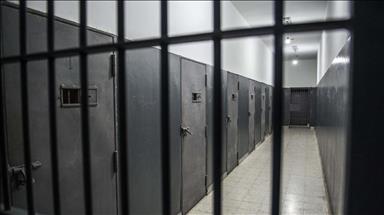
Zeya Lwin was one of a group named Generation Peacock, who have only recently been freed from jail after more than a year in detention for a protest calling for academic freedoms.
“This shows great, great change in our country,” Zeya Lwin said after performing at a station in Yangon’s Mingalar Taungnyunt Township.
One of those watching was police officer Myint Thein.
“I do like the chants,” he tells Anadolu Agency. “They pinpoint out our [societies'] weaknesses.”
Myitta says that with the coming to power of the NLD, the chants have been allowed to represent the public voice more so than in previous years.
“This time chanting groups reveal the mistakes ranging from ordinary people to the president,” he says.
However some issues are still too sensitive.
Around one week before the festival, group leaders were told that they should not touch on an issue championed by a group of nationalist monks that many suspect targeted the country’s Muslim population.
“Yangon chief minister requests us not to make jokes about race or religious affairs... He told us the religious issue is very sensitive here,” said Myitta.
“We agree with him,” he underlines.