On April 25, a wave of coordinated attacks shook Mali to its core.
Armed convoys struck simultaneously a series of strategic military and urban centers, including Kidal and Gao in the north, Sevare and Mopti in the center, and Kati, which hosts Mali’s largest military garrison, just outside of Bamako, the capital.
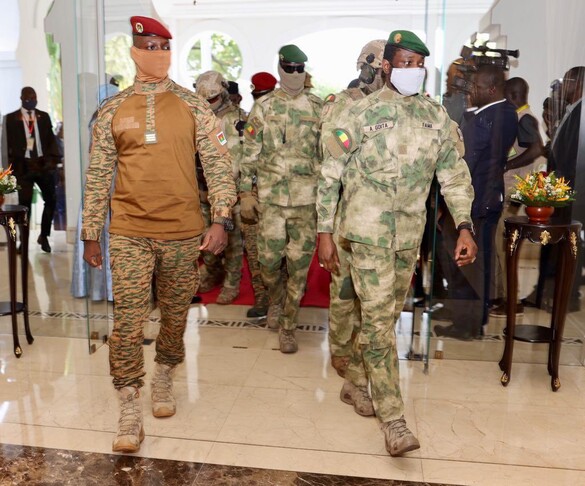
A suicide car bombing in Kati killed Defense Minister Sadio Camara, one of the most powerful figures in the military government, along with dozens of others, according to the official account. The blast, felt more than 10 kilometers (6.2 miles) away, obliterated the minister's residence and several surrounding buildings, including a neighborhood mosque.
The assault -- multi-front, simultaneous and devastating -- bore the hallmarks of a new level of operational sophistication.
The attackers belonged to JNIM, the Sahel’s most powerful al-Qaeda-affiliated coalition, which now fights alongside Tuareg separatist factions grouped under the banner of the Azawad Liberation Front.
In the days that followed, the armed groups appeared to seize or attack additional strategic positions in northern Mali, including the Tessalit military camp near the Algerian border, though Malian authorities disputed the full extent of the losses.
Analysts say the offensive marks a turning point in Mali’s long-running history of insurgency – not only because of its scale, but because of the deeper alliances, regional rivalries and geopolitical shifts now reshaping the conflict.
Northern Mali has never been fully at peace with Bamako.
Since the first Tuareg rebellion in 1963, the Saharan and Sahelian regions inhabited largely by Tuareg and Arab communities have periodically risen up against what they see as a distant and neglectful central government.
"From 1963 to today, Mali has faced a cyclical crisis, even if the context changes each time,” Malian security analyst Paul Oula told Anadolu.
Three previous uprisings flared and subsided, each giving way to a peace agreement.
“In 2012, a new element entered the picture -- jihadism,” Oula said.
That year, groups including Ansar Dine, led by Tuareg figure Iyad Ag Ghali, al-Qaeda affiliate AQIM and Al-Mourabitoun temporarily allied with the secular separatist movement MNLA (National Movement for the Liberation of Azawad) to seize Mali’s three northern regions: Gao, Timbuktu and Kidal.
International intervention followed quickly.
France launched Operation Serval in January 2013, pushing rebel forces out of occupied towns. The mission later evolved into the broader Operation Barkhane, supported by the G5 Sahel Joint Force, the UN, the EU and the French-led Takuba Task Force.
For nearly a decade, those international missions helped contain the insurgency.
That security architecture unraveled in 2021 and 2022, when Mali’s military authorities, who took power after the August 2020 coup, ended the mandates of foreign and multilateral forces operating in the country.
What is unfolding today is qualitatively different from the past, according to Ahmadou Toure, director of the Center for Research in Governance, Mediation and Security in the Sahel, who drew a distinction between the 2012 alliance and the current one.
"At the time, the alliances were essentially tactical and opportunistic -- separatist groups opened up the terrain and jihadists exploited it to establish a foothold, but both blocs retained distinct, often antagonistic objectives,” he told Anadolu.
“Today, we are seeing close operational coordination, resource sharing and a deeper ideological convergence.”
JNIM and Tuareg armed factions now share not only the battlefield but also intelligence, logistics and planning.
Another difference, Oula said, is that these groups are now better equipped and better funded than in previous rebellions, with support from external actors.
He also said they are adept at spreading their messages.
"The armed groups are running a pernicious media campaign. JNIM spokesman Bina Diarra, for instance, has issued threats against anyone who ventures to travel out of Bamako,” said Oula.
JNIM has broadened its messaging from the Fula language to Bambara, suggesting a deliberate effort to speak beyond the Fulani community to the wider population of Mali.
“Bina Diarra’s addresses to the nation are widely watched,” Malian trader Soumaila Konipo said.
While analysts rejected suggestions that the government is on the verge of collapse, they say the coordinated attacks reflect an increasingly sophisticated and geographically expansive insurgency.
"The recent attacks do not reflect any weakening of state control or of the Malian Armed Forces (FAMa)," Toure said.
"Rather, they illustrate a new stage in the asymmetric warfare waged by groups that, faced with the growing strength of the FAMa and their partners, have opted for spectacular, media-driven actions designed to create a widespread sense of insecurity."
Oula agreed that the shift is primarily tactical rather than a sign of government weakness, but acknowledged that armed groups are now opening simultaneous fronts across Mali, a vast country roughly 1.6 times the size of Türkiye.
"Nevertheless, Malian forces have demonstrated resilience by repelling attacks in Kati, Sevare, Gao and Kona," he said.
Since 2022, Mali has firmly pivoted toward Russia, which has supplied instructors and fighters through the Africa Corps.
After the wave of coordinated attacks, Russia’s Africa Corps confirmed on social media platform Telegram that it had pulled out of the northern city of Kidal alongside personnel from the Malian army.
On Wednesday, the Russian group said it continued to conduct combat operations and reconnaissance against the armed groups.
At the same time, Moscow has issued repeated declarations of solidarity since the attacks.
"Russia is showing its partners that it remains a very reliable, very committed ally -- and is also sending a message to those who criticize it, like France,” said Oula.
France faces near-unanimous rejection among Mali's ruling authorities, who allege that Paris has backed armed groups -- accusations that serve a dual purpose: identifying alleged "external sponsors" while mobilizing strong nationalist sentiment.
Ukraine’s 2024 acknowledgment of intelligence support to Tuareg rebels near the Algerian border constitutes, according to Oula, evidence that the conflict has taken on the dimensions of a proxy war.
Toure went further, alleging broader collusion involving “France, Ukraine and NATO.”
Meanwhile, Algeria had positioned itself as the indispensable mediator in the last three crises in northern Mali, but that role has largely collapsed.
Mali renounced the 2015 Algiers Peace and Reconciliation Accord, and the destruction of a Malian drone by Algerian air defenses -- in what Bamako describes as Malian territory -- triggered a full diplomatic crisis, with both countries recalling their respective ambassadors.
Against expectations, Algerian President Abdelmadjid Tebboune has proposed a fresh mediation initiative. However, both Oula and Toure expressed skepticism.
"Mali is currently in a new posture -- one of managing the crisis internally," Oula said.
news_share_descriptionsubscription_contact