LIMA, Peru
No amplified calls to prayer echo across Lima during Ramadan, and the city’s daily routines continue largely uninterrupted. In Peru’s sprawling capital of 11 million, the rhythms of work, traffic and commerce rarely pause for the spiritual demands of fasting or prayer.
Even iftar – the meal that breaks the fast – begins here as quietly as the sun sets over the Pacific Ocean, beneath a sky awash in hues of pink, lavender, and gold.
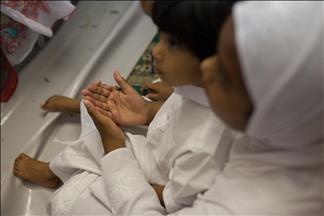
Still absorbed in prayer, Imam Ahmed Mohamed chats with fellow worshippers in Spanish as dates are passed around and congregants slowly file out into the garden.
“In the Middle East or a Muslim-majority country, you feel that emotional and spiritual support everywhere – from local businesses and the state itself. Here in Lima, people go about their lives. It’s a strong test of faith,” Mohamed, 36, told Anadolu.
It was that faith that led the Egyptian-born cleric – a naturalized Peruvian citizen – to lead the Islamic Association of Lima, the country’s oldest and largest mosque. Mohamed arrived in Peru in 2021 for a religious post that was arranged by the two governments.
In this deeply Catholic nation of 34 million, Muslims are one of the smallest minorities in the country. Yet in a quiet residential neighborhood overlooking the Pacific, a small but devoted Muslim community has thrived for decades.

Faith and community
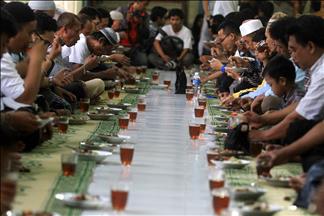
As evening prayers end, congregants slowly move into the mosque’s garden, where food is shared with worshippers and visitors alike.
“Many people from the community come by out of curiosity. One rule of Islam is to do good deeds, and it teaches us that one of those is sharing food,” said Mohamed.
In the mosque’s garden, congregants are served bread and soup alongside escabeche, a tangy chicken dish stewed with vinegar, onions, and spicy peppers. Muslims from Peru, Pakistan, Afghanistan, Egypt, Venezuela and other countries gather around the tables, often joined by curious neighbors who want to learn more about Ramadan.
Mohamed said such acts of feeding others go beyond his mosque. The Islamic Association of Lima donates groceries during the month of Ramadan to nearly 2,000 families, Muslim and non-Muslim alike, in Lima’s poorest neighborhoods.
“Among them are immigrants, Cubans, Venezuelans, and Dominicans as well. We give them this kind of help simply out of brotherhood,” said Mohamed. “There is so much poverty … Most of them are almost forgotten, so there are many opportunities to give that kind of charity, to bring them some joy.”
A tiny minority
While Catholic traditions dominate Peru’s religious landscape – a Catholic seminary even overlooks the mosque – the country’s constitution guarantees freedom of religion.
Peru’s last census, taken in 2017, found that 76% of Peruvians identify as Catholic, while 4.8% belong to other religions, including Islam.
Official estimates place the Muslim population in Peru at approximately 2,600. Roughly 2,000 live in Lima, while about 600 are concentrated in southern Peru, along the border with Chile.
Established in 1990, the Islamic Association of Lima occupies a stately home once owned by a Palestinian family, and has served as a spiritual center for Muslims across the capital and beyond for nearly four decades.
Although Arab Muslim migrants arrived in Peru in the late 19th and early 20th centuries – mainly from Lebanon, Syria and Palestine – most Muslims in the country today are converts.
“Here, our Muslim community is around 99% Peruvian by birth. They’ve converted to Islam of their own will. Ramadan in Peru, just like in Egypt, Türkiye and elsewhere, is about brotherhood,” said Mohamed.

Finding Islam in Peru
One of those converts is Abu Bakr, born in Peru’s Amazon region of Ucayali. During Ramadan, he travels to the mosque in Lima to join fellow believers in prayer.
“We’re a very small community compared to the huge Catholic presence here in Peru,” said Bakr. “We’re tiny in comparison and often viewed a little strangely. But a lot of people come here looking for change in their lives, and for us, it’s a pleasure that they visit.”
He said his interest in Islam began at a young age, sparked by a fascination with the Middle East and the Muslim world.
Fifteen years ago, a visit by a group of Pakistani Muslims left a lasting impression on him. Their discipline in prayer and sense of community ultimately inspired him to convert.
“Then came the process of learning about this faith and how to live a life distinct from what I was living before. With time, fasting during Ramadan became easier. After a while, you don’t even feel the hunger – rather, it’s the happiness I feel knowing I’m developing myself.”

Others arrived in Peru already practicing Islam. Farid Nassim, who immigrated from Pakistan in the 1980s after becoming fascinated with the Incan Empire and Latin American history, said Ramadan in Peru remains both familiar and unique.
“People in Peru are not that aware of the rest of the Muslim world. There’s much curiosity about Ramadan in Peru,” said Nassim.
Despite cultural differences, he feels that Ramadan “is the same here as practically anywhere else in the world,” barring one exception: “There’s no comparison with iftar in a Muslim country and here.”
As the evening meal winds down, children run through the garden while conversations drift between Spanish, Arabic and other languages.
Gradually, worshippers gather their belongings and head home through the streets of Lima. For Imam Mohamed, the small community represents something larger than its numbers.
“Faith in Islam is lived, not just felt,” said Mohamed. “Borders don’t matter, origin doesn’t matter, skin color doesn’t matter, language doesn’t matter. Here, everyone is equal and … we’re all united in wanting the best for our country.”


contact_the_ombudsman
is_there_an_error_in_this_story