Anadolu Ajansı © 2026


TUNIS (AA) – Haythem Mekki orders a plate of couscous in a restaurant next door to the Radio Mosaique offices in central Tunis.
When he complains theatrically that he has been brought a fork rather than a spoon, to eat with, the waiters smile indulgently. Objecting to things is Mekki's trademark.
His daily slot at Mosaique, where he delivers political analysis in a punchy, streetwise style, is essential listening for taxi-drivers and decision-makers alike.
Mekki was one of a loose group of tech-savvy friends and acquaintances who used social networking sites to relay news of what was happening during the final weeks of the Ben Ali regime – as a provincial revolt swelled into a national uprising.
The experience they gained over the previous two years, when they had campaigned against Ben Ali's web censorship, was a key catalyst in the revolution.
Almost three years since Ben Ali's fall, some, like Mekki, have been given a platform in the mainstream media.
Others, like Azyz Amami, a blogger who was famously arrested and held by the Interior Ministry in the days leading up to Ben Ali's ouster, campaign independently on issues that interest them.
Lina Ben Mhenni, a cyber-activist who teaches linguistics at a Tunis university, was shortlisted for the Nobel peace prize in late 2011 in recognition of her courage in relaying news of the revolt against Ben Ali.
This autumn she was given her own news review slot on the privately-owned Nessma television channel.
The channel is currently waging a campaign aimed at countering what it describes as a government drive to limit the hard-won freedom of expression of Tunisian youth.
In late 2011, Nessma clashed with conservative Islamists over the broadcasting of French-Iranian animated film 'Persepolis.'
- Disgruntled -
Three years on, the cyber-activists – who once played cat-and-mouse with Ben Ali's censors – are far from happy with the state of the nation.
Mekki speaks indignantly about recent prison sentences for rap artists Weld 15 and Klay BBJ over a song by the former entitled "The Police are Dogs."
"They are being punished under criminal law for what they said in their songs," Mekki told Anadolu Agency. "And of course they were hit by the cops, and harassed."
"There are people in the police, the judicial system and the civil service who want to punish young people who are not very well-known, who are not really activists," Amami agreed.
"They want to transmit a message to Tunisian society that 'We haven't forgotten you. If you resist us, we will always punish you in the end'," he added.
A film producer was recently charged for throwing an egg at the culture minister, while a photographer was arrested for filming the incident.
Kafon, a rapper whose songs could be construed as being anti-government, has been imprisoned for marijuana possession.
A group of five musicians and filmmakers were also recently dragged from their homes in a dawn police raid – a flagrant violation of judicial due process.
And a young man was badly injured in the jaw by a bullet fired by police manning a checkpoint.
As the prosecution of young artists multiplied in August and September, activists such as Amami and Mekki were unconvinced by the Islamist-led government's arguments that the judicial system was now operating independently of political control.
The profusion of cases seemed reminiscent of life under the Ben Ali regime.
- Anti-Islamist -
Proudly patriotic, the cyber-activists are internationally-minded modernists who did not welcome the October 2011 election victory of the Islamist Ennahda ("Renaissance") Party.
As cyberspace was freed up in 2011, it became an area in which Tunisians firmly opposed to Islamist ideology in government clashed with Ennahda supporters.
Even the more conservative Salafists took to social-networking sites with enthusiasm.
Ben Mhenni now enjoys police protection after her name was found on a hit-list, apparently drawn up by the militant Ansar ash-Sharia group.
Mekki and his colleague at Radio Mosaique, presenter Naoufal Ouertani, were also on the list.
"For now I'm a pessimist," Ben Mhenni told AA when asked about Tunisia's future.
"I dreamt of freedom, and here you see me now with police protection," she said. "And I'm not the only one."
The assassination of two leftist politicians – that of Chokri Belaid in February and that of Mohamed Brahmi in July – triggered unprecedented opposition demonstrations this summer.
Government officials have blamed the killings on Ansar ash-Sharia militants.
The answer to the conservative Islamist ideology that has gained a foothold among some of his generation, Amami believes, is debate – along with better life opportunities.
"We need to explain that Islamism is not the solution, because it is based on authoritarianism," he said.
- Courted -
The endorsement of these young opinion-makers is nowadays being courted by the new Nida Tounes ('Tunisian Call') party, which counts figures linked to the Ben Ali regime among its members, along with other opposition parties.
Nida Tounes is positioning itself as Ennahda's main challenger in next year's elections.
Prime Minister Ali Laarayedh, who hails from Ennahda, has now committed his government to resigning by mid-November, when it will hand over power to a temporary, non-party administration that will prepare the ground for 2014 elections.
However, the revolutionary cyber-activists appear in no hurry to jump on any bandwagons.
Ben Mhenni speaks for many young Tunisians when she says, "Personally, I don't identify with any political party."
However, she adds: "Yes I'll vote. Of course I have to vote."
For Mekki, the 2011 constituent assembly election that brought the Ennahda-led coalition into office "wasn't perfect, because of political money and media corruption. But it was an experience that we have to learn from."
Despite his acknowledged anti-Ennahda stance, Mekki clearly strives for balance in his political commentary.
He berates parties across the political spectrum, especially when they appear to be making compromises with the former regime.
Radio Mosaique itself was founded in 2003 under the benevolent gaze of the Ben Ali regime. Since the revolution, however, it can no longer has Belhassen Trabelsi – Ben Ali's brother-in-law – as a shareholder.
In the meantime, the former cyber-activists remain cautious of aligning themselves too closely with old-regime voices.
Instinctively anti-authoritarian, they would have much to lose if the wave of extremist violence that Tunisia is experiencing prompted a further authoritarian clampdown.
They are still capable of mobilizing a significant segment of young opinion.
Their persistence in defending the freedom of expression that they won in the revolution pays off in small victories.
On October 11, a court found no case to answer for Mourad Meherzi, who had faced charges in the case of the minister and the egg.
Six days later, charges were likewise dropped against rapper Klay BBJ.
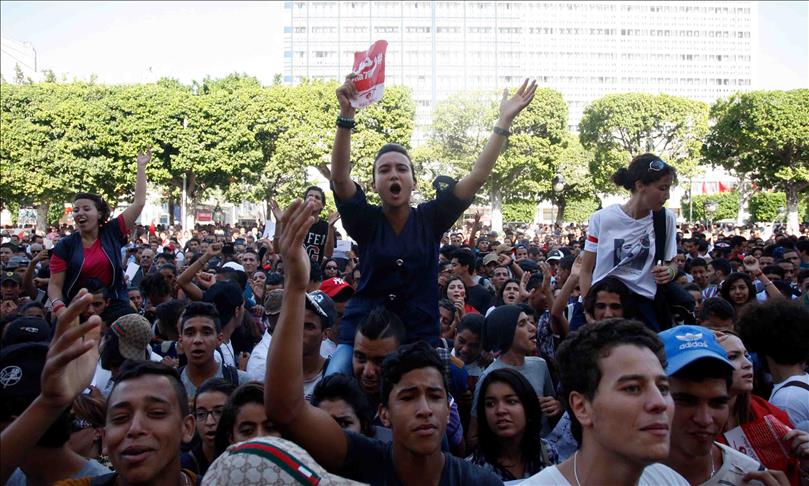
A strong showing by young people outside the courthouse, mobilized via Facebook, may have helped, along with the international media attention that had been notably absent under the old regime.
"There is no doubt that we should keep on the democratic path," insisted Mekki.
"No coup, no terrorism, no torture, no civil war."
By Eileen Byrne - Anadolu Agency
englishnews@aa.com.tr
news_share_descriptionsubscription_contact

contact_the_ombudsman
is_there_an_error_in_this_story