JAKARTA
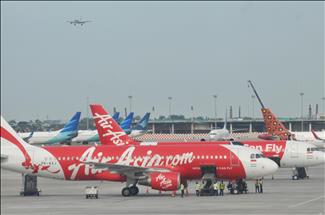
Search teams retrieved Tuesday the second black box of AirAsia flight QZ8501, leading to hopes that investigators will be able to ascertain what caused the plane to crash into the Java Sea with 162 people on board.
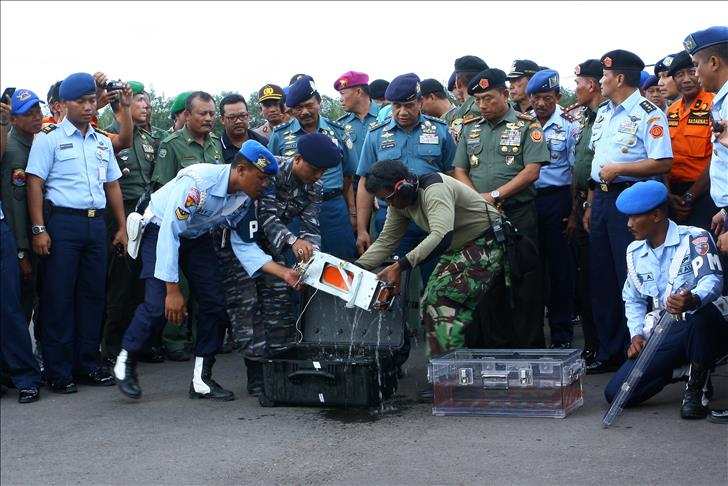
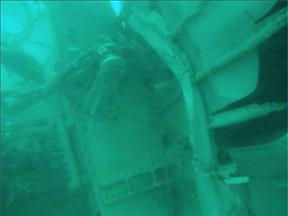
The cockpit voice recorder was found wedged under the plane’s wing Tuesday, 65 feet (20 meters) from where the flight data recorder was recovered the day before in Karimata Strait, between the islands of Sumatra and Borneo, according to Metro TV.
Tatang Kurniadi, head of the National Transportation Safety Committee, told a press conference on Indonesia’s Iskandar warship that navy divers had recovered the cockpit voice recorder from the sea.
Declining to provide details, he said, "[the recorder] was retrieved this morning. But, I as the Committee’s head who represents the country has to examine it. It can't be careless."
The Iskandar’s commander, Johnson Simatupang, said the recorder’s serial number would be checked on the Banda Aceh warship before it is transported to Pangkalan Bun, the nearest town to the crash site, and then Jakarta.
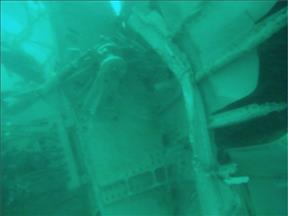
SB Supriyadi, the director of operations of Indonesia's National Search and Rescue, said large sections of the plane were discovered at a depth of around 100 feet.
Referring to the use of floatation bags over the weekend to lift the plane’s tail section from the seabed, he said, "We will lift the wing by using the same method of lifting bags we used in raising the plane's tail.”
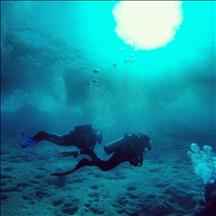
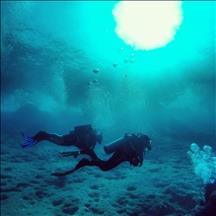
Supriyadi said search teams – including seven ships and 81 divers -- will focus on finding the fuselage Tuesday, and estimated that around half of the passengers and crew of Flight QZ8501 would be trapped there. To date, 48 bodies have been recovered.
"We estimate that 50 percent of the victims’ corpses remain in the main body. I’m concluding that based on the findings of the wreckage so far," Supriyadi told MetroTV.
Supriyadi added he has enlisted the help of fishermen to inform the agency about any findings of bodies or debris from the plane.
Meanwhile, the National Transportation Safety Committee said it would download data from the flight data recorder recovered Monday before converting it into graph form.
"We won’t be able to read the recorder today, we will only download [its data]," Mardjono Siswosuwarno, the Committee’s chief AirAsia investigator, told detikcom.
“Two weeks are needed to convert [the data] into graphs. And then it can be defined," he added.
While the flight data recorder records altitude, speed, air pressure, and weather conditions during a flight, the cockpit voice recorder records conversations between pilots, co-pilots, and flight attendants.
Investigators are hoping that both will reveal clues as to the final minutes of Flight QZ8501, which lost contact with air traffic control with 155 passengers and 7 crew on board during bad weather Dec. 28 while flying from the Indonesian city of Surabaya to Singapore.
Later on Tuesday, Sunu Widyatmoko -- CEO of AirAsia’s Indonesia subsidiary -- told parliament that the airline had committed an administrative error in relation to the licensing of the flight.
"There was negligence by the administration whereby we [AirAsia] did not convey the proposed slot changes to the Air Transport Directorate of the Ministry of Transport," he said, adding that the tragedy would motivate the company to correct its internal management.
He explained that the airline had only orally conveyed proposals to change its Surabaya-Singapore flights from Monday, Tuesday, Thursday and Saturday to Monday, Wednesday, Friday and Sunday.
Although it had not officially received permission for the change, AirAsia Indonesia decided to submit the new slots to the authority at Juanda International Airport in Surabaya, Indonesia’s second city, according to Widyatmoko.