By Ainur Rohmah
JAKARTA
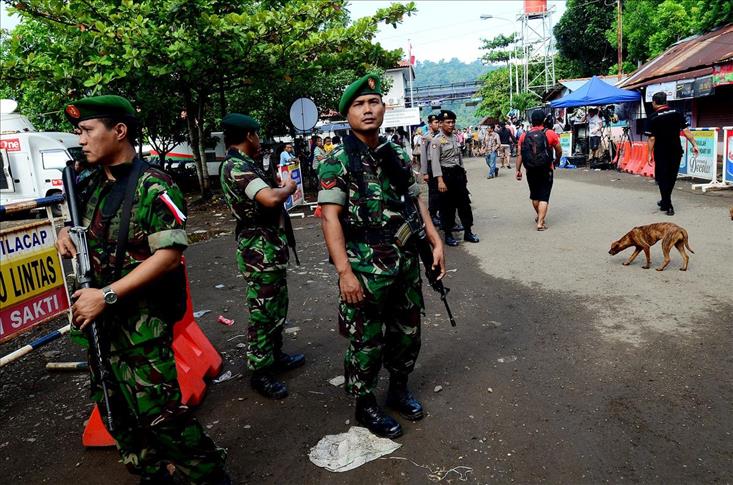
Indonesian police are urging residents of a district of central Sulawesi not to travel alone after an armed radical group led by the country's most-wanted man killed three people in a suspected revenge killing.
Speaking to reporters Thursday, Police Chief Gen. Badrodin Haiti said that the murders were being seen as retaliation for the shooting of a member of the East Indonesia Mujahideen.
The outlawed Indonesian group - led by Santoso (many Indonesians use just one name) - has been accused of killing several policemen and pledged allegiance to Daesh.
"From the results of our investigation, the murder was committed by Santoso's group," Haiti said at police headquarters in Jakarta.
He said that the group member had been killed during a gun battle after police received a tip-off that up to 40 Mujahideen fighters were in the mountainous Auma area, suspected to be a hideout.
Police also seized bombs, handguns, ammunition and an M-60 anti-tank gun that they later said was from the southern Philippines - a hotbed of rebel insurgency.
A police officer died during an attempt to evacuate the dead group member’s body.
"After the clash, they [the Mujahideen] threatened to come down from the mountain," Haiti said.
"Life for life, blood for blood,” he stated.
On Monday, the decapitated corpses of two cocoa farmers and another unidentified corpse were discovered in Parigi Moutong district, Central Sulawesi,
Benar News reported the wife of one of the men - who found his body - as saying that five men carrying backpacks, long guns and machetes had taken her and her husband to their cocoa plantation, and then told her to stay where she was as they disappeared with her husband.
Haiti said that the reprisal underlined the threat not just to security forces but also to "anyone who they [the Mujahideen] meet," and urged people to be careful and not to travel alone.
Security has been improved in the area, he added.
Santoso - also known as Abu Wardah - has been linked to a number of attacks on police, including the murder of at least six officers.
In January, the group killed three farmers, alleging they were police spies.
Police have blamed the failure of operations to apprehend the group and their leader on the tough mountain forest terrain in which they are based.
In July, an Indonesian court sentenced three Uighur Muslims to six years in prison after finding them guilty of conspiring to join the group.