KARACHI, Pakistan
Trucks laden with petrol and diesel smuggled from Iran into Pakistan have recently increasingly been involved in fatal accidents. One of the most shocking came at the end of March, when 45 people were burnt alive in a head-on collision, near Pakistan's commercial hub Karachi, between two passenger buses loaded with the smuggled oil.
Those two buses were not unusual, they were like two-thirds of buses that between Karachi and Baluchistan, a southwestern region which borders Iran, that have cans full of oil loaded onto their roofs and often stuffed under passenger seats.
"These vehicles are moving dynamites, which may explode any time," Rehmatullah Sanghur tells Anadolu Agency. He is from Baluchistan's coastal city Turbat but currently lives in Lyari town in Karachi. The shanty town straddles the edge of the Arabian Sea and is both the collection and distribution point for smuggled Iranian oil. Dozens of depots of varying sizes line the narrow streets of the Lyari, which has become a centre of the fight between two powerful rival gangs for control of the oil smuggling and drugs businesses.
Rehmatullah frequently travels between Karachi and Turbat to see his family and has kept a habit for seeking repentance for his "sins" before boarding a bus. "One does not have to be a genius to figure out the fate of passengers in case of an accident or some kind of fire in the bus," he says.
"These vehicles are moving dynamites, which may explode any time"
The route involves check posts run by coastguards, customs, maritime security and other security agencies, yet buses still manage to smuggle significant quantities of fuel to Karachi everyday.
"No one can stop them from carrying fuel because they fully take care of the security agencies' officials," claims Matiullah Baluch, whose cousin died in March's incident. "If security agencies want, at least the lives of those travelling in these passenger buses can be saved ... It does not require any rocket science."
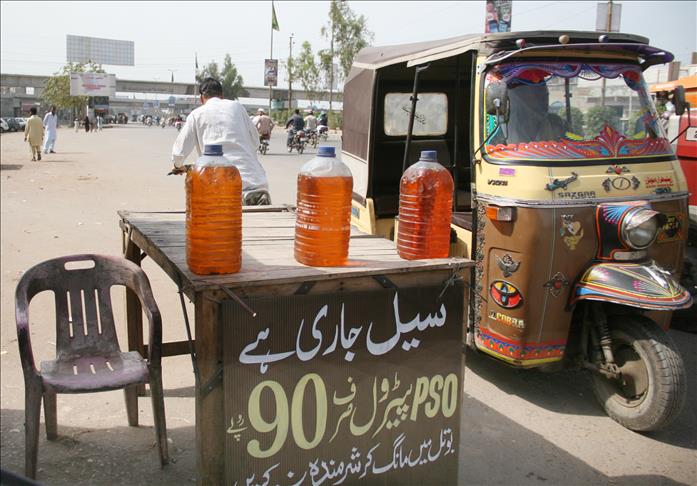
Sea vessels plying the Gulf of Oman unload the smuggled petrol on the Gawadar, Turbat and Jiwani coasts of Baluchistan, where it is then loaded onto pick-up trucks, or mules, and stocked in makeshift depots. The smuggled oil also comes through Pakistan and Iran's shared borders at Mand Balo and Taftan, sometimes to be taken to Afghanistan where selling smuggled oil has become a popular business. Much of the oil taken to Afghanistan comes from Baluchistan's capital Quetta, a city where oil is sold openly on the street; dumped in vast open drums and supplied to sellers in plastic cans or emptied soft drinks bottles.
“We mostly use modern ways of transport like buses, small tankers, and pick-up wagons to ship petrol and diesel to different parts of Pakistan and Afghanistan,” a smuggler using the name Faiz Baluch tells AA. “But in case of the mountaineer routes (mostly to southern Afghanistan), we use mules and donkeys for shipping oil consignments."
Routes along the country's 700 kilometer-long coastal belt are favored by smugglers says Faiz, who owns several depots in Karachi and Quetta. A smile spreads across his face when asked about the strict security presence along those very routes.
“You think we have been doing this business for decades at our own?” Faiz asks sarcastically. “We pay each and everyone’s share. That’s why this business has been continuing.”
– Parallel economy
Smuggled fuel from Iran has for the last two decades underpinned a parallel economy in Pakistan's Southern Sindh and Southwestern Baluchistan provinces, involving thousands of people and their families.
Guhram Baluch, a 15-year old boy from Lyari, runs a make-shift stall that sits on a street corner, adorned by a dozen old oil-filled Pepsi bottles. His clients are mainly motorcyclists who quickly empty the smuggled oil into their tanks and drive off.
“I earn an average profit of 300 (Pakistani) rupees ($3) by selling 15 to 20 bottles per day,” says Guhram.
For him the physical and legal hazards of the business are barely worth worrying over – he plans to expand his business. “Nothing will happen,” says Guhram. “People here are dying for nothing. I am at least trying to earn money for my family.”
Iranian petrol and diesel costs no more than 102 Pakistani rupees ($1) per liter, while the official rate for refined petrol is 112 Pakistani rupees per liter, 117 for diesel.
There are no specific figures for the quantity of smuggled petrol but the All Pakistan Petroleum Association (APPA) estimates the quantity to be between 500,000 and 600,000 liters per day and industry experts believe the national exchequer misses out on 18 billion Pakistani rupees ($180 million) in lost tax revenues.
“Iranian oil is not properly refined. The constant use of this oil reduces the life of vehicles by 50 per cent compared to the adequately refined normal fuel,” says APPA chairman Abdul Sami Khan.
Faiz Baluch, the smuggler, downplays Khan's contentions.
“We are not smuggling drugs or weapons. It’s just fuel. We can only be blamed for tax evasion, and nothing else,” he says. “But in return, we provide livelihood to thousands of families, which otherwise is the state’s duty.”
By Aamir Latif
englishnews@aa.com.tr
news_share_descriptionsubscription_contact

contact_the_ombudsman
is_there_an_error_in_this_story