Necva Tastan Sevinc
18 April 2026•Update: 18 April 2026
Here is a rundown of all the news you need to start your Saturday, including US President Donald Trump warning that a "new dawn" is coming to Cuba; Trump saying the US will get 'all' of Iran's nuclear dust “with lots of excavators”; and Iran announcing Strait of Hormuz is “completely open” for commercial shipping.
TOP STORIES
Trump vows 'new dawn for Cuba' coming after '70 years in waiting'
President Donald Trump said a "new dawn" is coming to Cuba, arguing that American "strength" would soon deliver change to the island nation after 70 years.
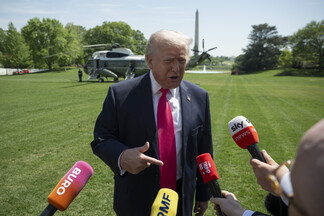
"And very soon, this great strength will also bring about a day, 70 years in waiting. It's called a new dawn for Cuba. We're going to help them out with Cuba," Trump told a crowd at an event in Phoenix, Arizona.
Pointing to Cuban American communities, he claimed they "were brutally treated, whose families were killed and brutalized."
"And now watch what happens," he added.
US to get 'all' of Iran's nuclear dust 'with lots of excavators': Trump
President Donald Trump said the US will retrieve Iran's nuclear dust using excavators in an operation with Tehran, as he declared the Strait of Hormuz effectively open.
"This will be a great and brilliant day for the world, because Iran has just announced that the Strait of Hormuz is fully open and ready for business and for passengers," Trump told a crowd at an event in Phoenix, Arizona.
On retrieving Iran's nuclear dust, he said, "The USA will get all nuclear dust."
While implying the risks, he said, "We're going to take it anyway, but taking it, taking it that way, is slightly more dangerous, but we're going to get it anyway."
"We're going to get it by going in with Iran, with lots of excavators," he added.
Iran announces Hormuz ‘completely open’ for commercial shipping after Israel-Lebanon ceasefire
Iranian Foreign Minister Abbas Araghchi declared the Strait of Hormuz “completely open” for all commercial vessels, linking it to a ceasefire in Lebanon.
The decision was made “in line with the ceasefire in Lebanon,” Araghchi wrote on US social media company X.
US President Donald Trump announced a 10-day ceasefire between Israel and Lebanon.
He said the passage will remain "open for the remaining period of ceasefire" on the "coordinated route" as already announced by the Iranian Ports and Maritime Organization.
NEWS IN BRIEF
- The US has imposed sanctions on five individuals and entities for their alleged links to the Sudanese civil war as the conflict enters its fourth year, the State Department said.
- Operatives of Nigeria’s civil defense agency dismantled an alleged “baby factory” in Lagos, rescuing dozens of victims and arresting two suspects, officials said.
- The UN Children's Fund (UNICEF) expressed outrage over the killing of two drivers contracted to deliver clean water to families in the Gaza Strip.
- The Palestinian Centre for Human Rights (PCHR) warned about an “unprecedented escalation” in alleged abuses against Palestinian detainees in Israeli prisons, citing widespread torture, enforced disappearances and arbitrary detention.
- Iran agreed to suspend its nuclear program indefinitely, and will not receive any of its funds frozen by the US, President Donald Trump said.
- France’s domestic intelligence agency, the DGSI, urged companies to exercise greater vigilance and to limit the use of foreign applications and software.
- The US sanctioned seven “Iran-aligned” Iraqi militia commanders for “planning, directing, and executing attacks against US personnel, facilities, and interests in Iraq.”
- Finland’s government has submitted a series of legislative proposals to parliament aimed at tightening immigration rules, including the introduction of a citizenship test expected to take effect in 2027.
- Spain’s National Court has begun reviewing a complaint against Israeli Prime Minister Benjamin Netanyahu and senior Israeli military leadership for the detention of a Spanish UN peacekeeper by Israeli forces in Lebanon, broadcaster RTVE reported.
- European Commissioner for Defense and Space Andrius Kubilius called for a new intergovernmental treaty to establish a "genuine European defense union," arguing that the EU’s legal framework is insufficient to meet evolving security challenges.
- Poland experienced a record number of cyberattacks in 2025, with incidents rising more than 140% year-on-year, its digital affairs minister said.
- Talks between Hamas and the United States held in Cairo ended “without tangible progress” on advancing the second phase of the Gaza ceasefire agreement, two Palestinian sources said.
BUSINESS & ECONOMY
Energy prices post huge weekly drops amid easing tensions in Middle East
As tensions in the Middle East region eased following the announcement that the Strait of Hormuz had been opened to commercial shipping, energy futures closed the week with strong weekly declines.
US President Donald Trump said the waterway is completely open and the US naval blockade against Iran in the strait would remain in effect until the agreement is 100% finalized.
Oil prices saw sharp declines with Brent futures dropping around 3.5% on weekly basis to $91.8 per barrel, and West Texas Intermediate (WTI) was down 11.4% to $85.5.
IEA chief says Mideast energy output may take 2 years to recover to 'pre-war levels'
International Energy Agency (IEA) Executive Director Fatih Birol said Middle East energy production may take around two years to return to pre-war levels, while signaling that further emergency stock releases remain under consideration.
The recovery would vary across countries, with Iraq likely taking longer than Saudi Arabia, although the region overall could return to pre-war output in about two years, Birol told Switzerland's German-language daily Neue Zurcher Zeitung.
He said production would improve significantly once the Strait of Hormuz reopens, but reaching full capacity would take time.