By Richard McColl
BOGOTA, Colombia
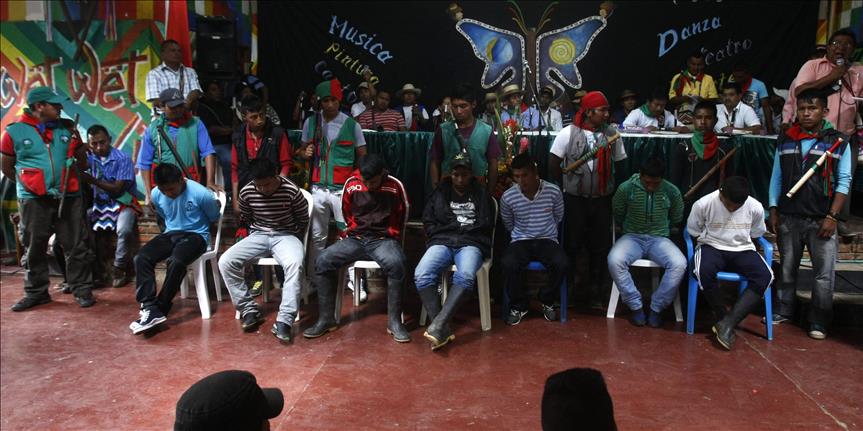
Seven FARC guerrillas who were found guilty of killing two members of the indigenous Nasa tribe were dealt lengthy prison sentences Sunday evening by an indigenous court.
Tribe members Manuel Tumiñá and Daniel Coicué from the Cauca region in southwestern Colombia , were killed Nov. 5 by members of the Sixth Front of the Revolutionary Armed Forces of Colombia (FARC rebels). The men tried to prevent the guerrillas from hanging posters and banners commemorating the third anniversary of the death of former FARC leader Alfonso Cano who was killed in a military attack Nov. 4, 2011.
The killings of Tumiñá and Coicué come at a delicate time as the ongoing peace dialogues between FARC and the Colombian government taking place in Havana are currently addressing the thorny issue of the victims of the conflict.
“While the diaogues continue in Havana, they are killing our leaders,” said Gabriel Pavi an indigenous spokesperson and regional community leader while speaking to Semana magazine of the guerrillas’ actions.
“We have hope for the peace dialogues in Havana. Our hope is that someday we will see peace in our territories because there has been none,” he said.
The ruling, which was delivered on Sunday before a crowd of an estimated 5,000 indigenous people who went to the town of Toribio near where the killings took place, was believed to be significant in that it would serve as an example to others due to its severity.
Carlos Iván Silva Yatacué, also known as “Fercho,” the principal orchestrator of the killings, was sentenced to 60 years in prison. Four other FARC members were each handed sentences of 40 years for their roles. Two minors, aged 14 and 17, were given 20 lashes and handed over to authorities.
“It’s hard to take knowing that those who committed these killings are our own brothers,” said Floresmiro Noscué, governor of the district of Tacueyó.
The FARC delegation in Havana released a statement on its website that lamented the deaths but failed to condemn the actions of some of their own. “The FARC-EP is inspired by a deep respect both for our native people and for the whole of our combatants, many of whom are also indigenous; circumstance that forces us to dedicate all our efforts to maintaining the best possible relationship of brotherhood and coexistence.”
The killings have been widely condemned in Colombia and have drawn some light on the precarious existence of Colombia’s indigenous peoples, in particular in the region of Cauca that has long been a strategic corridor for the transportation of illicit drugs from the interior of the country to the Pacific coast. The region’s geography is mountainous, with poor infrastructure and limited state presence.
Whether last week’s events place the peace dialogues under more pressure remains to be seen but at least one member of President Juan Manuel Santos’ Social Party of National Unity has let his feelings known.
“Not only are the deaths of these civilians lamentable but also the curt nature of the communiqué released by the guerrillas in this circumstance. The FARC do not understand that if it continues to attack the civilian population on a daily basis, it becomes more difficult for those of us defending the peace process to maintain public support for the process,” Sen. Roy Barreras told the El Tiempo newspaper on Monday.
Peace dialogues between the government and the FARC began in November 2012 with the aim of bringing to an end to 50 years of conflict that has caused the deaths of 220,000 people and displaced 5 million more, according to Human Rights Watch. The two sides have so far have reached agreements on the issues of agrarian reform, political participation and illicit drugs.
www.aa.com.tr/en