TRIPOLI
The Libyan military has called on a retired army commander to hand himself in to military-judiciary authorities after he sent shockwaves through the country by calling for the dissolution of parliament and the interim government.
Speaking at a Friday press conference in Tripoli, Army Chief-of-Staff Abdul-Salam al-Obaidi said an arrest warrant had been issued for Khalifa Haftar, a retired military commander who played a leading role in the 2011 uprising against Muammar Qaddafi, calling on the retired commander to hand himself in "without bloodshed."
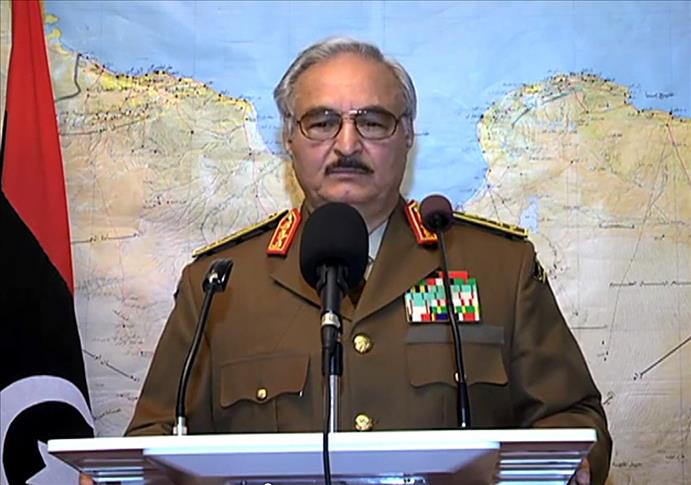
Earlier Friday, Haftar prompted fears of a military coup when he appeared on television in military uniform to call for the dissolution of Libya's parliament and interim government.
Haftar had also claimed that his forces had seized control of several of the country's military and strategic sites.
According to al-Obaidi, military regulations will be applied to anyone who "embroils themselves in political altercations."
The army, he added, was is in control of all military units and barracks across the country, while army forces had been kept in a state of high alert for the last two weeks in anticipation of "suspicious activity targeting the Libyan revolution."
He also asserted that the army would oppose any attempt to "highjack or undermine the revolution," reaffirming the army's support for the "legitimacy" represented by parliament and government.
Libya has remained in political crisis since the General National Congress – the country's interim parliament – voted to extend by one year both its mandate and that of the transitional period instated following the fall of Gaddafi in late 2011.
Under an initial transitional timetable, parliament should have elected a constituent assembly, drafted a constitution, and put the draft charter to a popular referendum before holding parliamentary polls sometime before February.
The new GNC-endorsed timetable, however, stipulates that a constituent assembly be elected by February and a new constitution drafted by July, to be put to a vote by August. Parliamentary elections should be held by December, according to the new timeline.
The twin term extensions have met with anger on the part of many Libyans, who have called for protests aimed at pressuring parliament to reverse the move.
By Mohamed al-Nagem
englishnews@aa.com.tr