YANGON, Myanmar
Sai Thae Htun’s humble rice shop in Yangon has been slathered from wall to wall with bright blue paint. He seems happy with the new makeover, which comes courtesy of global telecoms giant Telenor.
The company’s blue and white logo is plastered all over the little restaurant in Myanmar’s main city: on walls, on napkin holders - there is even a Telenor branded clock. And sitting at the back of the room in a Telenor-blue T-shirt is one of its representatives, a young woman who comes in every day to run a promotion inviting people to make their own ringtone.
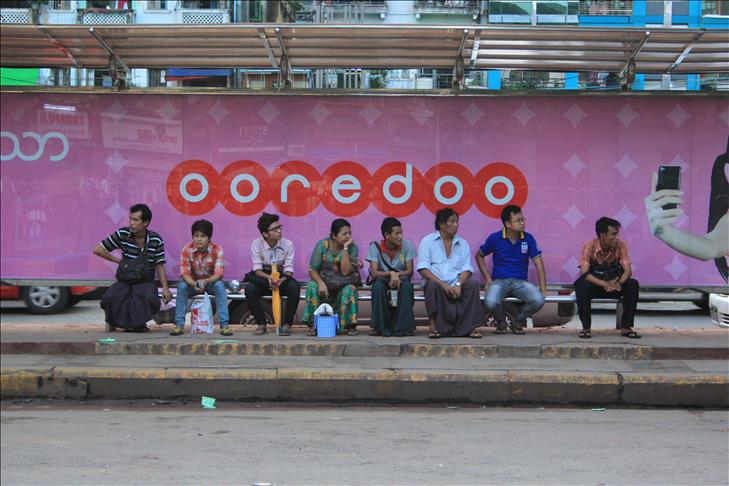
The Norwegian company, along with Qatari rival Ooredoo, is gearing up to launch its SIM cards in Myanmar within three months. Both will spend billions of dollars on transmission towers and other infrastructure in a bold act of frontier investing. The potential prize: profiting from one of the last untapped mobile telecoms markets in the world.
After five decades of isolation under military dictatorships, the vast majority of Myanmar’s roughly 60 million citizens still don’t have mobile phones. And most of the 10 percent that do only acquired theirs after a quasi-civilian government came to power in 2011, ushering in sweeping political and economic reforms.
“All of my friends are waiting for Telenor and Ooredoo,” La Byae, a 28-year-old kitchen worker from Yangon told the Anadolu Agency. He glances down at his touchscreen phone, which at the moment runs on a SIM from MPT, a state-owned company that is the source of much frustration for Myanmar’s Internet-hungry urbanites.
“The charges are really high and the Internet connection is really slow,” he explains.
Analysts predict that building a properly functioning telecoms network - almost from scratch - will lay the foundations for Myanmar to grow into a modern economy. Ulrich Zachau, the World Bank’s country director for Southeast Asia, said in February that telecoms reform is “an integral part of lifting millions of people out of poverty” in Myanmar.
Sachin Gupta, a Singapore-based telecoms analyst told AA, “Once you get the communication element sorted out, [it supports] other infrastructure elements.”
In short, having decent network coverage and reliable 3G will make it an awful lot easier to do business.
Telenor told AA in a statement that it expects its services to “spur innovation in other critical industries – such as education, healthcare and finance – and contribute to overall socioeconomic development.”
The former military dictatorship imposed ludicrous controls on SIM cards, pushing prices as high as US$4,500. But after President Thein Sein’s reformist government came to power, prices plummeted as officials made a limited number of cards available to the public.
Many sold their cards on for a big profit. Six months ago, a second-hand SIM could be bought for up to $130, but now the going rate is around $85.
When Ooredoo and Telenor are up and running, their cards will cost a small fraction of that - no more than the equivalent of about $1.50.
“Under the military government SIM cards were $4,500, now they will be 1,500 kyats!” marveled a Yangon taxi driver to AA, before mixing English with Myanmar to create the phrase “Crazybeh, naw?” - "It’s just crazy, isn’t it?"
The lurch into the 21st century is making itself felt elsewhere on the streets of Yangon. Myint Myint San owns and runs a street-side stall in the city where customers can make calls using one of two old-fashioned, landline telephones. Since SIM cards became more widely available, she has been struggling.
“Business is bad,” she told AA. “I used to bring in 150,000 kyats (about US$150) a month, now it’s half that.”
When Ooredoo and Telenor launch, it will likely spell the end for many of Yangon’s phone stalls. Telenor has already committed to charging less than 25 kyats per minute. Myint Myint San can’t compete; she charges 200 kyats per three minutes for a local call.
“Hopefully people will still come here when their phones have run out of credit,” she said.
Ooredoo and Telenor stand to make tremendous gains in Myanmar, but doing business in a politically volatile impoverished country with drastically poor infrastructure won’t be easy.
Ooredoo, which is majority-owned by the Qatari government, has already had a taste of the country’s fraught religious politics - Buddhist nationalists are calling for a boycott of its services because it comes from a Muslim country.
The same reform process that has opened Myanmar’s economy to companies like Ooredoo has also unleashed a wave of anti-Muslim hate speech, spearheaded by radical monks who insist Muslims are trying to take over the country.

Among the supporters of the Ooredoo boycott is Sai Thae Htun, who told AA he wasn't paid by Telenor to redecorate his rice shop or to station one of its employees there - he simply did it to illustrate his opposition to Ooredoo.
“If I use Ooredoo’s SIM cards, my money will go to Muslims,” he said. “They’ll use that money to try and convert people to Islam.”
Thiri Kyar Nyo, Ooredoo’s public relations manager in Myanmar, told the AA this week that opposition to the company will die down once its brand becomes more familiar and people see the “positive” changes the company makes.
The arrival of the two pioneering telecoms firms has not just been used to stir anti-Muslim sentiment; it has also flagged other deep-rooted problems in the long-isolated Southeast Asian country.
Both companies are busy building transmission towers, but even acquiring the land on which to build presents a headache. Myanmar’s military has been trampling over ownership rights and seizing people’s land for decades, meaning it is often difficult to establish whom plots belong to.
And another thing: only about a third of the country has access to electricity, which will make charging phones a challenge for many. Ooredoo’s Thiri Kyar Nyo was cryptic when asked about this problem, insisting the company would explain its plans to tackle it “closer to the launch.”
Despite the obstacles, Ooredoo and Telenor have ambitious goals. Thiri Kyar Nyo says Ooredoo is aiming to get coverage to 97 percent of the population within five years. Telenor is aiming for 90 percent.
Myanmar’s government originally said it wanted 80 percent of the population to have SIM cards by 2015, the year of a landmark general election. But it has since revised that target to 50 percent.
Telecoms analyst Gupta says the 80 percent target would have been “somewhat challenging”.
He added, “For that you need 80 percent of customers in the country to have a phone, which is not even really the case in India at this stage because they really don’t even have the networks throughout the country.”
Certain areas of Myanmar may be out of reach for some time, with some remote regions still suffering from sporadic fighting despite attempts by Thein Sein to secure a nationwide ceasefire deal with various ethnic rebel groups.
As part of its expansion into rural areas, where many have never even used the Internet, Telenor plans to open 200 community centers, which it says will “foster user adoption of mobile services and Internet... and improve digital literacy.”
Many will be eager to learn. Back in Yangon, 38-year-old Myat Htut’s desire to catch up with the rest of the world is obvious: “I want cheaper rates and faster internet, but if I can’t have both I’d rather have fast Internet,” he told AA.

contact_the_ombudsman
is_there_an_error_in_this_story