NEW DELHI
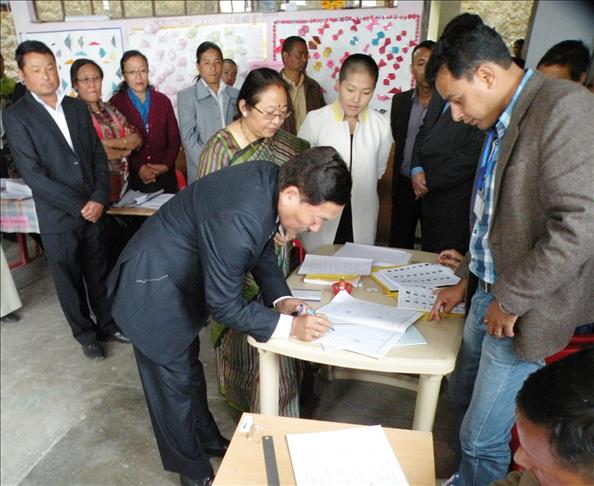
The fourth phase of the Indian national election witnessed an impressive voter turnout Saturday. In the three northeastern states of Assam, Tripura and Sikkim and the coastal western state of Goa the polls by mid-afternoon were registering turnouts of above 50 percent.
Many voters were wearing colorful traditional dress as they waited in long queues outside hundreds of polling booths.
“People in the northeast are more conscious of their democratic right to voting,” Amit Patro, proprietor and editor of English daily newspaper, Sikkim Express, told Anadolu Agency, adding “the statistics will reflect the enthusiasm of northeasterners.”
Sikkim simultaneously voted for the state assembly election for the 32-member house.
Heavy security arrangements were in place as India’s northeast is home to a number of separatists groups who in the recent past have boycotted polls.
Special security arrangements were also in place in one Assam district as the separatist group, Karbi Peoples’ Liberation Tigers had observed a shutdown till Friday demanding the creation of an autonomous tribal state.
India’s Border Security Force additionally deployed more forces along the "sensitive" 856km long Indo-Bangla border.
The coastal state of Goa, considered a stronghold of the country's Bharatiya Janata Party was also contested by the Congress Party and the popular anti-corruption party, Aam Aadmi Party.
After casting his vote in Panaji, Goa's state capital, Goa's Chief Minister and Bharatiya Janata Party leader Manohar Parrikar said he was confident of his party’s victory. “I feel there is the pro-incumbency factor in Goa as people have seen the functioning of the state government for the last two years.”
With Saturday’s voting, 111 seats out of total 543 seats for the lower house of Parliament have gone to polls.
Meanwhile, Congress party Vice-President Rahul Gandhi filed Saturday his nomination papers for the northern state of Uttar Pradesh’s Amethi constituency, considered a stronghold of India’s Gandhi family.
Narendra Modi, Bharatiya Janata Party’s prime ministerial candidate, bitterly attacked the ruling Congress party for its “vote-bank” politics saying it had divided the country at a rally in Barmer, the western desert state of Rajasthan.
“When a Bangladeshi enters this country he is welcomed. But why are the Pakistani refugees not getting their rights,” Modi, the frontrunner to be the next prime minister said adding that he will address the problem of Pakistani refugees living in India.
The Bharatiya Janata Party, riding on the “popularity wave” of its mascot Narendra Modi, is trying to wrest control of the federal government from the Congress party-led coalition, the United Progressive Alliance. The coalition has ruled India since 2004, but has recently come in for sharp criticism and public scrutiny over a series of corruption scandals, policy paralysis and the dwindling economy.
The hotly contested election is being fought in nine phases from April 7 to May 12 around the key issues of corruption, inflation, unemployment, anti-incumbency and secularism with the election results expected to be announced May 16.
It is the first national election in which India’s voters have the right to reject candidates by pressing a NOTA (None of the Above) button, after a Supreme Court ruling last year.
Around 815 million registered voters are expected to cast their ballots, an increase of 100 million new voters on the 2009 election.
By Mubasshir Mushtaq
englishnews@aa.com.tr