Filipino governor urges all-out war against Abu Sayyaf
Demand comes after Abu Sayyaf militants killed six soldiers Sunday in Philippines’ autonomous Muslim region.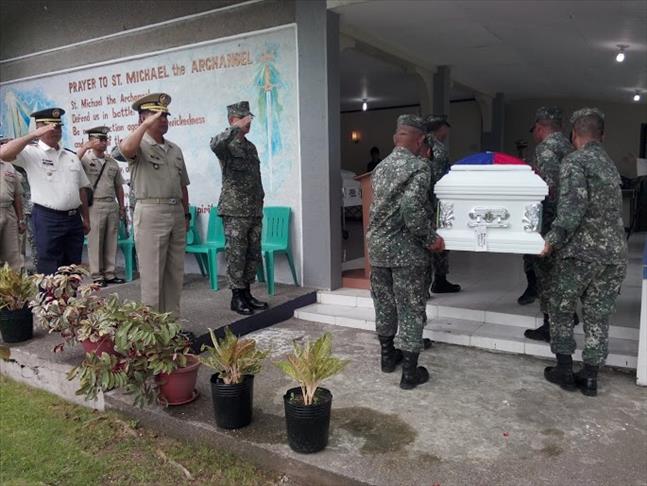
By Hader Glang
ZAMBOANGA CITY, Philippines
The governor of the Philippines’ autonomous Muslim region has called for an "all-out" war against al-Qaeda-linked militants after a weekend clash left six government troops dead.
Autonomous Region in Muslim Mindanao' Governor Mujiv Hataman told reporters Monday that he was "recommending an all-out offensive against these terrorist groups."
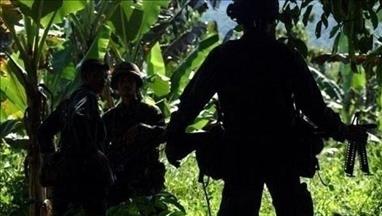
Hataman spoke as the soldiers were being buried Monday. The men -- including a junior army officer -- were ambushed by the Abu Sayyaf on Sunday in Sumisip town in Sulu's southern Basilan province -- a known stronghold of the group.
The troops had been assigned to guard a Saudi-assisted road project, and were not involved in operations to combat the Abu Sayyaf, according to an army chief-of-staff.
Condemning the attack as a "cowardly act that had left the soldiers without anywhere to run," Hataman added that "the Abu Sayyaf may have found a pattern in the soldiers' patrol route."
Army chief-of-staff Gen. Gregorio Pio Catapang, declined to comment Monday on Hataman’s suggestions of the mass offensive.
"We cannot just say out rightly there is a need,” he said in a statement, expressing his wishes to speak with people and groups in Basilan to see "how we can turn around the situation from an area that is difficult, into a Moro area that is peaceful and productive."
The Moro -- the abbreviated form of Bangsomoro -- are the country’s ethnically indigenous Muslim population.
On being questioned if the Abu Sayyaf had attacked the soldiers as a diversionary tactic to free pressure on comrades under siege from government troops elsewhere in the province, Catapang sought to clarify that the men were not conducting any offensive operations.
"I want to correct the impression that we are on an all-out offensive [in Sulu]," he said.
"What we are doing now is an all out law enforcement operation and then next week I think we already had a clearance to conduct the peace and economic and development summit."
Hataman had earlier expressed confidence that the multi-million-peso (dollar) Saudi-assisted project, which runs around 80 kilometers (nearly 50 miles) and is designed to improve the livelihood of the local Muslim population by linking nearly half of Basilan’s main highways, would be completed soon.
"This road project is meant to address hardships of the people here who feel they are neglected," he said.
Sunday’s attack came the day after the army had launched morning air strikes against the group in the nearby island of Sulu, which triggered intense clashes that continued throughout the afternoon and left an undetermined number of casualties.
Catapang said he had ordered an investigation into the ambush, but did not proportion blame for the encounter, or highlight tactical lapses.
He underlined that the army had sufficient forces in Basilan, but a more "honest-to-goodness assessment" was required as the incidents were starting to appear "like a Harry Potter movie which has a never ending story that every now and then the soldiers are ambushed so they lose the upper hand."
"I want an honest-to-goodness assessment so that history will not keep repeating itself," he stated.
Sulu occupies the middle group of islands in the Sulu Archipelago of the Autonomous Region in Muslim Mindanao in the Philippines deep south, between Basilan -- the Abu Sayyaf's island stronghold -- and Tawi-Tawi.
Since 1991, the Abu Sayyaf -- armed with mostly improvised explosive devices, mortars and automatic rifles -- has carried out bombings, kidnappings, assassinations and extortions in a self-determined fight for an independent Islamic province in the Philippines.
It is notorious for beheading victims after ransoms have failed to be paid for their release.