CAIRO
On Monday and Tuesday, millions of Egyptians will head to the ballot boxes for the second presidential elections since the 2011 uprising that led to the ouster of autocrat Hosni Mubarak.
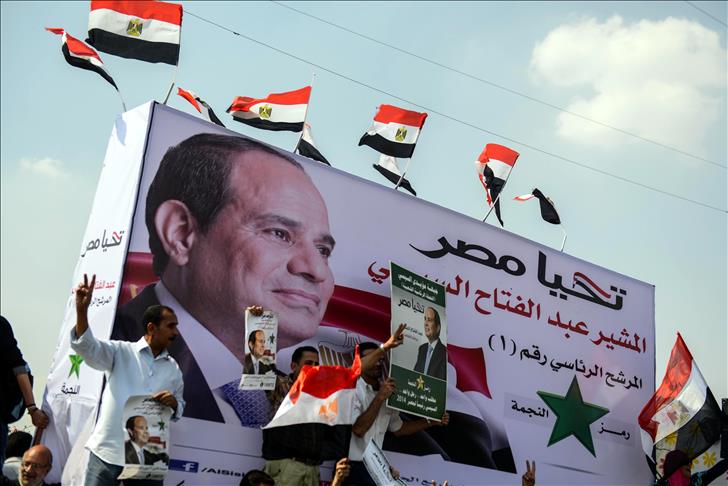
Some 54 million Egyptians are eligible to vote in the two-horse race between former army chief Abdel-Fatah al-Sisi - who led the army last July to remove elected Mohamed Morsi following protests - and leftist Hamdeen Sabahi who came third in the 2012 elections which brought Morsi to power.
The looming elections will mark the second milestone – after a constitution referendum in January – in a roadmap announced by al-Sisi upon Morsi's ouster, where parliamentary elections are also expected sometime this year.
The country's electoral commission has scheduled the voting procedures at 9am-9pm on Monday and Tuesday in 13,900 polling stations across the country's 27 provinces, including 325 general stations to which vote-counting results will be submitted.
The commission has the discretion to extend voting hours depending on voters' show-up rate.
The electoral commission will then receive the tallied results from the general stations, where the official results have been scheduled for a June 5 announcement.
The electoral commission has declared that 53,909,306 out of roughly 86 million Egyptians are eligible to vote in the expected polls.
Voters aged 18-40 are estimated at 58.9 percent of the total electorate, whereas those above 40 make up the remaining 41.1 percent, according to the commission's statistics.
Male voters make up 51.5 percent of the electorate, while women make up the remaining 48.5 percent.
Five international organizations and 79 local ones have been authorized by the electoral commission to observe the polling process.
In addition to nongovernmental monitors, envoys from the Arab League; the European Union; the African Union; the Common Market for East and South Africa will also take part in following up the vote.
International NGOs which have been approved by the commission include the International Network for Rights and Development; the International Institute for Justice and Human Rights; Democracy International; Ma'ona Association for Human Rights and Immigration and Electoral Institute for Sustainable Democracy in Africa.
Local groups which have been approved by the commission include the Egyptian Organization for Human Rights; the Ibn Khaldoun Center for Development Studies and the state-run National Council for Human Rights.
Around 432,000 police and army personnel will be deployed to secure the process nationwide, according to earlier announcements by the Egyptian military and Interior Ministry.
Military planes will also be deployed for surveillance and aerial footage-shooting of events on the ground.
The security plan includes the deployment of an eight-member police combat team and a riot police unit per five polling stations - to be equipped with live ammunition, birdshot and teargas.
The Health Ministry also announced it will deploy 25,000 ambulance vehicles around polling stations nationwide.
A group of political forces decided to boycott the polls, mainly out of disapproval of al-Sisi's candidacy as he is believed by opponents – especially the embattled Islamist camp - to be responsible for a deadly crackdown on dissent launched in the wake of Morsi's ouster which left hundreds killed and thousands detained.
The largely Islamist National Alliance for the Defense of Legitimacy, Morsi's main support bloc, has announced it will boycott the poll in continuation of its refusal to recognize the military-backed roadmap.
The centrist Strong Egypt and the Egyptian Current parties, along with the Revolutionary Path Front which opposes Islamist as well as military rule, have also distanced themselves from the polls.
Moreover, the April 6 protest movement– which played a key role in the January 25 uprising as well as last June's protests against Morsi – is also boycotting the vote, along with the Revolutionary Socialists movement.
www.aa.com.tr/en