BANGKOK
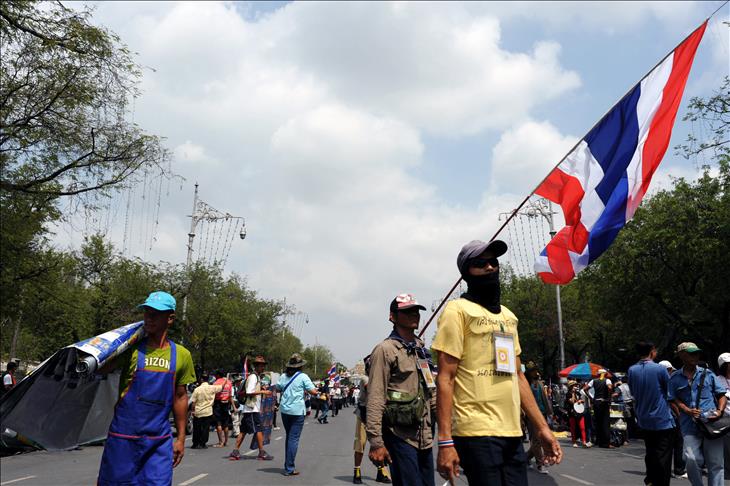
A deadly attack on an anti-government rally in eastern Thailand has raised fears about increasing violence as efforts to bring down Prime Minister Yingluck Shinawatra's administration continue.
A 5-year-old girl, hit in the head by a fragment from a grenade, died after men in two pickup trucks attacked a People's Democratic Reform Committee (PDRC) rally in Trat late on Saturday night, reported Thai media.
Trat is about 300km east of Bangkok near the Thai-Cambodian border. Anti-government movement the PDRC want an unelected "people’s council" to run Thailand until the political system is reformed.
Witnesses said men in the first pickup threw grenades at PDRC guards sitting near a noodle shop, while men in the second vehicle sprayed bullets at the shop before turning their guns at the stage, according to the Bangkok Post newspaper on Sunday.
About 2,000 people were listening to a speech by Pong Sarakham, a PDRC leader, when the drama occurred.
More than 30 people were injured, five of them seriously, including a seven-year-old girl.
Trat PDRC spokesman Suwicharn Suwannakha said they had expected no problems because local people "knew and loved each other" and he did not believe they opposed the rally.
“It was chaotic. I saw two pick-up trucks speed away. I believe they were attackers,” Suwicharn told The Nation newspaper Sunday.
The attack sparked further newspaper debate about parents taking children to rallies, although previous incidents of violence have been largely confined to the Thai capital Bangkok and Chiang Mai, the main city in the north.
There have been numerous grenade attacks on rally sites in Bangkok over the past three months, including two on anti-government marches in broad daylight in January.
Last night's attack was the first in a smaller provincial town. It came amid security warnings that red-shirt guards and other government supporters were getting increasingly restless by the long-running protest to bring down the Shinawatra government.
A mass meeting of several thousand red-shirt leaders and organisers is being held on Sunday in Nakhon Ratchasima, the country's third biggest city, several hours northeast of Bangkok.
Outspoken red-shirt leaders have dubbed the meeting a "war drum" gathering, and claimed on Saturday that they will descend on Bangkok with a million supporters.
The red shirt (pro-government) movement is mostly from Thailand's poorer north and north-east and is determined to maintain an administration which has delivered them clear material benefits.
There is considerable scepticism among analysts and the media in Bangkok, however, about the strength of support for Yingluck's government following its controversial push for a blanket amnesty for political offences. The move was seen to mainly benefit Yingluck's brother Thaksin, a former PM and deeply divisive figure whose Thai Rak Thai (Thais love Thais) party led the country from 2001 to 2008 when he was convicted of corruption. Thaksin fled before the judgment and now lives in exile, mostly in Dubai.
The collapse of a key policy of the Yingluck government - a scheme to purchase rice at a rate about 50 percent above the market price – has also left more than a million farmers unpaid for crops submitted to government stockpiles several months ago.
These two grave failings are believed to have greatly eroded support for the government, although Yingluck and her brother have been most popular among rural citizens - for policies that have helped people in the provinces dating back to the era when Thaksin was premier (2001-2006).
Many residents in Bangkok, meanwhile, have made it clear they have had enough of the Shinawatra governments, and policies such as the rice scheme, which have damaged the country’s financial position.
More than a million people were estimated to have massed in rallies late last year and in mid-January in support of the PDRC and their bid to oust the government.
However, increasing attacks by pro-government radicals, and efforts by the PDRC to block voting in the election on February 2, appear to have also cut support for the protesters.
PDRC spokesman Akanat Promphan on Sunday called on the government to take responsibility for the latest attack, saying it was a well-organised strike by gunmen armed with M16s and grenades.
“The reason for the continued attacks on our rally sites is because the government is doing nothing to prevent them and has failed to find anyone culpable for past incidents of violence,” he said in a statement.
Thailand is deeply divided between an urban middle class which despises Yingluck's populist government and provincials in the poorer north and north-east, determined to maintain the administration.
The conflict also puts two rival factions of the elite at opposition - the traditional establishment focused on the monarchy, comprised of old Sino-Thai business families, and a class of "new rich" Thais, who have made a fortune since the beginning of the 1980s.
The new wealth is epitomized by former prime minister Thaksin, a telecom magnate and billionaire, who is accused of massive corruption by the anti-government demonstrators, but adored by the provincials for his social policies.
According to renowned Thai political scientist Thitinan Pongsudhirak, a lynchpin of the crisis has been the will of the old elite to push away Thaksin through short-cuts - military coups or judicial coups, as in 2007 and 2008 when two pro-Thaksin political parties were dissolved by the Constitutional Court.
englishnews@aa.com.tr